



The death count in Indore's Bhagirathpura water contamination outbreak has risen to 17, intensifying fears that the crisis in India's so-called "cleanest city" is far from over and may be more dangerous than initially believed.
The latest victim, Omprakash Sharma (69), a retired police officer from Shiv Vihar Colony in Madhya Pradesh's Dhar, had come to Indore to visit his son. He was admitted to a private hospital on January 1 after complaining of severe vomiting and diarrhea. Medical tests revealed kidney failure, and his condition deteriorated rapidly. He was shifted to the ICU on January 2, placed on a ventilator two days later, and died on Sunday at around 1 pm.
Authorities have officially declared the situation a "local epidemic." AIIMS Bhopal and Indian Council Of Medical Research (ICMR) teams are now investigating how contaminated drinking water led to such a fast and widespread outbreak in one locality.
On January 4, the health department surveyed 2,354 households in Bhagirathpura, examined 9,416 people, identified 20 new cases, and followed up with 429 patients already under treatment.
According to the survey, more than 1,400 residents have fallen ill so far, and several remain hospitalised in serious condition.
But even as the immediate crisis continues, doctors are now flagging a new and deeply worrying dimension: the possibility that the contamination is causing not just stomach infections but also damage to the nervous system and other organs.
One such case is that of Parvati Bai Kondla (67), a long-time resident of Bhagirathpura, who is now fighting Guillain-Barre Syndrome (GBS), a rare, potentially fatal neurological disorder.
Parvati fell ill on December 27 with vomiting and diarrhea and was admitted the next day to a small private hospital. Within two days, she lost consciousness. Her reflexes disappeared, her limbs weakened, and she could no longer breathe on her own.
On January 2, Parvati was shifted to Bombay Hospital, Indore, where she is currently on a ventilator and undergoing advanced treatment.
Parvati's son, Pradeep Kondla, said the family was stunned by how fast her condition collapsed.
"On the evening of the 27th, she started vomiting and having loose motions. She became unconscious the next day, so we admitted her to a hospital. On January 1, we were told it was GBS. The MRI showed clots in the brain, so we had to come to a higher centre. We have been drinking the same water for 35 years. The infection spread suddenly at night while she was sleeping. She has not regained consciousness since," said Pradeep.
Dr Rajesh Bharani, a nephrologist at the Bombay Hospital, described her condition as extremely serious. "There are two major problems, kidney failure and neurological damage. There are multiple clots in the brain, which is why she is unconscious. The nerves are not functioning properly; this is polyneuropathy, scientifically GBS. We have started plasmapheresis treatment. Whether recovery will happen depends on how she responds."
GBS is an autoimmune condition often triggered after infections, in which the immune system attacks the body's own nerves. It can lead to paralysis, respiratory failure, and death. Treatment is expensive and prolonged, often costing families Rs 10-15 lakh.
The district administration has not officially linked Parvati's condition to the water contamination. Chief Medical & Health Officer Dr Madhav Hasnani said, "GBS is a neurological disease that can be caused by many factors, including viruses. It is a clinical diagnosis. We have not received any official report of this case."
Fear has now gripped Bhagirathpura after water from borewells, often considered a safer fallback, has also been found to be contaminated. Of the samples tested, 35 failed quality checks, leading to a ban on water use from 516 borewells, including 400 private and 116 government ones.
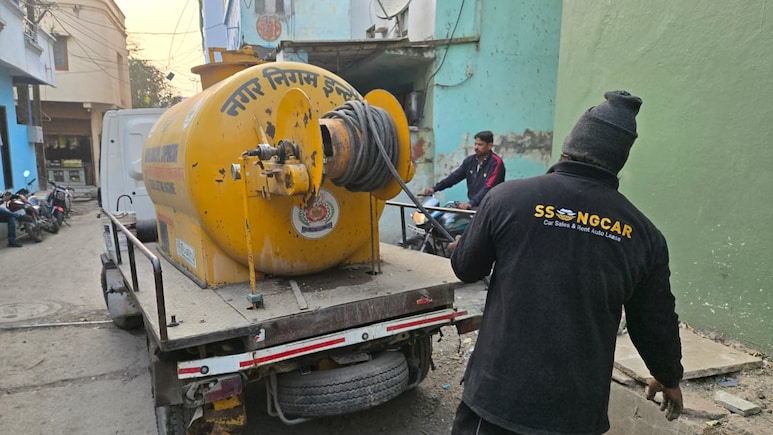
Demand for RO purifiers has surged. Tanker water is being viewed with suspicion. Residents say their trust in all water sources has collapsed.
A community health expert said, "This is no longer just a diarrheal outbreak. We are seeing physical, neurological, and psychological effects. People are anxious, traumatised, and unsure what is safe anymore."
Track Latest News Live on NDTV.com and get news updates from India and around the world

