





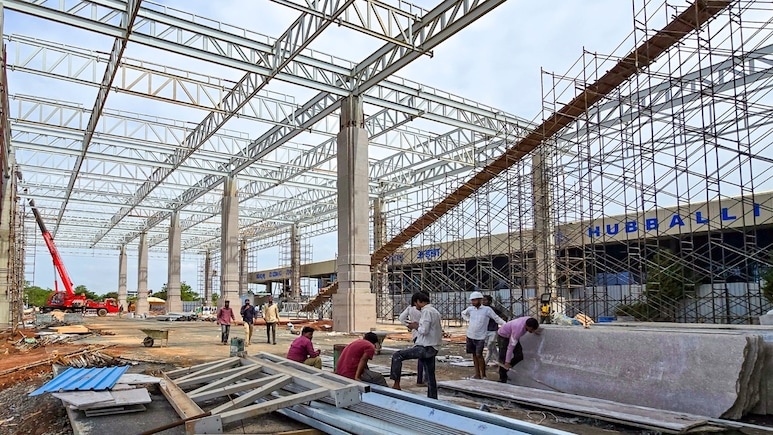
- India's growth is projected at 6.4% in 2026, driven by private consumption and services
- Global growth is forecast to slow to 3.0% in 2026, then rebound to 3.4% in 2027
- China's growth is set to slow to 4.6% due to higher oil prices and structural issues
India remains among the fastest-growing major economies, with growth projected at 6.4 per cent, supported by strong momentum in private consumption and services activity.
The International Monetary Fund (IMF) said in its July 2026 World Economic Outlook (WEO) Update report that India maintains this leading position even as global growth faces a slowdown.
The report showed that global growth is projected to slow to 3.0 per cent in 2026 before recovering to 3.4 per cent in 2027. World trade volume growth is also expected to decelerate sharply from 5.0 per cent in 2025 to 3.5 per cent in 2026 before recovering to 4.3 per cent in 2027.
According to the IMF, these dynamics reflect earlier front-loading and the drag from tariffs as well as the gradual adjustment of trade linkages and production chains through trade diversion and rerouting.
In emerging markets and developing economies, growth is projected to slow to 3.8 per cent in 2026 before recovering to 4.5 per cent in 2027.
China's 2026 growth is projected to slow to 4.6 per cent due to higher oil prices and structural headwinds. Conversely, Vietnam's growth projection is revised upward to 7.5 per cent, and Malaysia is projected to grow at 4.7 per cent, benefiting from the global technology cycle.
"In the United States, growth is projected at 2.3 per cent in 2026 and 2.2 per cent in 2027, virtually unchanged from April," the IMF report stated.
"Activity is supported by fiscal policy, accommodative financial conditions, and continued technology-related business investment and productivity strength, with only limited impact from the war given the country's net energy exporter status," the report added.
Meanwhile, growth in the euro area is projected at 0.9 per cent in 2026, which is 0.2 percentage point lower than the April forecast. The IMF attributed this to a negative carryover from the first quarter, higher energy prices, and weak consumer confidence.
In the United Kingdom, growth is projected to fall to 1.0 per cent in 2026, while Japan is expected to slow to 0.6 per cent. Korea's growth is expected to rise to 2.6 per cent, buoyed by semiconductor demand.
In the Middle East and Central Asia, growth is projected to drop sharply to 0.7 per cent in 2026 before rebounding to 6.5 per cent in 2027. This follows a longer closure of the Strait of Hormuz.
Commodity producers like Iraq, Kuwait, and Qatar face sharp contractions in 2026, while Saudi Arabia is projected to grow at 1.7 per cent. Iran's growth is revised upward to -5.4 per cent.
"Global inflation is expected to pause its steady decline," the IMF stated in the report.
"Headline inflation is projected to rise from 4.1 per cent in 2025 to 4.7 per cent in 2026 before easing to 3.9 per cent in 2027, with the increase for 2026 driven mainly by higher energy and food prices," the report noted.
Core inflation is expected to return to targets only gradually. The IMF estimated that inflation targets will be met by mid-2027 in the United Kingdom, by the end of 2027 in Japan and the United States, and only in 2028 in the euro area. Inflation in China is expected to rise from low levels.
(Except for the headline, this story has not been edited by NDTV staff and is published from a syndicated feed.)
Track Latest News Live on NDTV.com and get news updates from India and around the world

