





A structural imbalance in India's cooking-fuel economy, one that has been widening for two decades, has now collided with a geopolitical shock in one of the world's most volatile energy corridors.
A Two-Decade Gap: Consumption Surges, Production Stagnates
Official data from the Petroleum Planning and Analysis Cell (PPAC) shows a widening gap between what India consumes and what it produces domestically. India's LPG demand has risen rapidly as household access expanded nationwide, while domestic production has moved only marginally.
In FY2000, India consumed 6.4 million tonnes of LPG and produced about 4.5 million tonnes domestically. By FY2025, consumption had risen nearly five-fold to 31.3 million tonnes, while production stagnated at around 12.8 million tonnes. Imports have filled this gap, jumping from 1.6 million tonnes in FY2000 to over 20.6 million tonnes in FY2025, making imports the backbone of India's LPG supply.
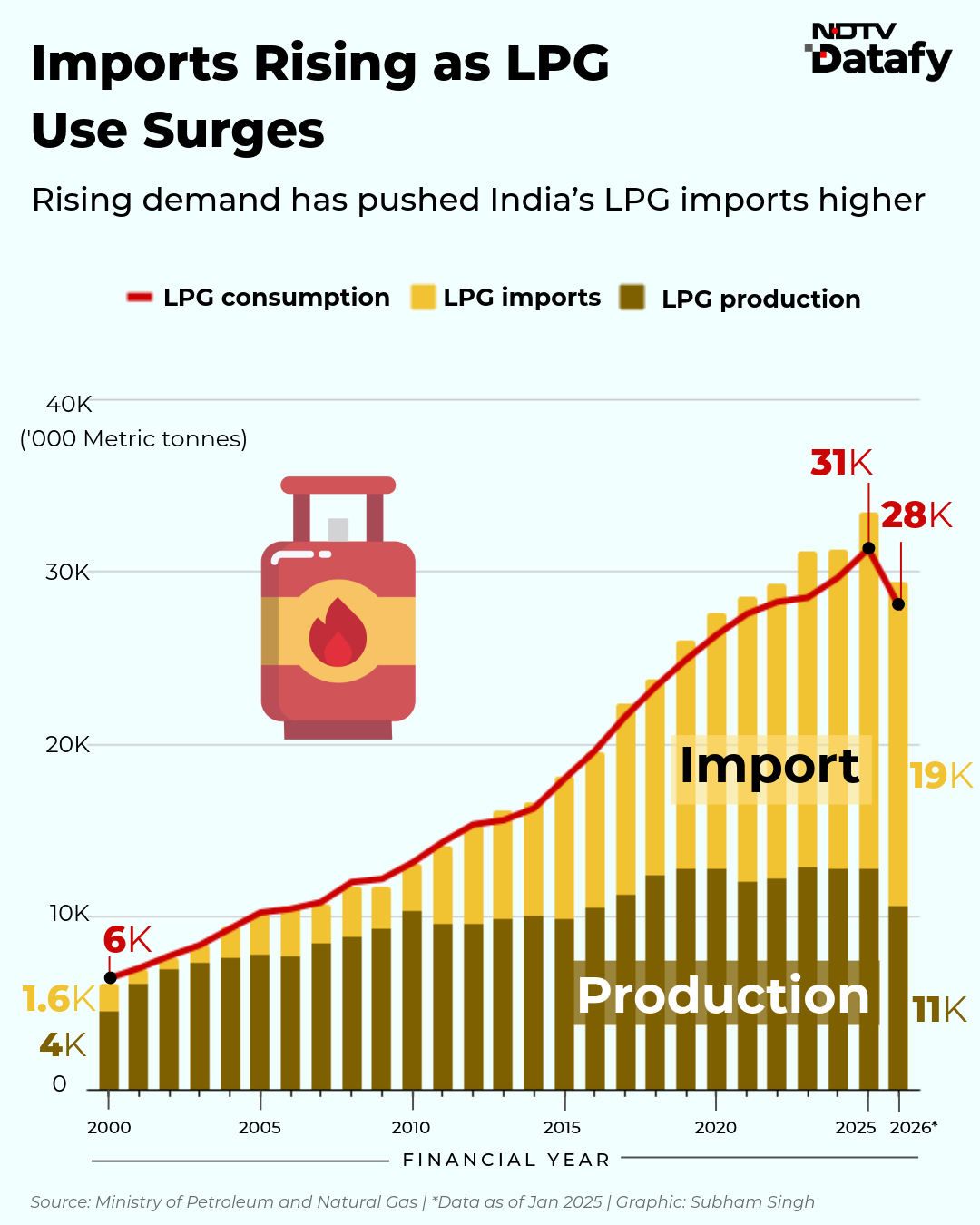
This dependence is not new, but it has made India acutely vulnerable to any disruption in West Asia, its primary sourcing region.
Hormuz: The Jugular Vein Under Fire
More than 90% of India's LPG imports from West Asia pass through the Strait of Hormuz, the narrow Gulf waterway through which about a fifth of the world's oil supply normally flows.
Iranian officials have vowed to keep the pressure on shipping through the strategic choke point, warning that the conflict could escalate if attacks on the country continue.
Even without a full blockade, the combination of war-risk premiums, insurance withdrawals, and shipping delays is enough to shake India's domestic supply chain, which is reflecting in agency-level shortages and marketplace anxiety.
A Nation Built on Cylinders
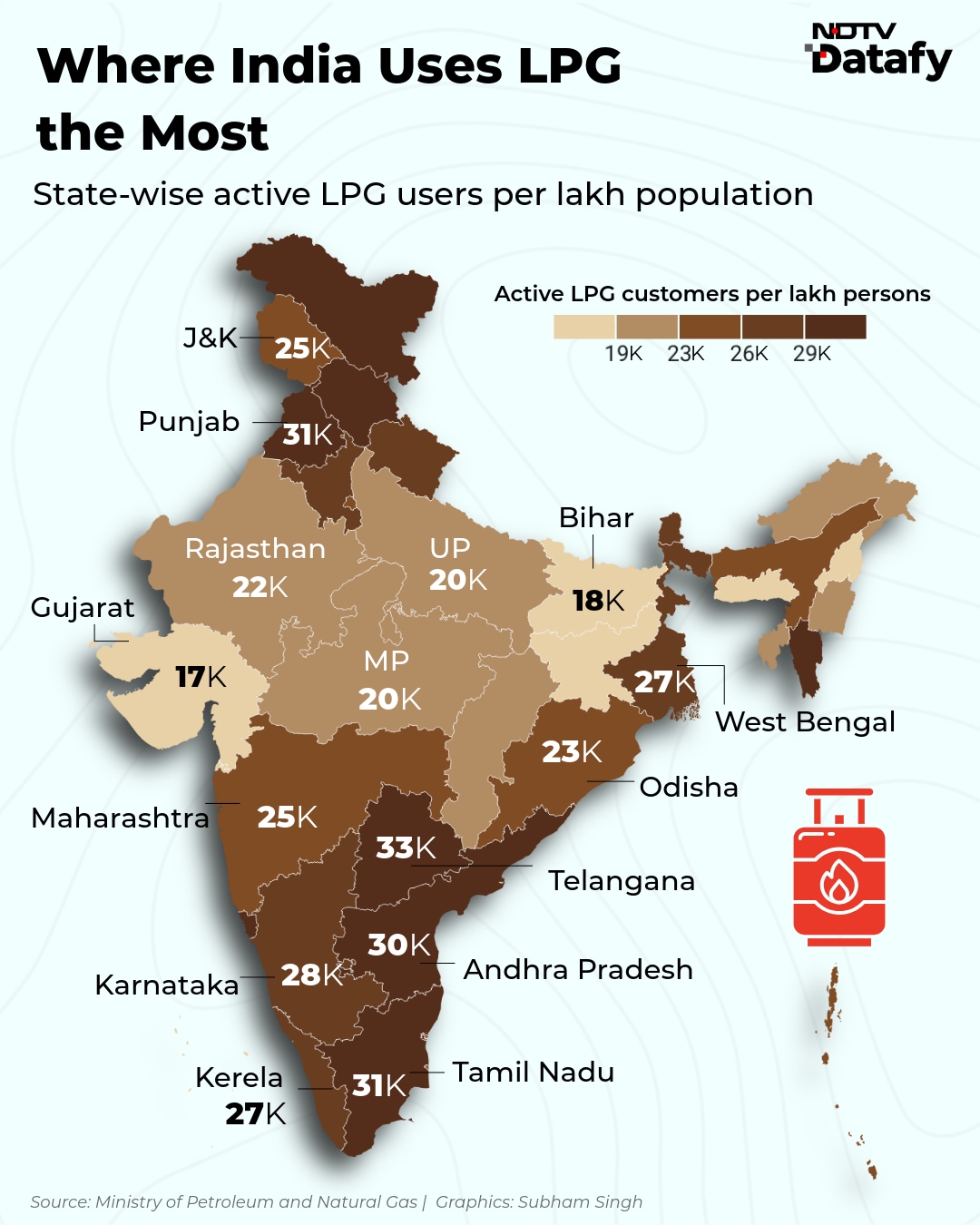
The pressure is magnified by how deeply LPG has penetrated Indian homes. Roughly 87% of India's total LPG consumption now comes from households, making cylinders the dominant cooking-fuel source nationwide.
State-wise data shows particularly high LPG dependency in Goa, Telangana, Tamil Nadu, Punjab, Kerala, and Delhi where there are more than 25,000 active LPG users per lakh population.
Populous states like Uttar Pradesh (20,085), Bihar (17,775) and Madhya Pradesh (19,742) have also crossed thresholds where even small supply disruptions affect millions simultaneously. This explains why visuals of long queues are emerging across both metropolitan and semi-urban India.
PNG Helps, But Only for a Few
LPG vulnerability is not uniform across states. Piped natural gas (PNG) provides a partial buffer in some regions. Delhi, with over 8,300 PNG connections per lakh persons, and Gujarat, with more than 5,100 per lakh, are far less dependent on cylinders for daily cooking.
Maharashtra and Haryana also show relatively high PNG penetration, especially in urban clusters. In these regions, households connected to city gas networks are largely insulated from cylinder shortages.
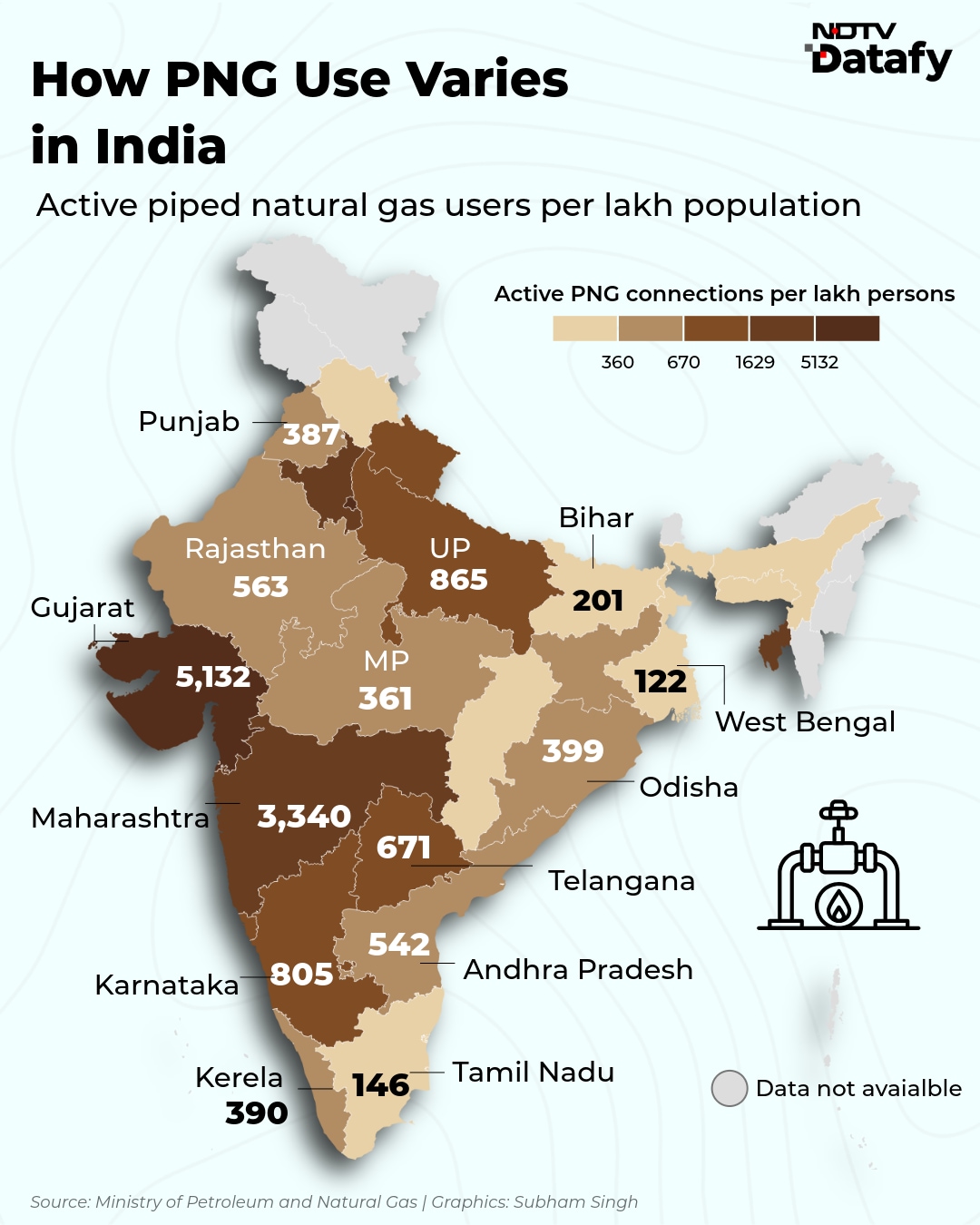
However, even in PNG-rich states, the coverage is predominantly urban. Rural and peri-urban areas, which form the majority of India's population, are still dependent on the cylinder-based model.
Total LPG connections = 329.7 million
Total PNG connections = 15.8 million
Ratio = 21:1
It means that for every 21 LPG connections in India, there is only one PNG connection.
What the queues ultimately reveal is not just fear, but exposure.
India's LPG system rests on a fragile triangle: stagnant domestic production, rising mass consumption, and import routes running through a conflict-hit chokepoint.
Until domestic production expands, alternative supply routes scale, or PNG coverage grows beyond urban enclaves, geopolitical tremors in West Asia will continue to spill into Indian kitchens.
Track Latest News Live on NDTV.com and get news updates from India and around the world

