






As artificial intelligence redraws the global balance of power, India has quietly but decisively entered the foundational layer of this transformation.
At the heart of this moment stands BharatGen, India's sovereign generative AI programme - built from the ground up for the country's languages, culture, governance needs, and societal realities. And behind BharatGen's rise lies a sustained, strategic push by the Department of Science & Technology (DST), which has helped India do what only a handful of nations have managed so far: build its own foundational AI models.
That effort reaches a defining milestone with the upcoming announcement that PARAM-2, a 17-billion-parameter multilingual Mixture-of-Experts (MoE) model, will be formally launched at the India AI Impact Summit 2026. Trained on India-centric datasets under Bharat Data Sagar and supporting all 22 Scheduled Indian languages, PARAM-2 marks a leap from experimentation to national-scale capability.
"This is not just a model release," says Professor Ganesh Ramakrishnan of IIT Bombay, one of the key architects of BharatGen. "It is the coming together of an ecosystem - researchers, institutions, government, industry, all working together so that India can own its AI future."
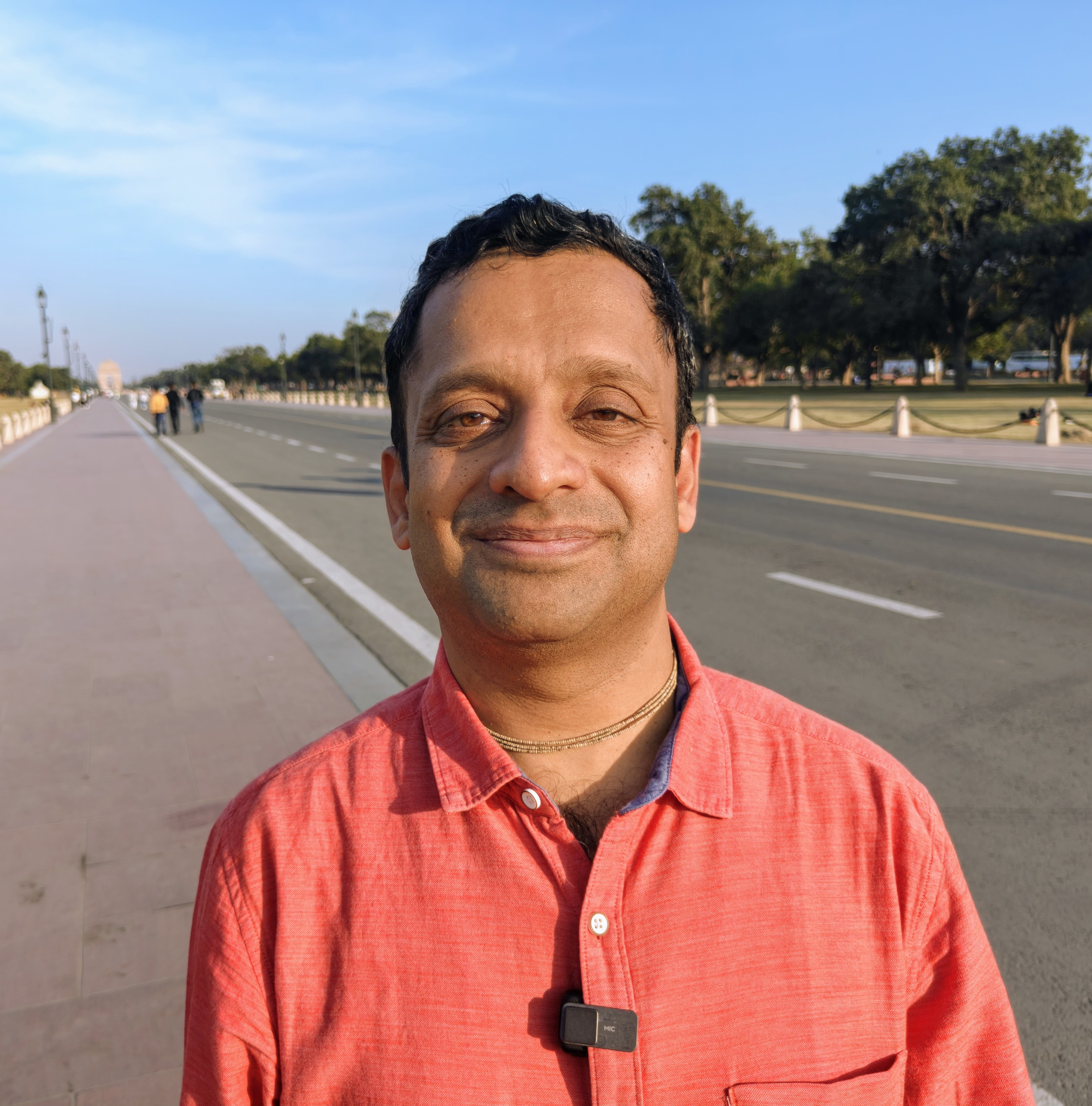
Prof Ganesh Ramakrishnan, Department of Computer Science, IIT Bombay, who spearheads the making of BharatGen (Photo Credit: Pallava Bagla)
Why Sovereign AI Matters for India
India's sheer scale, its population, linguistic diversity, and governance complexity, demands a fundamentally different AI approach from that of Western tech giants. Global large language models may work well for English-dominant contexts, but India's reality is multilingual, multi-script, culturally layered, and deeply local.
"Sovereignty is our North Star," Ramakrishnan explains. "Not sovereignty for the sake of nationalism alone, but sovereignty for sustainability, transparency, and trust. If you don't know where your data came from, how your model was trained, and why it behaves the way it does, you don't really control it."
That philosophy is embedded into BharatGen's design.
Unlike consumer-facing platforms such as ChatGPT or Gemini, BharatGen does not operate as a centralised business to customer (B2C) service. Instead, it releases models as national public digital goods, enabling governments, banks, hospitals, courts, and educational institutions to deploy them locally, even in air-gapped environments with no internet connectivity.
"This is what we call a glass-box approach," Ramakrishnan says. "You don't just see what works; you also see what failed. That knowledge is as important as success. It allows co-design, institutions building AI with us, not just consuming it."
DST's Quiet but Pivotal Role
The backbone of BharatGen is the National Mission on Interdisciplinary Cyber-Physical Systems (NM-ICPS) under DST. Through NM-ICPS, DST supported India's first national generative AI initiative, titled "BharatGen: A Suite of Generative AI Technologies for India."
Prof Abhay Karandikar, an electrical engineer and Secretary, Department of Science and Technology, New Delhi says, "When the AI mission was still in formation, DST had approved Rs 235 crore for BharatGen through our mission on cyber physical. Today, with support of Rs 900 crore through IndiaAI mission by MeitY, it is one of the largest whole of government approaches towards building sovereign AI where DST seeded the project and MeitY is helping scale. Same seeding we are now doing in Quantum. Many quantum start-ups have now come up doing amazing work. Now we will catalyse deep tech eco-system through the Research and Development Initiative (RDI)."
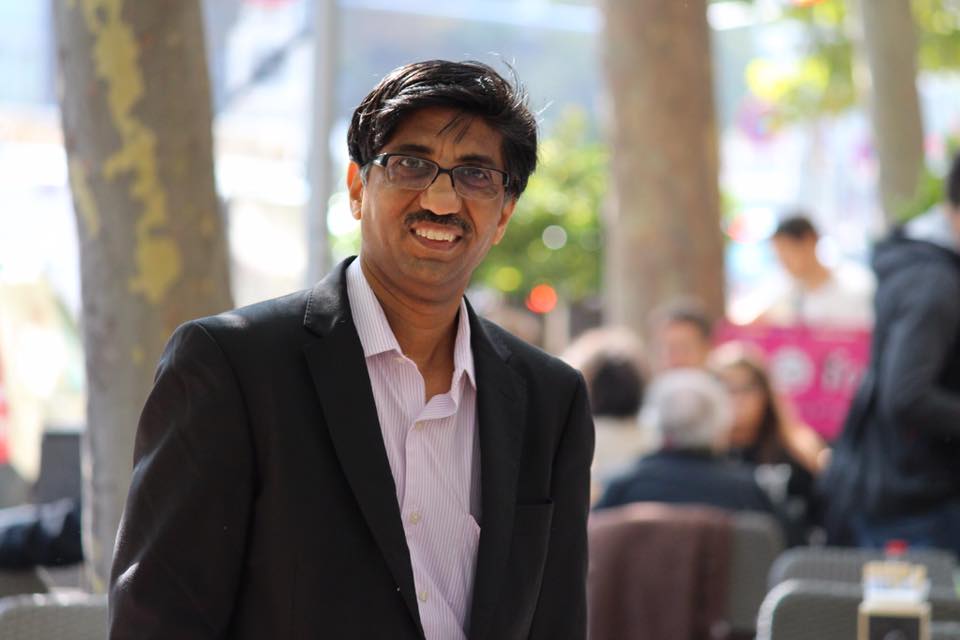
Prof Abhay Karandikar, Secretary, Department of Science and Technology (Photo credit: DST)
BharatGen is implemented through a consortium with an unusual but deliberate mix of engineering, AI research, and management expertise.
"This had to be a whole-of-nation effort," Ramakrishnan says. "AI cannot be built in silos. Academia alone can't do it. Industry alone can't do it. Government alone can't do it. The ecosystem had to be designed intentionally."
DST's support enabled BharatGen to start small but think big. The journey began with PARAM, a 2.9-billion-parameter bilingual model in Hindi and English, built not to impress, but to learn. "We had to groom our capability," Ramakrishnan recalls. "India has been in a service mindset for decades. Building foundational technology means understanding the entire stack, from data to GPUs to deployment."
From there came a 7-billion-parameter model in 16 Indian languages, and now PARAM-2, covering all 22 Scheduled languages. Along the way, BharatGen also released SHRUTAM (speech-to-text), SUKTAM (text-to-speech), and PATRAM, India's first document vision-language model-each built from scratch.
AI Designed for Indian Languages
One of BharatGen's most distinctive features is how it treats Indian languages not as isolated silos, but as a connected linguistic ecosystem.
"Indian languages share phonetic, lexical, and grammatical structures," Ramakrishnan explains. "The way a Tamil speaker pronounces a word is not radically different from how an Assamese speaker does. Word order, subject, object, and verb, is common across most Indian languages. Why should we force them into a Western linguistic mould?"
This insight allows BharatGen to build more efficient and culturally grounded models. Rather than imposing a pan-Indian uniformity, the system respects dialectal variation while leveraging shared structures, a balance that global models often miss.
From Research to Real-World Impact
BharatGen is already moving beyond research labs. Domain-specific fine-tuned models have been released for Ayurveda (Ayur-PARAM), Agriculture (Agri-PARAM), and the Indian legal system (Legal-PARAM). These are being tested for use in courts, classrooms, public service delivery, and governance workflows.
"We don't believe AI should replace institutions," Ramakrishnan says. "It should complement them. Teachers should not be replaced. Judges should not be replaced. Doctors should not be replaced. AI should make them more effective."
That philosophy echoes India's success with UPI - a decentralised digital public infrastructure that scaled nationally without eroding local control. BharatGen aims to replicate that model for AI.
The Compute Challenge - and India's Response
Training large models requires enormous computational power, and India's access to GPUs has long been a bottleneck. BharatGen has already trained models on 5,000-plus GPUs, with access now expanding further. But Ramakrishnan is clear that raw compute is only part of the equation.
"Inference is the real killer," he says. "If you centralise inference for a country of 1.4 billion people, energy use becomes unsustainable. A decentralised, scale-out approach-where models run locally, is far more efficient."
This decentralised design also strengthens sovereignty, reducing dependence on foreign cloud infrastructure and minimising data leakage risks.
PARAM-2: A National Milestone
The launch of PARAM-2 at the upcoming India AI Impact Summit 2026 is therefore more than a technical upgrade. It signals India's arrival at the foundational AI layer, a space dominated until now by the US and China.
"Sometimes being late is an advantage," Ramakrishnan reflects. "We can learn from others' mistakes-about hallucinations, energy use, governance, ethics-and build something more responsible."
BharatGen's roadmap includes even larger models, with the India AI Mission announcing ambitions that go up to trillion-parameter-scale foundational models. PARAM-2 is the bridge between capability building and that future.
AI for Viksit Bharat
For India, the stakes are clear. A country of India's scale cannot depend indefinitely on foreign AI systems trained on foreign contexts and governed elsewhere.
"India cannot become a developed country without deploying AI," Ramakrishnan says bluntly. "But it must deploy AI in a way that strengthens its culture, its institutions, and its sovereignty, not weakens them."
In that sense, BharatGen is not just a technology project. It is a national statement: that India will not merely consume artificial intelligence, but shape it, on its own terms, in its own languages, for its own people.
As PARAM-2 goes live, the message from DST and BharatGen is unambiguous. India is vast. It needs a sovereign AI large language model. BharatGen is the answer.
Track Latest News Live on NDTV.com and get news updates from India and around the world

