



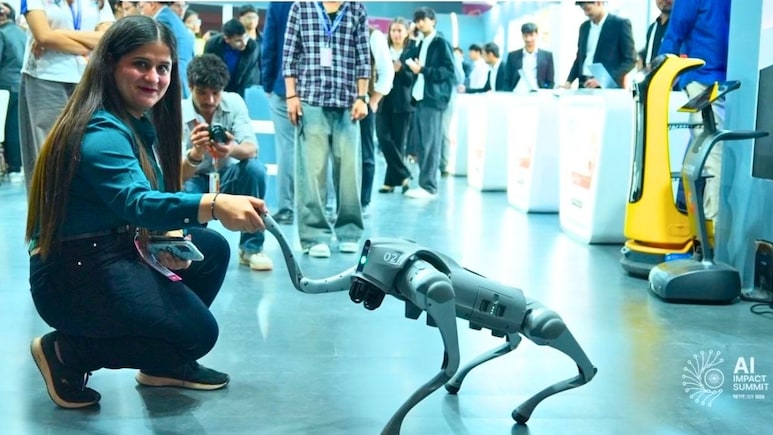
- Galgotias University faced criticism for displaying a Chinese-made robot as its own at an AI summit
- The robot was the Unitree Go2 model, renamed Orion during the event by university staff
- University said the robot was used only as a teaching aid to help students learn AI programming
Galgotias University has described the intense online and offline criticism over its display of a robotic dog at a major artificial intelligence event in New Delhi as a "propaganda campaign" against the institution.
The controversy arose at the India AI Impact Summit after a video showed university representatives presenting a commercially available Chinese-made robot as a development from Galgotias University's Centre of Excellence. The machine, identified by social media users as the Unitree Go2 model produced by the Chinese company Unitree, was referred to as "Orion" during the event.
Galgotias University was later asked to vacate its stall at the summit expo, sources said. The university, based in Greater Noida, has denied any wrongdoing and maintained that the robot was used solely as a teaching aid.
— Galgotias University (@GalgotiasGU) February 17, 2026
In an official statement, the university said robotic programming formed part of its efforts to teach students how to build artificial intelligence applications and to develop and deploy real-world skills using tools and resources available globally.
"We at Galgotias, faculty and students, are deeply pained by the propaganda campaign against our university. We would like to clearly state that the robotic programming is part of our endeavour to make students learn AI programming and develop & deploy real-world skills using globally available tools and resources, given that developing AI talent is need of an [sic] hour," the statement read.
"Our university's vision is focused on student learning & innovation and we provide students with access to modern technologies so they can gain practical experience and prepare for the future. Spreading negativity can harm the morale of students, who are working hard to innovate, learn, and build their skills using global technologies," the statement added.
A video that circulated widely on social media captured a woman, later identified as Professor Neha Singh of Galgotias University, introducing the robot as "Orion" and describing its features during a media interaction at the summit.
In the clip, she stated that Galgotias University's Centre of Excellence had developed the machine. Social media users identified the device as the Unitree Go2, a model sold openly in India for between Rs 2 lakh and Rs 3 lakh. Critics accused the university of presenting imported technology as an Indian innovation developed in-house.
The university responded on the social media platform X, formerly Twitter, stating that the robotic dog had been procured from Unitree and was being used purely as a learning tool for students.
It insisted it had never claimed to have built the device.
"The recently acquired robodog from Unitree is one such step in that journey," the post said. "It is not merely a machine on display; it is a classroom in motion. Our students are experimenting with it, testing its limits and, in the process, expanding their own knowledge. Let us be clear: Galgotias has not built this robodog, nor have we ever claimed to. Let us be clear - Galgotias has not built this robodog, neither have we claimed. But what we are building are minds that will soon design, engineer, and manufacture such technologies right here in Bharat."
Professor Neha Singh, who appeared in the original video, told news agency ANI that she had never sought to present the robodog as the university's own creation."We have never claimed that it is ours, Indian, or Galgotian. Its main branding is still on it. The robot that had come for a particular task has gone there for the children's study, for the children's research and development. Our centre, our campus -- it has gone into the children's lab. It was here for two days for projection; the projection has been completed," she said.
Addressing the viral video, Professor Singh said the controversy had grown from a single misinterpretation.
"By one misinterpretation, the internet has gone by storm. It might be that I could not convey well what I wanted to say, or it was misunderstood. I am a faculty member in communications at the School of Management, not in AI. Only you (the media) have heard what the government has said. As far as I know, we are here at the expo. As a university, we are standing tall. The robot was brought here only for projection," she claimed.
"This is a jumble of two words, develop, and development. We didn't develop it. We worked on its development... We want to bring them, just like that robot was brought, and an effort was made to get students to do research on it... I can say that perhaps she (Professor Neha) might have been confused by the words "develop" and "development" in the flow. But the truth is that we bought this robot for children's research... If China is making the claim, then maybe it (robodog) could be bought from China... I haven't received any such official communication yet (on vacating the expo),' said Nitin Kumar Gaur, registrar of Galgotias University.
The university came under renewed online questioning after it stated that staff and students on its Greater Noida campus had built a soccer drone from scratch. Users on social media claimed that the drone is a commercially available model known as the Striker V3 ARF, which can be purchased in the Indian market for around Rs 40,000. The Helsel Striker V3 is indeed a soccer drone developed by South Korea's Helsel Group for drone sports.
Track Latest News Live on NDTV.com and get news updates from India and around the world

