





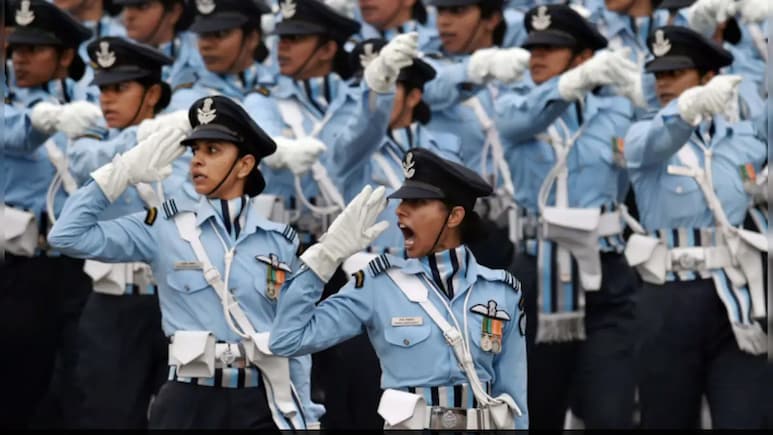
The denial of permanent commission to women officers with short service commissions (SSC) in the Army, Navy and Air Force was a consequence of systemic discrimination, the Supreme Court said Tuesday, invoking Article 142 to render "complete justice".
The male officers, the top court said, cannot expect the vacancies to be exclusively male.
Earlier, the Centre had defended its policy, saying that the Army's processes were gender-neutral and that "elimination is part of a policy to keep the forces young."
The judgment came on a batch of petitions, including those filed by Wing Commander Sucheta Edan and others, challenging the denial of Permanent Commission (PC) based on policy changes in 2019 and previous Armed Forces Tribunal (AFT) rulings.
A Permanent Commission in the armed forces is a career path that allows an officer to serve until the retirement age.
Unlike a SSC, which has a fixed term of 14 years, a Permanent Commission offers a long-term career with opportunities for promotion to the highest ranks and full entitlement to pensions and other retirement benefits.
A bench comprising Chief Justice Surya Kant and Justices Ujjal Bhuyan and N Kotiswar Singh held that as a one-time measure those women SSC officers who were considered for Permanent Commission but were denied it would be "deemed" to have completed the minimum qualifying service of 20 years required for a pension, even if they were released from service earlier.
The court underscored that for years, evaluation metrics like Annual Confidential Reports (ACRs) were written with the biased assumption that women would never have a long-term career.
"The ACRs were written with the presumption that they would not undergo career progression. This adversely affected their overall merit," Chief Justice Surya Kant said.
Because women were initially ineligible for Permanent Commission, they were never given the same "criteria appointments" or "career enhancement courses" as men, which unfairly lowered their merit scores when they finally became eligible for permanent roles, the court said.
To prevent future "systemic discrimination," the Supreme Court has mandated a new transparent protocol for all future Selection Boards across the Army, Navy, and Air Force.
Before any selection board is conducted, the authorities must now issue a general circular that clearly discloses the number of vacancies available in each branch, the detailed criteria for evaluation, and the specific marks allocated for every component.
This landmark shift ensures that career progression in the Indian Armed Forces will no longer be determined by undisclosed or subjective "value judgments," but by a transparent and fair process.
The bench separately dealt with the denial of Permanent Commission to SSC women officers of the Air Force, Navy and Army.
Regarding the Air Force, the bench found that the "Service Length Criteria" and "Minimum Performance Criteria" introduced in 2019 were implemented in haste, denying officers a reasonable opportunity to meet them.
Using its extraordinary powers under Article 142 of the Constitution, which empowers the top court to pass any orders to do complete justice, the bench said, as a one-time measure, all SSC women officers considered for Permanent Commission in selection boards held in 2019, 2020, and 2021, including those released in 2021, will be deemed to have completed 20 years of qualifying service.
It said the pension will be fixed based on this 20-year deemed service, effective from November 1, 2025.
The court, however, declined to order reinstatement, citing "operational effectiveness", but said that this could not be a ground to deny financial benefits.
Dealing with issues pertaining to the Army and Navy, it found similar flaws in their assessment models and said the failure to disclose evaluation criteria adversely impacted these officers.
To avoid the delay of convening new boards, the top court directly ordered the grant of Permanent Commission for specific categories of officers currently in service, including those inducted before January 2009 and certain male officers previously barred by their initial terms.
Those released during the litigation who fall into these categories are also deemed to have completed 20 years of service, with pension fixed from January 1, 2025.
Track Latest News Live on NDTV.com and get news updates from India and around the world

