





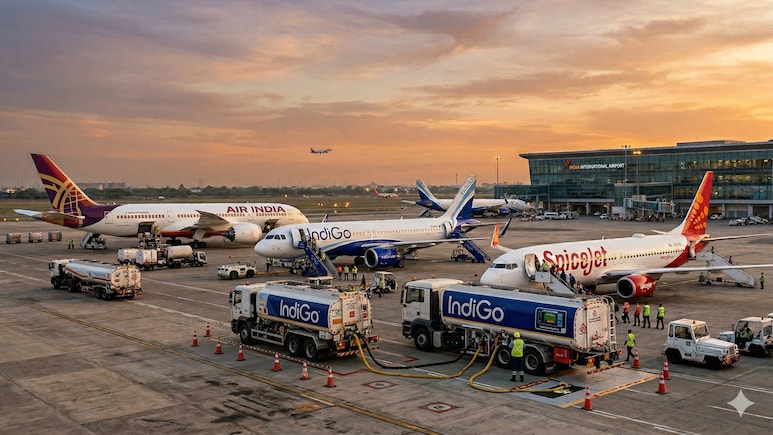
- Delhi cut VAT on aviation fuel from 25% to 7% for six months to aid airlines
- Maharashtra reduced Mumbai's ATF VAT from 18% to 7% for domestic flights only
- Delhi and Mumbai airports handle majority of India's air passenger and refueling volume
Delhi and Mumbai - India's two largest aviation hubs - have sharply cut taxes on aviation turbine fuel (ATF), offering airlines a major cost breather as the industry grapples with soaring jet fuel prices triggered by the Iran war, rupee weakness, and rising operational expenses.
Delhi reduced VAT on ATF from 25 per cent to seven per cent for six months, while Maharashtra cut Mumbai's ATF VAT from 18 per cent to seven per cent for domestic flight operations.
Industry experts said the move could significantly improve operating economics because the two metro hubs together account for a disproportionately large share of India's passenger traffic, long-haul connectivity, and aircraft refuelling activity.
The tax relief comes after airlines warned the government that the fuel crisis was threatening route viability.
In a formal communication to the Ministry of Civil Aviation on April 26, the Federation of Indian Airlines (FIA), representing Air India, IndiGo, and SpiceJet, said fuel costs had surged to 55 to 60 per cent of operating expenses, compared to 30 to 40 per cent before the conflict escalated.
The sharp rise followed disruptions around the Strait of Hormuz after the US-Iran conflict intensified. Nearly 20 per cent of global oil and LNG supplies pass through the strategic maritime route.
Global jet fuel prices subsequently surged from $99.4 dollars per barrel at the end of February to $162.89 dollars per barrel for the week ending May 8, 2026.
Why Delhi And Mumbai Hold The Key To Airline Fuel Economics
The importance of the VAT reduction lies not just in the tax cut itself, but in where it has been implemented.
Delhi's Indira Gandhi International Airport handled nearly eight crore passengers in 2024-25, according to figures cited by Chief Minister Rekha Gupta, making it India's busiest airport. Mumbai airport handled 55.5 million passengers in 2025 and recorded more than 331,000 aircraft movements.
Together, the two airports form the backbone of India's aviation network, handling a substantial share of premium domestic traffic, international operations and airline hub connectivity.
This means airlines buy enormous volumes of fuel at these airports every day, making tax reductions at Delhi and Mumbai far more consequential than similar cuts at smaller airports.
Government data reflects the scale of this demand.
According to the Petroleum Planning and Analysis Cell (PPAC), India consumed around 764 thousand metric tonnes of ATF in February 2026 alone. Directorate General of Civil Aviation (DGCA) data showed domestic airlines carried nearly 167 million passengers in 2025.
Industry experts said the concentration of fuelling activity at Delhi and Mumbai means even a small reduction in VAT can translate into substantial savings for airlines operating dense domestic and international networks.
Fuel Prices, Rupee Weakness And Supply Crunch Hit Airlines Together
Fuel has become the single biggest stress point for airlines already dealing with rising lease rentals, aircraft shortages, engine maintenance issues and rupee depreciation.
India's aviation sector has long complained about fragmented ATF taxation because aviation fuel remains outside the GST regime and attracts varying VAT rates across states.
The FIA had urged the Centre to temporarily remove the 11 per cent excise duty on ATF and push states to lower VAT rates, which were as high as 25 per cent in Delhi and 29 per cent in Tamil Nadu before the latest cuts.
Tamil Nadu still levies the country's highest VAT on ATF at 29 per cent, followed by West Bengal at 25 per cent.
The financial pressure is already visible in airline performance.
Air India has cut routes on international flights, suspending routes to Chicago, Newark and Shanghai while reducing frequencies to San Francisco, Paris and Toronto.
IndiGo's net profit fell 77.6 per cent year-on-year to Rs 549 crore in the third quarter of FY26 amid rising fuel and operational costs.
Tax Cut Could Reshape Airline Refuelling Strategies
The VAT cuts may also alter airline operational planning and refuelling strategies.
For years, airlines have used practices such as 'fuel tankering' which implies carrying extra fuel from lower-tax airports to avoid refuelling at expensive hubs. While financially beneficial, the practice increases aircraft weight and reduces fuel efficiency.
Industry experts said lower VAT at Delhi and Mumbai could reduce the need for such tax-driven distortions and improve route economics.
Airlines with extensive hub operations in Delhi and Mumbai, particularly IndiGo and Air India, are expected to benefit the most from the reduction in fuel costs.
How Much Can Airlines Gain?
Even a reduction of a few rupees per litre translates into substantial annual savings at scale. The relief comes at a critical time for the industry when airlines are simultaneously facing elevated global crude oil prices, rupee weakness against the US dollar, rising aircraft lease rentals, maintenance and engine-related costs and supply-chain disruptions delaying aircraft deliveries. Due to these factors, airlines remain highly exposed to external shocks.
India imports more than 85 per cent of its crude oil requirement, making aviation fuel prices especially vulnerable to geopolitical tensions and currency volatility.
Why Passengers May Not See Immediate Fare Cuts
Despite the tax cuts, passengers are unlikely to see immediate reductions in airfares. That is because Indian aviation pricing is driven primarily by demand-supply conditions rather than direct cost pass-through.
DGCA data has consistently shown strong passenger demand even amid operational disruptions and capacity constraints. At the same time, supply remains tight due to aircraft groundings, engine inspection issues, and delivery delays from manufacturers.
This imbalance has increased airlines' pricing power on several domestic routes, especially metro-to-metro sectors. As a result, lower ATF taxes may help airlines absorb cost pressures and protect margins rather than significantly reduce fares.
The broader inflationary environment also remains challenging. Petrol and diesel prices were recently increased again to Rs 3.9 per litre, signalling that energy-related cost pressures persist across sectors.
Some analysts believe airlines could gradually introduce more competitive fares on busy domestic routes if fuel prices ease further. But sustained reductions in ticket prices would likely require a significant fall in global crude prices and de-escalation of the West Asia conflict.
Under Maharashtra's revised structure, the 7 per cent VAT applies only to domestic operations. International carriers operating from Maharashtra airports were already exempt from VAT on ATF.
Delhi And Maharashtra Brace For Revenue Losses
Both Delhi and Maharashtra have acknowledged the fiscal cost of the decision.
Chief Minister Rekha Gupta said Delhi could lose nearly Rs 985 crore in revenue because of the VAT reduction but argued that the move would strengthen the capital's position as a competitive aviation hub.
According to Gupta, VAT on ATF contributes around Rs 1,368 crore annually-nearly 19 per cent of Delhi's total yearly VAT collection.
Maharashtra officials estimate the state's annual revenue loss at Rs 550 to 600 crore.
The Larger Aviation Push: Renewed Calls To Bring ATF Under GST
The latest tax cuts have once again revived the aviation industry's long-standing demand to bring ATF under the Goods and Services Tax framework.
ATF has remained outside GST since its rollout in 2017, preventing airlines from claiming input tax credits on fuel purchases.
Airlines argue that varying state-level VAT structures distort operational costs, complicate route planning and inflate fuel expenses across the sector.
So far, however, the Centre has made no announcement on including ATF under GST despite repeated industry demands.
Track Latest News Live on NDTV.com and get news updates from India and around the world

