






- Delhi's auto drivers are comparing Delhi's EV shift to the early 2000s CNG transition
- Delhi's new EV policy mandates electric autos for new registrations from 2027
- Permit ceiling of 100,000 autos has halted new electric auto registrations in Delhi
Every morning, before Delhi's roads fill with commuters, Rama Shankar Shukla starts his day behind the wheel of his auto-rickshaw. After nearly three decades on the capital's roads, he has witnessed one of Delhi's biggest transport transitions before. Now, he believes another is beginning.
The 58-year-old remembers driving a petrol auto before Delhi switched to compressed natural gas (CNG) in the early 2000s. He remembers spending hours outside filling stations, uncertain whether there would be enough fuel to complete the day's work. Today, as the Delhi government prepares to roll out its new EV Policy, those memories are resurfacing.
"I've been driving an auto in Delhi for nearly 30 years. In all that time, the biggest change I saw was the shift from petrol and diesel autos to CNG in the early 2000s. Now, the move to electric vehicles feels like another such turning point," Shukla told NDTV.
For thousands of Delhi's auto-rickshaw drivers, the conversation around electric mobility isn't just about cleaner air. It is about livelihoods, affordability and whether the city has learnt enough from one of its most difficult transport transitions.
When Delhi Queued For Hours Just To Fill Fuel
Shukla remembers the CNG transition vividly.
"When the CNG transition began, there was a lot of uncertainty. CNG would arrive in tankers, and drivers would rush to fill their tanks because nobody knew if fuel would be available the next day. Long queues at filling stations became normal.
"It took years for things to settle. More CNG stations came up, the supply improved, and by around 2005-06, people had accepted the new system."
Delhi's shift to CNG was triggered by a landmark Supreme Court order in the MC Mehta case aimed at tackling the capital's worsening air pollution. The court directed buses, taxis and auto-rickshaws to switch to cleaner fuel, but the supporting infrastructure was nowhere near ready.
As the deadline approached, there were too few CNG stations, fuel supply remained erratic, and drivers often spent eight to ten hours waiting in queues. The Delhi government and transport operators repeatedly sought more time, arguing the city lacked adequate infrastructure, but the Supreme Court refused blanket extensions. Thousands of diesel buses were taken off the roads, disrupting public transport before the CNG network gradually expanded and the system stabilised.
Different Fuel, Same Questions
Nearly 25 years later, Shukla says the uncertainty feels familiar, even if the technology has changed.
"Today, the same uncertainty is back. Only now, instead of worrying about CNG, drivers are worried about charging stations, battery life, charging time and where they'll get repairs done."
He says rising CNG prices have already made it harder for drivers to make ends meet.
"CNG is no longer as economical as it used to be. Prices have gone up significantly, but passengers aren't paying higher fares. Our earnings are getting squeezed."
Competition has also intensified over the years.
"App-based cabs and bike taxis have reduced our business, while the number of auto permits has remained the same."
Despite the concerns, he believes electric mobility is inevitable.
"Every major transport transition takes time. Just like CNG eventually became normal, electric vehicles will also need proper infrastructure before drivers can fully accept the change."
Delhi Bets Big On Electric Autos
The Delhi government's EV Policy marks the biggest overhaul of the capital's three-wheeler sector in more than two decades.
From January 1, 2027, only electric auto-rickshaws will be eligible for new registrations. Existing CNG autos can continue operating until they complete their permitted lifespan, but replacement vehicles will have to be electric.
To encourage the transition, the policy allows purchase incentives of up to Rs 50,000 for electric three-wheelers, continued exemption from road tax and registration charges, and plans to install 30,000 public charging points across the city.
The government expects around 40,000 to 50,000 ageing auto-rickshaws to be replaced over the coming years, making this one of the biggest changes to Delhi's public transport fleet since the CNG rollout.
The Biggest Roadblock: A Permit Freeze
Despite Delhi emerging as one of India's leading EV markets, virtually no new passenger electric auto-rickshaws have been registered in the city for more than a year.
Senior Transport Department officials said fresh registrations have remained frozen because Delhi has already reached its permit ceiling of around one lakh passenger auto-rickshaws.
The situation is now expected to improve, they added.
According to the officials, ageing CNG auto-rickshaws will gradually be replaced with electric vehicles over the coming years. The government is also exploring legal options to increase the existing permit ceiling, potentially allowing more electric autos to enter the market.
Auto unions, however, say the permit cap has already slowed Delhi's EV transition.
Rajendra Soni, General Secretary of the Delhi Auto Rickshaw Sangh, says the permit ceiling has become one of the biggest bottlenecks.
"Delhi's population has increased significantly, but the permit ceiling remains the same. Because of that, new electric auto registrations have not been happening for more than a year."
According to Transport Department data, 1,426 passenger electric auto-rickshaws were registered in 2024. Fresh registrations have effectively stopped since the permit ceiling was reached, despite continued policy support for electrification.
Has Delhi Learnt From The CNG Chaos?
Industry experts believe comparisons between the CNG and EV transitions are inevitable, but argue that Delhi begins this transition from a much stronger position.
Vinkesh Gulati, Chairperson of the Automotive Skill Development Council (ASDC), says Delhi has already crossed the experimentation stage of electric mobility.
"I would say Delhi has crossed the experimentation stage and is entering the acceleration phase, but we are not yet at full-scale adoption."
According to him, electric two-wheelers, three-wheelers and buses have already gained momentum in Delhi. The next phase will depend on reliable charging infrastructure, stable government policy and continued improvements in affordability and technology.
"We are approaching a tipping point, but reaching mass adoption will depend on three things: reliable charging infrastructure, stable policy, and continued technological improvements that make EVs more affordable and practical. I feel the new policy takes care of all these points."
He says the biggest difference from the CNG era is that charging is no longer limited to one type of fuel station.
"During the CNG transition, infrastructure lagged far behind demand. Vehicles were available before fuelling stations were ready, which led to long queues and inconvenience. With EVs, charging can happen at homes, offices, workplaces and public stations, making the ecosystem inherently more distributed."
"The good news is that we already know what went wrong during the CNG era. The CNG transition taught us that infrastructure should lead demand, not chase it."
He believes consumer confidence has also improved significantly.
"Customers don't buy technology, they buy confidence and convenience."
However, he cautions that charging infrastructure alone will not determine the success of the transition.
According to Gulati, financing, skilled EV technicians, spare parts, battery recycling, dealership preparedness and consumer awareness must all evolve together.
"Successful transitions are ecosystem-led, not regulation-led."
CNG vs EV: What Changes For Drivers?
For drivers, electric autos promise lower daily running costs but also introduce new concerns around charging time, battery replacement and repairs.
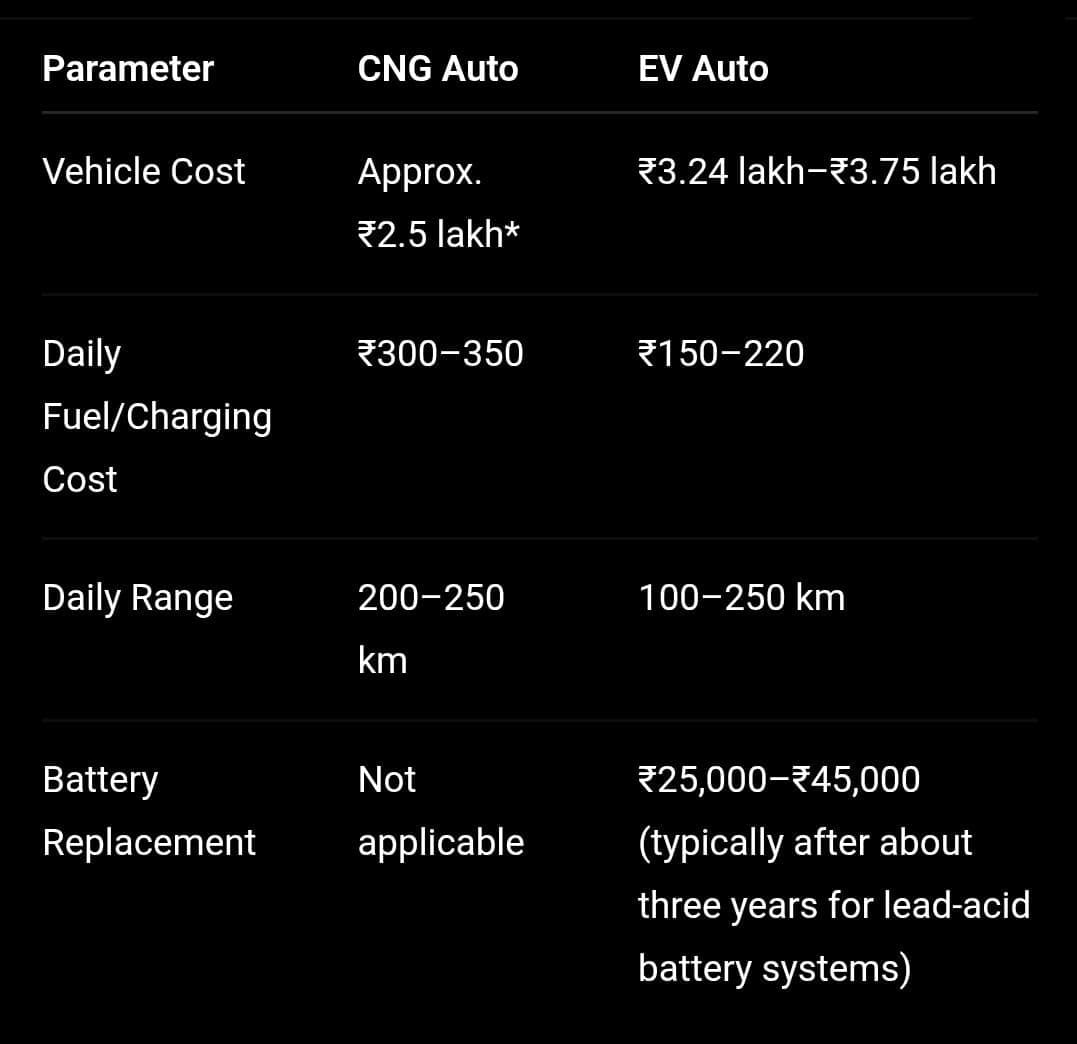
(Approximate vehicle cost when permits were available. Costs shared by drivers are indicative and may vary depending on vehicle model, ownership pattern and daily usage.)
While the lower running cost makes EVs attractive, many drivers say their biggest concerns remain charging availability, battery replacement expenses, repair infrastructure and resale value.
Will Delhi Rewrite History This Time?
Twenty-five years ago, Delhi's CNG transition transformed public transport and helped improve the city's air quality, but only after years of disruption, court battles, fuel shortages and endless queues.
This time, the questions are different. Instead of waiting outside CNG stations, drivers worry about charging stations. Instead of fuel availability, they worry about battery life, charging time and where they will get their vehicles repaired.
For Rama Shankar Shukla, who has experienced both transitions from behind the wheel, the lesson from the CNG era remains simple.
"Every major transport transition takes time. Just like CNG eventually became normal, electric vehicles will also need proper infrastructure before drivers can fully accept the change."
Track Latest News Live on NDTV.com and get news updates from India and around the world

