






Coffee, the aromatic beloved beverage that fuels millions every morning, is facing an unprecedented challenge. Climate change and global warming are shaking the very roots of coffee plantations worldwide, and India, home to some of the finest shade-grown coffee, is not immune. The world is staring at a brewing crisis, and experts warn that the impact could hit consumers sooner than expected.
As per India's weather office, the country recorded its eighth warmest year in 2025, with temperatures 0.28 degrees Celsius above average.
For centuries, India's coffee has thrived under the canopy of shady trees in the lush Western Ghats. Introduced from Yemen in the 17th Century, coffee in India has evolved into a unique system where beans grow alongside spices and other high-value crops. This biodiversity, combined with proactive breeding programmes, gave India an edge in resilience and flavour. Today, the country boasts more genetic diversity in coffee than most origins and has carved a niche as the world's highest-quality producer of robusta coffee. But the climate clock is ticking.
"Coffee plantations are in danger," said Ajoy Thipaiah, owner of Kerehaklu Coffee Estate in Chikkamagaluru and President of the United Planters Association of Southern India (UPASI), headquartered in Coonoor. "Over the past 15 years, we have seen dramatic changes in rainfall patterns. What used to be predictable weather has become erratic. Monsoons that once receded in September now spill into harvest months, disrupting processing and slashing productivity," he said.
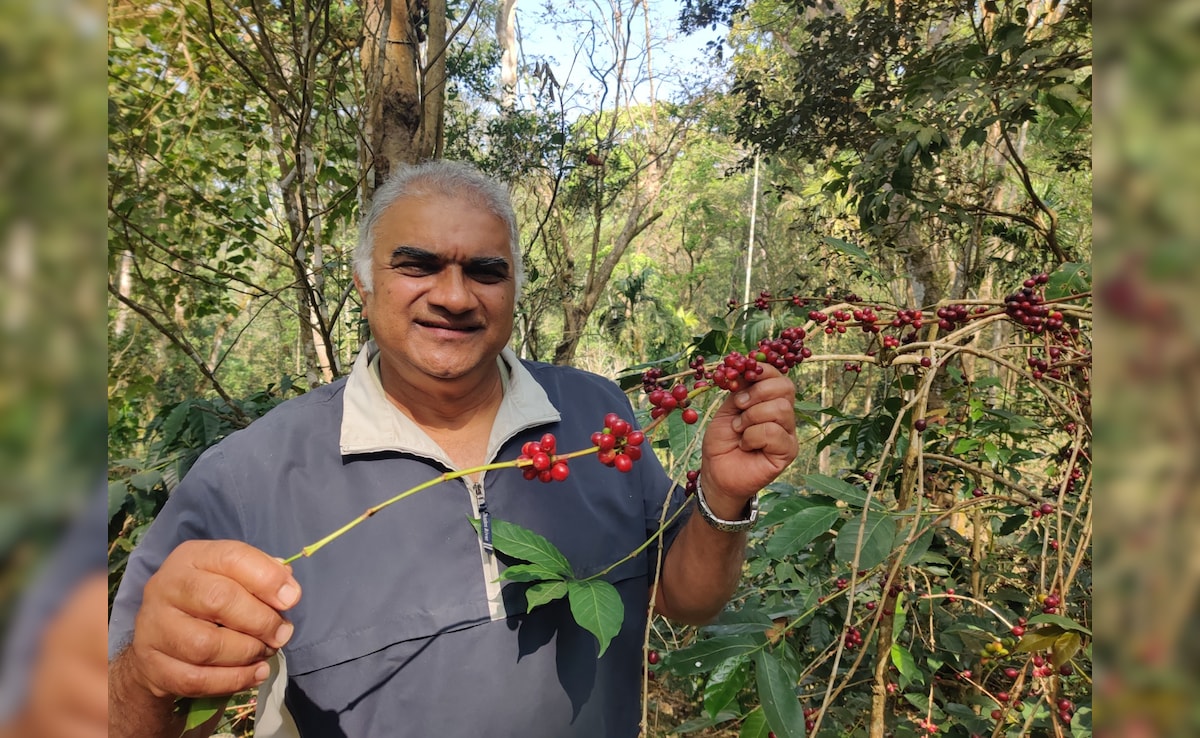
Ajoy Thipaiah, owner of Kerehaklu Coffee Estate in Chikkamagaluru and President of the United Planters Association of Southern India (UPASI) with Coffee beans
Photo Credit: Pallava Bagla
According to the Coffee Board of India based in Bengaluru, the country's journey with coffee began centuries ago, when the legendary saint Baba Budan brought seven Mocha seeds to the hills of Karnataka in the 17th Century. His simple act of planting these seeds in the courtyard of his hermitage in Baba Budan Giri unknowingly set in motion the rise of India as one of the world's prominent coffee producers. Over the centuries, the cultivation of coffee in India has evolved from a humble practice to a thriving industry with the country's coffee now widely loved across the globe.
India is now the seventh-largest coffee producer globally with exports reaching $1.29 billion in FY 2023-24, almost double the $719.42 million in 2020-21. India's Central Coffee Research Institute, Chikkamagaluru is celebrating its centenary year.
India's coffee exports have grown significantly due to the increasing global demand for its rich and unique flavours.
In the first half of January 2025, India exported over 9,300 tonnes of coffee with top buyers including Italy, Belgium, and Russia.
Approximately three-fourths of India's coffee production consists of Arabica and Robusta beans. These are primarily exported as unroasted beans. However, there is a growing demand for value-added products like roasted and instant coffee, further fuelling the export boom.
Due to rise of cafe culture, higher disposable incomes and a growing preference for coffee over tea, coffee consumption in India is also steadily increasing. This trend has been observed particularly in both urban and rural areas. Domestic consumption has increased from 84,000 tonnes in 2012 to 91,000 tonnes in 2023. This surge reflects a broader shift in drinking habits, as coffee becomes a staple in daily life.
Yet the numbers tell a grim story. Arabica, prized for its delicate flavour, has suffered the most.
"Production per acre has dropped by up to 40 per cent," Thipaiah explained. "Growers are switching to robusta coffee because it's more resilient. But this shift is not just about economics, its survival," he added.
Unseasonal rains aren't the only culprit. Rising temperatures, prolonged dry spells, and increased disease pressure compound the crisis. India has long battled pests like the white stem borer, but climate variability is making these threats harder to manage. "We have absolutely no control over what nature throws at us," Thipaiah said. "At best, we can adapt. We are urging the government to introduce weather-resilient varieties, but that's a long-term solution," he added.
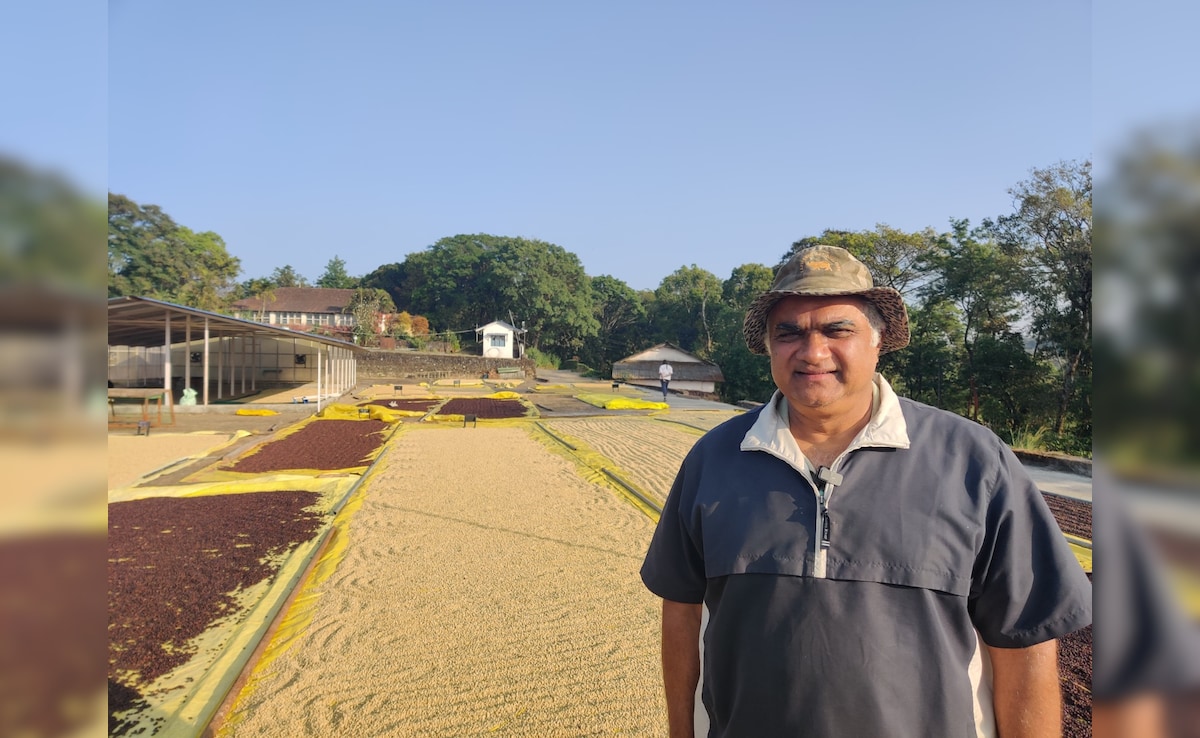
Drying coffee beans
Photo Credit: Pallava Bagla
Globally, the picture is equally alarming. Coffee production dipped last year, particularly in Brazil and Vietnam-the world's largest producers. This shortfall sent Arabica coffee prices soaring, though robusta coffee remained relatively stable. "It is not just coffee," Thipaiah pointed out. "Climate change is hitting many crops. But for coffee, the impact is immediate and visible."
Ironically, while yields fall, flavour is improving. "Not because of climate change," Thipaiah clarified, "but because of better varieties and practices introduced to cope with it".
For consumers, that means your cup might taste richer-but it could also cost more.
According to the Coffee Board of India, the stakes are high. Coffee is a $1.29 billion export industry for India, supporting 330,000 farmers and countless workers in Karnataka, Kerala, and Tamil Nadu. Beyond economics, coffee plantations are the custodians of the Western Ghats, a UNESCO World Heritage site and biodiversity hotspot.
"We consider ourselves lucky to be in this region," Thipaiah said, "This industry has been around for over a century. I believe we will overcome these issues-but it will take innovation and resilience."
Dr M Senthilkumar, Director of Research at the Coffee Board of India, in a report offered a note of cautious optimism, saying: "Climate change is real, and it is global... But India need not worry too much about losing coffee by 2050. Unlike countries that grow coffee in open conditions, most of our coffee is shade-grown. We are pushing farmers to plant more traditional shade trees, deciduous and evergreen species, to create microclimates that buffer temperature extremes."
This shaded system is India's secret weapon. It not only shields coffee from heat stress but also supports soil health and biodiversity.
Combined with India's strong research infrastructure - the Central Coffee Research Institute, Chikkamagaluru has been operating since 1925-the country is better positioned than many to adapt. "We are working on climate-smart varieties," Senthilkumar reported, "It will take time, but the process is underway".
Still, adaptation is not optional. The world consumes over two billion cups of coffee daily, and demand shows no sign of slowing with the global production pegged at 11 million tonnes annually.
If production continues to falter, shortages and price spikes could become routine. For millions who start their day with a steaming mug, that's sobering news.
As Thipaiah put it: "Issues with nature are something we need to face, with a different kind of mental application. We can't control the weather, but we can innovate."
From resilient varieties to smarter farming practices, the race is on to safeguard coffee's future.
For now, your morning cup is safe, but the storm clouds are gathering. And unless the industry, governments, and consumers act swiftly, the aroma of freshly brewed coffee could become a rare luxury in the decades ahead.
Track Latest News Live on NDTV.com and get news updates from India and around the world

