





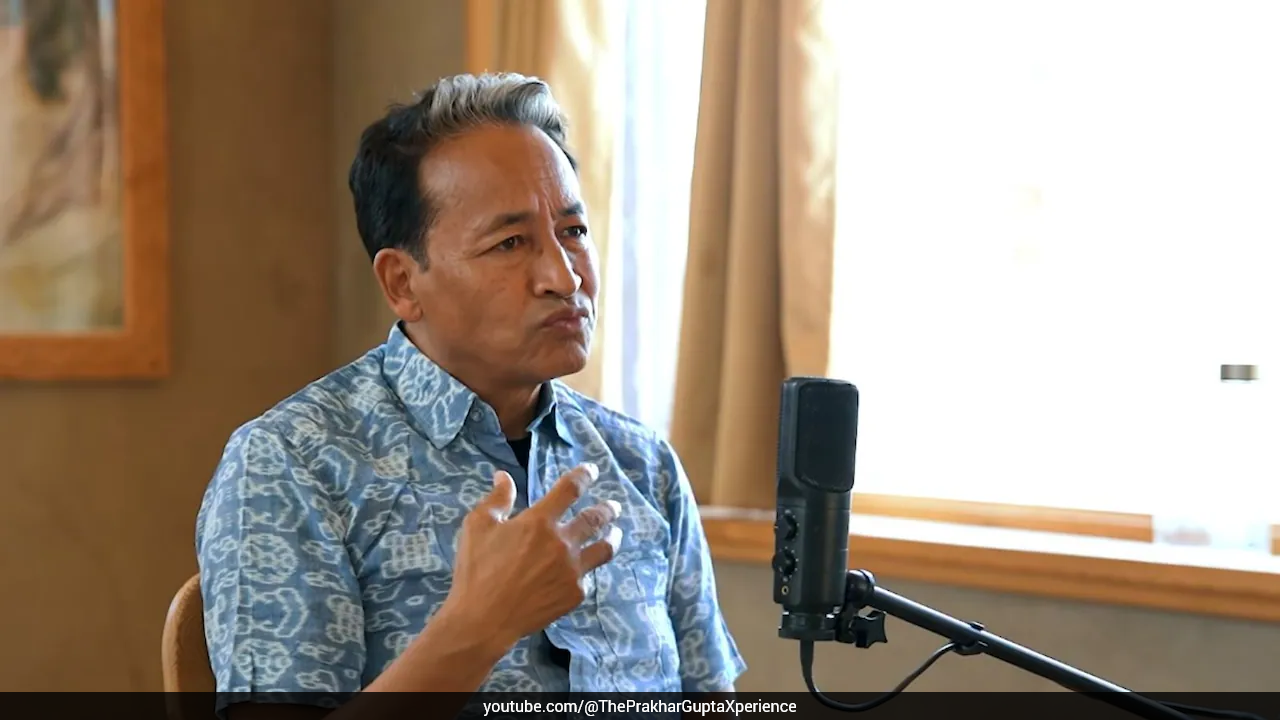
The satirical political group Cockroach Janta Party (CJP) wanted Sonam Wangchuk to make an appeal asking everyone to return home after the police action in central Delhi's Jantar Mantar on July 20, the activist from Ladakh said in a YouTube podcast.
Wangchuk, who was in hospital then amid his fast, said he agreed to the exit strategy SOS and wrote a message asking the protesters who had clashed with the police to return home. But the message was not sent by them eventually, the activist whose fast lasted 26 days told YouTube creator Prakhar Gupta.
"There were one or two people who asked me how to exit from this... They said 'we want to leave this place'," Wangchuk said, adding the mood at the protest site and among protesters who called for the resignation of the then Union education minister over the NEET paper leak "fluctuated" depending on the crowd size.
Wangchuk said that after the clashes with the police on July 20, the CJP's key members reached out to him.
"The stage was vandalised, people were gone, they said there is no hope now," Wangchuk said, adding the CJP organisers asked him to tell protesters to "get good rest now, we can see tomorrow what to do."
However, protesters returned the next day and that ensured continuity of the CJP-led agitation that ended with the resignation of Dharmendra Pradhan as Union education minister, Wangchuk said.
The CJP was created by Abhijeet Dipke, a Boston University graduate who returned to India to lead the protest over paper leaks. The protest at Jantar Mantar began on June 6 and gained wider attention after Wangchuk joined it. Dipke was associated with the Aam Aadmi Party (AAP) from 2020 to 2023 and volunteered with the party's social media team.
Wangchuk praised young students for not letting the agitation lose steam. "The youth did something remarkable. The protest leaders look at faces and their morale sometimes goes up and sometimes goes down. When they left, it had gone down. When the youth came back the next day, their morale went up," he said.
After it first appeared on social media, the CJP gained traction through sharp political satire and commentaries using memes. Much of its content centred on youth concerns such as unemployment, examination paper leaks and education, packaged through graphics, animation, manifestos and charter-style demands. The protests on the streets came later.
Wangchuk's hunger strike began on June 28, demanding reforms in the education system and accountability over paper leaks. He stayed put at Jantar Mantar alongside the CJP's protesters, until the police removed him and took him to hospital due to concerns over his health.
Track Latest News Live on NDTV.com and get news updates from India and around the world

