





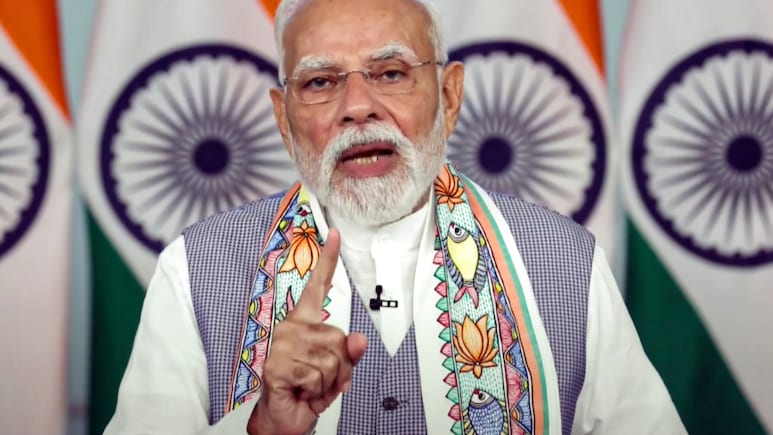
Prime Minister Narendra Modi on Friday denounced attempts to link India's past economic slowdown with the Hindu faith, calling the “Hindu rate of growth” label a deliberate distortion.
Speaking at the 23rd Hindustan Times Leadership Summit, PM Modi said the term was used to malign the Hindu way of life by associating it with decades-old economic stagnation.
He spoke of India's rising global standing, saying that even as the world faces fragmentation and uncertainty, the country is emerging as a bridge builder”. PM Modi said India today stands “in a different league”, driven by confidence and resilience. “When the world talks about slowdown, India writes stories of growth. When the world faces trust crisis, India becomes a pillar of trust,” he added.
What Does ‘Hindu Rate Of Growth' Mean?
The term “Hindu rate of growth” was coined by economist Raj Krishna in 1978 to describe India's slow economic growth after independence, mainly from the 1950s to the 1980s, when the country's GDP grew only about 3.5-4 per cent per year.
The phrase suggested that this slow growth came from the “Hindu way of life,” implying a cultural habit of accepting fate or being content with little.
Debate Around ‘Hindu Rate Of Growth'
Economists pointed out that the real reasons were government policies, heavy state control, and restrictive rules, not religion or culture. Many also call the term unfair because it links poor economic performance to a religion. After India liberalised its economy in the 1990s, growth picked up, making the term mostly outdated today.
In 2023, former RBI Governor Raghuram Rajan warned that India was “dangerously close to the Hindu rate of growth,” citing the country's third-quarter GDP figures. His remarks drew criticism from several economists. Soumya Kanti Ghosh, Chief Economist at the State Bank of India, described such claims as “ill-conceived, biased and premature at its best when weighing the recent GDP numbers against the available data on savings and investments,” according to The Hindu Businessline.
In a 2023 report, SBI's research wing further cautioned that linking recent slower growth to the old “Hindu rate” overlooks broader data on savings, investments, and long-term structural factors.
That same year, Sudhansu Trivedi, BJP MP and a PhD from Dr APJ Abdul Kalam Technical University, introduced the phrase “Hindutva rate of growth” while talking about India's economic achievements over the past decade. He said that India's GDP growth in 2023, at 6.3 per cent according to IMF data, was higher than that of the US, UK, European countries, and Japan, and credited this growth to PM Modi's governance and expenditure policies aimed at development and the poor.
Trivedi argued that the economic transformation aligns with the philosophy of Dharma, quoting a Sanskrit shloka, “Dhan wohi sukh ka karak hota hain jo dharma ke marg se vyay hota hai. Only that money brings happiness which is spent in accordance with Dharma.”
Trivedi distinguished this from the historical “Hindu rate of growth”.
Track Latest News Live on NDTV.com and get news updates from India and around the world

