





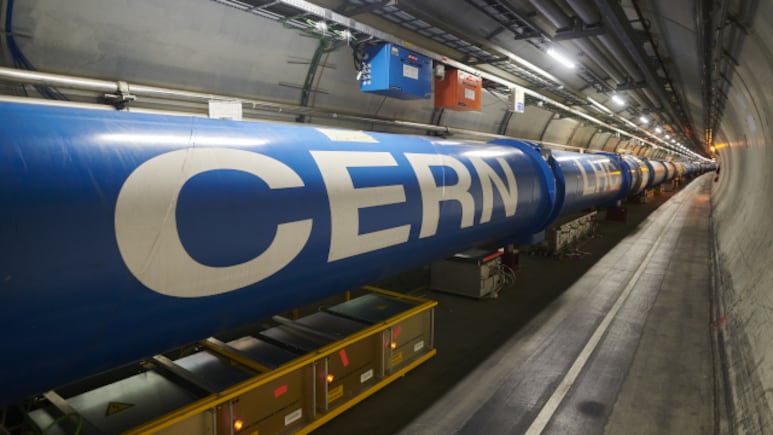
The discovery of the Higgs Boson, popularly known as the "God Particle", was one of the defining scientific breakthroughs of the 21st century. Announced by CERN in 2012, it confirmed a decades-old theory explaining how fundamental particles acquire mass and completed the Standard Model of particle physics.
But for CERN, the European particle physics laboratory in Geneva, the discovery was not an ending. It was a beginning.
The world's largest particle accelerator is now preparing for its next major scientific challenge: understanding dark matter, the invisible substance believed to account for a large share of the universe's mass but which has never been directly detected.
Speaking exclusively to NDTV, CERN Director General Dr Mark Thomson said the Higgs Boson itself remains an object of intense scientific interest.
"We've discovered this new type of particle, the Higgs Boson. It's a completely different type of matter, unlike anything we've ever seen before in nature. Its properties are completely bizarre, weird," he said.
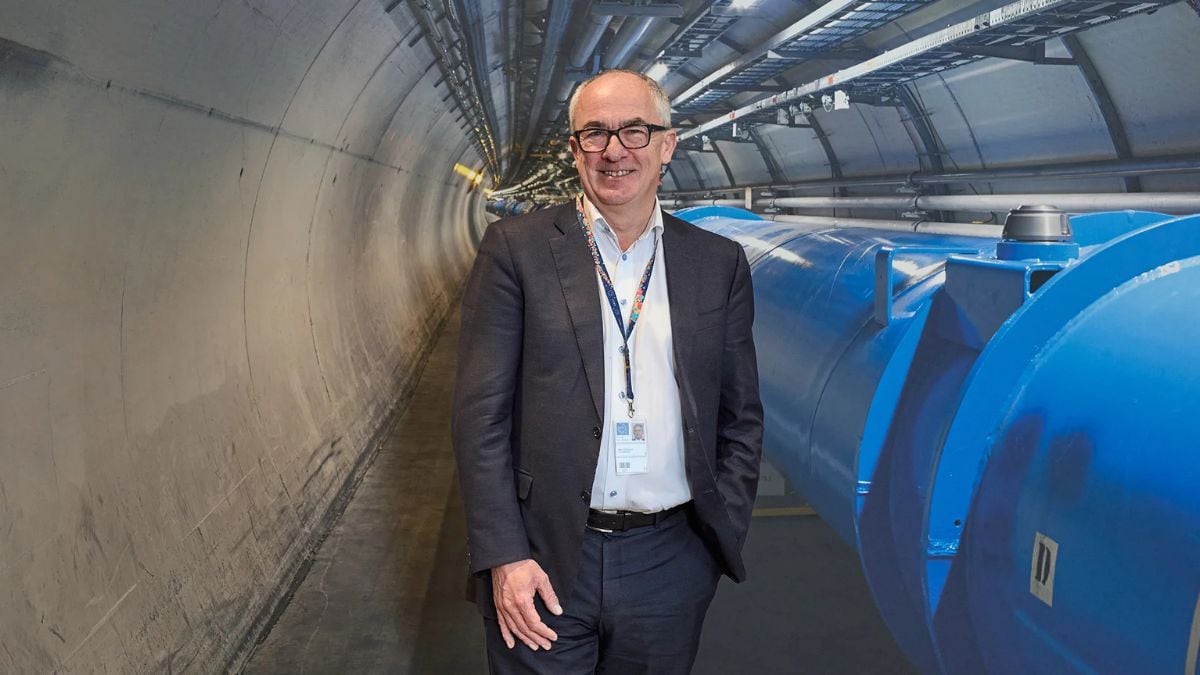
Dr Mark Thomson, DG, CERN
"We want to really understand this strange object we've discovered. What is it really? Really dig into it."
That effort will be aided by the next major upgrade to the Large Hadron Collider, or LHC.
Deep beneath the border between Switzerland and France, the LHC runs through a 27-kilometre circular tunnel almost 100 metres underground. It has become the world's most powerful particle accelerator and one of the most complex machines ever built.
The LHC is currently shut down for a major upgrade that will take several years. Around 1.2 kilometres of critical magnets are being replaced with newer technology, while the accelerator's detectors are also being upgraded.
The result will be the High-Luminosity Large Hadron Collider, designed to produce roughly ten times more data than the current machine.
"This will make it ten times brighter," Dr Thomson said, referring to the increase in luminosity, which will allow scientists to collect far more collision data.

Dr Mark Thomson, DG, CERN and Dr Archana Sharma, Scientist, CERN
The detectors are being equipped with advanced silicon technologies, while increasingly sophisticated computing and artificial intelligence systems will help scientists process the enormous quantities of data generated by the experiments.
Dr Thomson compared the transformation to replacing an early-generation smartphone with the latest model.
The objective is straightforward: collect more data, study the Higgs Boson in unprecedented detail and search for evidence of particles and phenomena that lie beyond the Standard Model.
One of the biggest targets is dark matter.
Everything visible to humanity, from stars and planets to galaxies and people, accounts for only about five per cent of the universe. Roughly 27 per cent is believed to be dark matter, while the remaining share is attributed to dark energy, which is associated with the accelerating expansion of the universe.
Dark matter does not emit or reflect light, making it invisible to conventional telescopes. Its presence is inferred from its gravitational effects on visible matter.
"We know it's there, but we don't know what it is," Dr Thomson said.
"There are many models for what dark matter could be. Certain types of dark matter we can potentially produce at the High-Luminosity LHC."
The LHC has already searched for possible signs of dark matter without finding direct evidence.
"We haven't seen it yet. That's why this huge step forward in capability is so important. This is not an incremental step. This is a giant leap," Dr Thomson said.
The upgraded collider will therefore give physicists a much larger dataset with which to test existing theories and look for unexpected signals.
When the LHC began operating, one of the biggest public controversies surrounding it was the fear that particle collisions could create black holes capable of swallowing the Earth.
Physicists repeatedly explained that even hypothetical microscopic black holes would be harmless and disappear almost immediately. They also pointed out that nature routinely produces particle collisions at energies higher than those generated by the LHC through cosmic rays striking Earth's atmosphere.
The scientific questions surrounding CERN have since moved on.
One of the laboratory's other major areas of research is antimatter.
Earlier this year, CERN researchers demonstrated that a small quantity of trapped antimatter could be transported across the laboratory campus, an important proof of principle for future experiments.
CERN produces antimatter by creating particle-antiparticle pairs in high-energy collisions. Antiprotons can then be isolated, slowed down and trapped using sophisticated electromagnetic fields.
The transported sample contained just 92 antiprotons.
"It is a proof of principle," Dr Thomson said.

The quantity was extraordinarily small and posed no danger. But the ability to move trapped antimatter could eventually allow scientists to conduct experiments in different locations with greater precision.
Experiments with antihydrogen could also help test whether antimatter behaves in exactly the same way as ordinary matter. Any subtle difference could have profound implications for understanding why the universe contains so much more matter than antimatter.
India is already deeply embedded in CERN's scientific ecosystem.
Indian scientists have been associated with CERN since the 1960s, decades before India became an Associate Member State. Today, around 300 Indian scientists collaborate with CERN and contribute to some of its major experiments.
During his recent visit to India, Dr Thomson saw detector technologies being developed by Indian scientists.
"The scientific contributions from India are really, really huge," he said. "We greatly value the scientific, technical and engineering expertise you have in India."
India's contribution is not limited to scientific research. Over the decades, CERN has also helped train generations of Indian scientists, engineers and technologists.
One of the most prominent links between India and CERN is Dr Archana Sharma, who has spent decades working on scientific collaborations between Indian institutions and CERN and mentoring young researchers. She is affectionately known by many as India's "Godmother at CERN."
Born in Jhansi, Sharma's career at CERN has also become an example of how international scientific institutions can create pathways for young researchers from India to work at the frontier of physics.
Dr Thomson believes India's greatest contribution in the years ahead could come from its young scientists.
"The most valuable contributions to CERN come from young, smart people," he said.
His invitation extended across generations.
"Gen Z, Gen Alpha, all of them, welcome."
There is also a striking Indian presence on the CERN campus that has little to do with particle detectors or accelerator technology.
A bronze statue of Nataraja, the dancing form of Lord Shiva, stands at CERN.
The statue was presented to CERN by India and depicts the cosmic dance of creation and destruction. For CERN, the image has become a metaphor for the constant transformation of matter and energy.
Dr Thomson described it as "a wonderful metaphor for the nature of the universe."
The symbolism is striking. Ancient Indian philosophical thought imagined the universe as a dynamic cycle of creation, transformation and dissolution. Modern particle physics, through an entirely different intellectual tradition, is attempting to understand the fundamental constituents and forces that govern that universe.
The Nataraja statue therefore serves as an unusual meeting point between India's ancient philosophical traditions and humanity's modern scientific pursuit of the nature of reality.
CERN is already looking beyond the upgraded LHC.
The organisation is developing plans for the Future Circular Collider, or FCC, a proposed 91-kilometre underground ring that would be more than three times the circumference of the existing LHC.
The first stage would collide electrons and positrons rather than protons, producing a cleaner environment for extremely precise measurements of the Higgs Boson and other fundamental particles.
The longer-term ambition is to push the search for physics beyond the Standard Model even further.
"It is a visionary, unique scientific project for humanity to push the boundaries of knowledge for the next fifty plus years," Dr Thomson said.
The FCC remains a future project, but its scale illustrates the direction in which CERN's scientific ambitions are moving.
The Higgs Boson answered one fundamental question about the universe. It did not answer all of them.
Dark matter remains unidentified. The nature of dark energy remains poorly understood. The apparent imbalance between matter and antimatter remains one of the great puzzles of modern physics.
The upgraded LHC will give scientists more data with which to attack these questions. Antimatter experiments will test some of the deepest assumptions about the laws of nature. And if the Future Circular Collider becomes reality, CERN could have a machine capable of shaping particle physics for decades.
For now, the question is deceptively simple: what is dark matter?
Nobody knows.
But beneath the fields and vineyards along the Swiss-French border, scientists are preparing to look harder than ever.
And India, through its scientists, engineers and young researchers, will be part of that search.
Track Latest News Live on NDTV.com and get news updates from India and around the world

