





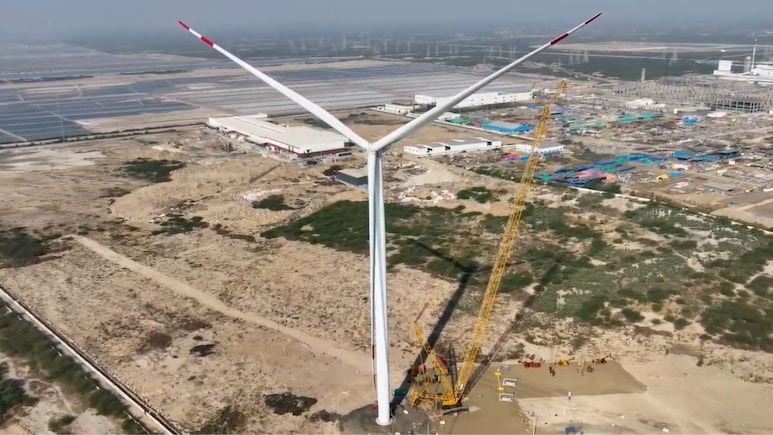
India will make its longest onshore wind turbine blades at 91.2 metres as Adani New Industries Ltd (ANIL) scales up production at its Mundra facility in Gujarat, reflecting a maturing wind manufacturing ecosystem backed by policy support and a push for clean energy self-reliance.
The blades will be deployed on next-generation turbines designed to improve energy output, particularly at low- and medium-wind sites. The Mundra plant currently manufactures blades of 78.6 metres and 80.5 metres.
The new 91.2 metres marks a significant leap in design complexity, materials engineering and manufacturing capability. According to industry sources, an initial set of 91.2 metre blades have already been erected on a new turbine model, with serial production expected to begin within the current calendar year.
Why Blade Size Matters
Blade length combined with higher rated capacity is a critical determinant of wind energy output. A 91.2-metre blade enables a rotor diameter of approximately 185 metres, sweeping an area of nearly 26,600 square metres. A larger swept area, with higher rated capacity wind turbines potentially allows it to capture more kinetic energy from wind, improving capacity utilisation and increased power output.
This is particularly relevant for India, where a large share of potential wind sites fall in low-to medium-wind regimes. Larger rotors and higher hub heights make these locations commercially viable, expanding wind deployment beyond traditional high-wind corridors. The shift towards turbines rated above 5 megawatts (MW) is therefore as much about geography as it is about technology.
To put the scale in perspective, a blade of this length is comparable to the size of a football field and taller than a 30-storey building. Each rotation sweeps an area larger than three football fields combined.
Manufacturing Scale And Investment
ANIL's blade manufacturing facility at Mundra has a current capacity of 2.25 gigawatts (GW) per annum, equivalent to about 450 blade sets annually. The company plans to scale this to 5 GW in phases, with a longer-term ambition of reaching 10 GW.
Mundra is evolving into a multi-technology renewable manufacturing hub, housing wind turbines, solar modules and supporting component facilities within a single ecosystem. Investments in wind manufacturing so far are estimated up to Rs 3,000 crore, with future capital expenditure focused on automation, advanced tooling and materials research, including recyclable blade materials and larger rotor designs.
India's Wind Manufacturing Momentum
India ranks fourth globally in cumulative installed wind capacity, with around 55 GW operational. It is also the world's third-largest wind manufacturing base, with domestic manufacturing capacity of approximately 20 GW, sufficient to meet about 10 per cent of global demand.
Localisation levels across the wind value chain are estimated at 70 to 80 per cent, covering towers, nacelles, blades and key components. Blade manufacturing alone accounts for nearly 16 GW of capacity, giving India close to 10 per cent of global blade manufacturing share.
Installation momentum has picked up sharply. India added 6.3 GW of wind capacity in 2025, the highest annual addition to date, representing an 85.2 per cent year-on-year increase, according to energy research and analytics firm Mercom Capital Group.
Policy Tailwinds And Supply Chains
Policy support has played a key role in strengthening domestic wind manufacturing. Earlier this year, the government approved a Rs 7,280 crore programme to build an integrated domestic ecosystem for rare earth permanent magnets, a critical input for wind turbines, electric vehicles and other clean technologies.
The initiative targets 6,000 tonnes per annum of manufacturing capacity, aimed at reducing import dependence.
The Road Ahead
In the current financial year, ANIL expects to deliver up to 1.25 GW of wind turbines to external-party customers, in addition to a similar volume for Adani Green Energy Limited (AGEL) projects, fully utilising its existing manufacturing capacity.
As India accelerates its renewable energy transition and positions itself as a global clean-energy manufacturing hub, the move to domestically produced ultra-long wind turbine blades, components, higher rated capacity wind turbines marks a critical inflection point. It reflects not just larger machines, but deeper integration across design, materials, policy and scale that is reshaping the country's wind power landscape.
(Disclaimer: New Delhi Television is a subsidiary of AMG Media Networks Limited, an Adani Group Company.)
Track Latest News Live on NDTV.com and get news updates from India and around the world

