





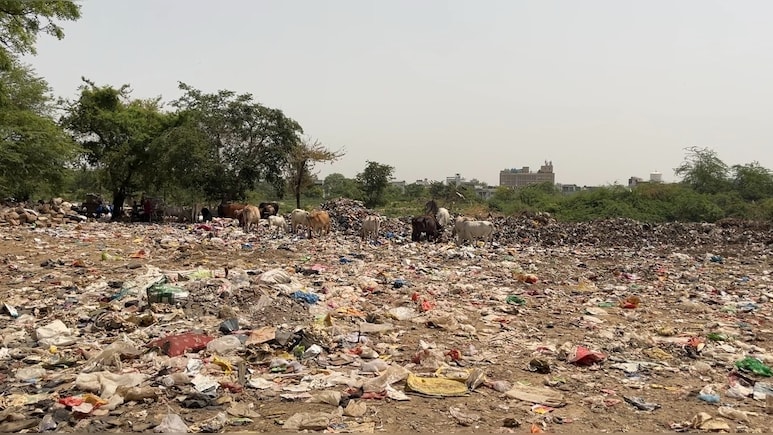
What was once a green cover in the Charmwood Village in Faridabad's Sector 39 has now turned into a looming environmental and public health crisis. For the past couple of years, residents of surrounding residential buildings have quickly watched a piece of land turn into a huge landfill. They say that this is not the view they negotiated for, but have to live with every day.
Residents say that the land where the dump is being created is owned by the Municipal Corporation of Faridabad (MCF) and was originally designated as a municipal buffer zone opposite the Surajkund Mela ground and transformed into an open dumping site. NDTV visited the site in Charmwood village which is right adjacent to dozens of residential houses.
From construction debris to household waste, plastic trash and human waste now cover the area. A piece of land that residents thought would turn into a public park now threatens their survival as many of them gasp for air, battle illness, foul odour, and contaminated water.
The biggest fear that clouds the minds of the citizens is whether this would mark the inauguration of Faridabad's version of a Ghazipur landfill.
"This Is A Time Bomb, Not Just Garbage Dump"
The constant stench of the dump makes it hard for the citizens to forget that they have a garbage dump near them. Dr Mahendra Kumar Gupta, president of RWA Woodbury Tower and convener of Charmwood Village RWAs, reflects on the battle the residents have been fighting.
"We have been facing this since 2023, but it has gotten too much now. Round the clock, we are facing lung problems, inhaling the toxic air, bad smell. About 20,000 people in the area are facing the problem."
79-year-old Dr Gupta argues that people around his age are significantly impacted. "Most of the people in this area are senior citizens. They have stopped walking because of impure air. Breathing in such poor air weakens the metabolism of the body."
Resident Pankaj Mathur terms the issue as an administrative failure: "This garbage dump is just the beginning. It is a time bomb, not just a garbage dump. We didn't ask for this life. It's coming to us as a gift from the administration. And the administration has to wake up. We paid so much to live here, but this is not the price we wanted to pay for living here."
The proximity to homes means basic daily comforts have disappeared. Bhairav Hazarika and Ranjna Bakaya Hazarika, a couple, stand on the balcony of their house which overlooks the landfill. Ranjna describes how the stench dominates their everyday life.
"It is difficult for us to open the balcony and sit over here. During Surajkund Mela, which takes place in February, they clear it entirely, once the Mela is over, the dumping happens again."
Bhairav Hazarika highlights the hypocrisy of dumping waste in an eco-sensitive belt, pointing out that the community's most vulnerable are paying the highest price. "In Surajkund and the Aravalli, which are eco-sensitive zones, dumping garbage is definitely not the order of the day. And the proximity to the residential area is such that it violates guidelines."
The health consequences are already manifesting in surrounding households. Local resident Salil Malhotra notes that the contamination is taking a direct toll on community wellbeing. "We are getting contaminated water. This is a major health hazard for all the citizens staying out here. We have seen umpteen number of cases of water contamination problems and gastric problems, and people being hospitalized recently."
The residents also reflect on the sense of psychological distress the dump creates. They argue that waking up at the sight of a dump is not what they paid for or suits their mind well. Yet, they are forced to live with this reality.
The Ecological Toll: How Unchecked Dumps Pollute
The civic crisis unfolding in Faridabad is a part of a broader systemic environmental hazard typical of unmanaged landfills. There are many ways in which such a crisis contributes to the environment:
Groundwater Contamination
One of the key patways is groundwater contamination. Rainwater percolates through toxic waste, generating leachate - a toxic liquid containing pathogens and dissolved pollutants. This toxic runoff then seeps into underground aquifers, contaiminating drinking water sources and posing serious risjs of gastrointestinal and other health problesm.
Severe Air and Atmospheric Pollution
Decomposing waste releases toxic and foul-smelling gases, like methane and hydrogen sulphide. Beyond causing persistent nausea and headaches, methane is highly combustible and acts as a potent greenhouse gas.
Soil Degradation
Toxins and non-biodegradable microplastics seep into topsoil, destroying beneficial soil microbes and killing local vegetation which earlier served as a natural pollution shield.
The Shadow of Ghazipur: A Regional Warning
The situation in Faridabad becomes even more frightening when viewed in context of the wider situation in the National Capital Region (NCR). Situated just 25 to 30 kilometres south of East Delhi's Ghazipur landfill, the site in Surajkund appears to be following an eerily similar trajectory.
Ghazipur too did not become a massive heap, a toxic mountain overnight, it started as an unmanaged neighbourhood dumping spot. Without immediate action, cleaning up of accumulated waste and strict enforcement from the Municipal Corporation of Faridabad, this eco-sensitive pocket in the Aravalli risks repeating the same tragic cycle.
Track Latest News Live on NDTV.com and get news updates from India and around the world

