





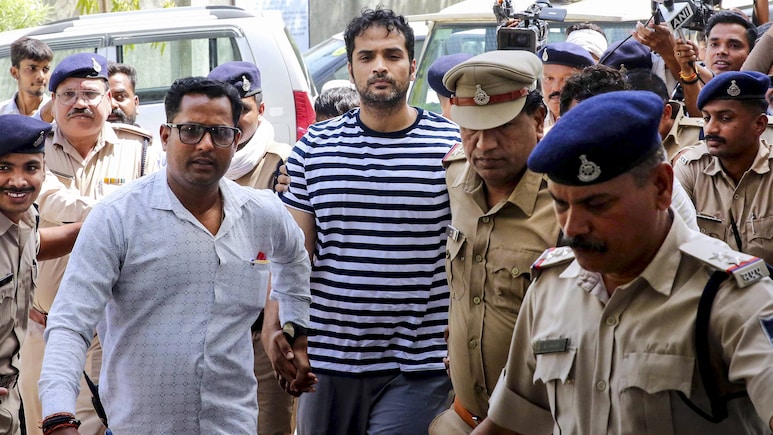
The mystery surrounding actress-model Twisha Sharma's death took a dramatic turn on Monday when the CBI arrived at her Bhopal residence with accused husband Samarth Singh and mother-in-law, former judge Giribala Singh, to recreate the events of the night she died.
What followed inside the barricaded Katara Hills residence looked less like a routine investigation and more like a forensic reconstruction of a case that has raised disturbing questions about death, evidence, alleged harassment, and a possible cover-up.
-

-
 Best Of NDTV World Summit 2026 | Defining Conversations, Big Ideas
 -
 PM Modi Says 'Parasite' Congress Hurts 'Honest' Dissent Movements
 -
 "Some Dreaming Of Disorder": PM Modi's Dig At Rahul Gandhi
 -
 PM Modi Highlights India's Firsts: Fast Breeder Reactor, Hydrogen Train, Asian Games Medals
 -
 "UN's Limits Clearly Visible": PM Modi Presses For 'New Solutions' At NDTV Summit
 -
 "World That Relied On India's Brainpower Now Trusts Its Mindpower": PM Modi
 -
 Non-Oil Trade With India Went Up 50% In 3 Years: UAE Minister At NDTV Summit
 -
 "Some Dreaming Of Disorder": PM's "Failed Product Of Congress" Jibe At Rahul Gandhi
 -
 'Viksit Bharat Not Just For Us': PM Modi's Top Quotes At NDTV World Summit
 -
 Has Indian Cuisine Arrived At The Global Stage? What Vir Sanghvi Believes
At the centre of the exercise was an 80-kilogram dummy.
Filled with sand and weighted down with iron dumbbells tied to its feet to match Twisha's body weight, the dummy was suspended from a noose and then lowered repeatedly as investigators attempted to test the version of events narrated by the accused.
For nearly two hours, the CBI recreated the crucial moments surrounding Twisha's death. According to sources, investigators wanted to determine whether the statements made by Samarth Singh and Giribala Singh were physically possible and whether they matched the crime scene, forensic evidence and witness accounts.
At one point during the reconstruction exercise, sources said there was a heated exchange between CBI officials and the accused, forcing investigators to repeatedly question inconsistencies in the sequence being demonstrated.
The CBI is trying to answer a fundamental question: What exactly happened inside the house during the final moments before Twisha Sharma was found dead.
Samarth Singh has claimed that he had brought Twisha down, while his mother Giribala Singh untied the knot around her neck.
Investigators used the dummy to verify whether the actions described by the mother and son were physically feasible. Giribala was reportedly asked to demonstrate how she loosened the ligature knot, while Samarth was required to show how he allegedly lowered Twisha's body.
The agency is now comparing the reconstruction with forensic findings, scene measurements and digital evidence collected during the probe.
Since Twisha's death on May 12, the case has remained suspended between two competing theories. Samarth Singh has consistently maintained that Twisha died by suicide.
Investigators say he has been unable to provide a clear explanation on what triggered the alleged act.
Sources said Samarth has claimed that Twisha was depressed following an abortion and that this emotional distress led to the tragedy.
The CBI is now testing that claim against medical records, witness statements and digital evidence.
The agency has also summoned the doctor who allegedly advised Twisha to undergo medical termination of pregnancy.
Investigators want to establish the exact circumstances surrounding the abortion, what advice was given, and whether the claims being made by different parties are supported by medical evidence.
Investigators are reconstructing every minute of the night Twisha died. Who first saw her; who touched the body; who removed her from the alleged hanging position; who was present inside the house; what happened between the discovery of the body and her arrival at the hospital. Every answer is now being cross-checked against CCTV footage, mobile phone records, electronic data and forensic evidence.
The agency is also examining allegations that Twisha may have been assaulted before her death and whether any evidence was altered afterward.
The investigation has also uncovered fresh details about Samarth Singh's movements after an FIR was registered on May 15. Contrary to earlier assumptions, investigators have learned that he did not immediately leave Bhopal. Sources say he remained in the city for nearly three days after the FIR before travelling to Jabalpur, where he allegedly spent approximately five days in hiding.
Investigators are analysing his mobile phone data, call records, banking transactions, location history and digital chats to identify where he stayed and who may have helped him evade arrest.
Perhaps the most startling revelation concerns the ligature belt allegedly used in the incident. Sources indicate that the belt was not immediately deposited as evidence.
Instead, it allegedly remained in the possession of a police Sub-Inspector who reportedly carried it around in his vehicle for nearly two days. The officer, who was on duty on the night of May 12, allegedly failed to submit the belt at AIIMS during the postmortem investigation.
It was only after questions began to be raised about the missing ligature that the belt was reportedly rushed to a forensic laboratory. Sources indicate disciplinary action may now be initiated against the officer concerned.
Track Latest News Live on NDTV.com and get news updates from India and around the world

