





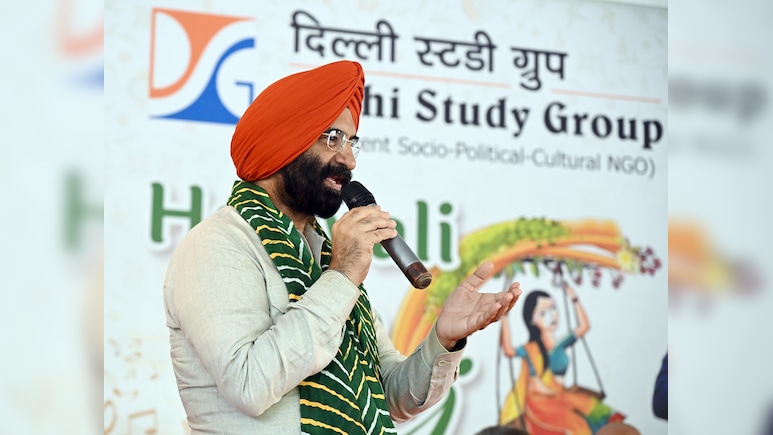
Delhi Environment Minister Manjinder Singh Sirsa on Monday said 60 per cent of river Yamuna has been cleaned, so much so that its water is now potable, and the entire river will be cleaned up by 2029 or 2030.
Speaking at the launch of Uber's "One Less Car" report here, the minister said the issue of vehicular pollution is a shared responsibility and even electric vehicles produce pollution, as their tyres lead to dust when moving.
Deliveries from cloud kitchens also add to pollution because of the number of workers and vehicles involved, he added.
Sirsa credited Delhi Chief Minister Rekha Gupta and the Union government's support over the last two years for the cleaning of river Yamuna. He said work began at one end of the river and will move to the other, which is why 60 per cent is done and not the whole stretch.
"60 per cent of Yamuna ji is totally clean...Clean means so clean that you can (even) drink that water," he said, urging people to visit the river and see for themselves.
Sirsa said the city's sewage goes through drains into the Yamuna, and a clean river is impossible unless that sewage is treated. He said the government is using sewage treatment plants (STPs) to deal with the issue.
Earlier this month, the Supreme Court of India said pollution in Yamuna has only increased despite huge sums being spent on cleaning the river, directing the Central Pollution Control Board (CPCB) to monitor water quality at the points where the Yamuna and its major drains enter and exit states, union territories and districts.
In an order dated November 4, a bench of Justices Manoj Misra and Manmohan observed that industrial pollutants and untreated sewage must be stopped at the source, and merely constructing more sewage treatment plants is not sufficient to clean the river.
"This court is of the opinion that everything that is wrong with the civic administration in towns, cities and villages situated along the banks of the river is reflected in the poor health of the river and in the 520 drains that discharge waste water into the Yamuna.
"This is why, despite huge sums being spent on cleaning the river, pollution in the Yamuna has only increased," the bench said while hearing a plea related to cleaning of the river.
On the city's garbage, Sirsa said 60 per cent of the legacy waste of the last 25 years has been cleared in less than two years, with support from the Union government. "Coming generations will see garbage mountains only in pictures, not in real life," he said.
Turning to air pollution, the minister said it is not one person's responsibility and called for public participation, saying the government alone cannot ensure clean air.
"Nothing is more important than health. Nothing is more important than clean air," he said.
Sirsa said the city has seen improvement this year and that more days in October and the first half of November were clean than in earlier years. Citing a New York Times article, he said the area around Delhi University recorded an air quality index of 900 in 2012.
No vehicle below the Bharat Stage-VI emission standard, including heavy vehicles and buses, is now allowed to enter Delhi from neighbouring areas of the National Capital Region, Sirsa said.
(Except for the headline, this story has not been edited by NDTV staff and is published from a syndicated feed.)
Track Latest News Live on NDTV.com and get news updates from India and around the world

