





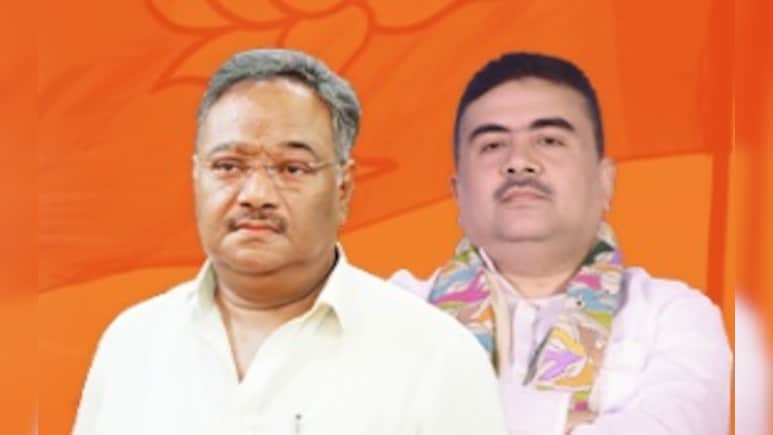
- Two BJP leaders, Suvendu Adhikari and Samik Bhattacharya, lead Bengal's 2026 campaign
- Adhikari focuses on rural Hindutva politics; Bhattacharya emphasises urban development
- BJP uses dual strategy: Hindutva appeal and governance to attract diverse voters
Two leaders, two approaches, a common goal: The BJP campaign for the 2026 West Bengal Assembly polls is led by two leaders strikingly different from each other. One is Suvendu Adhikari, the Leader of the Opposition in the Assembly, and the other is Samik Bhattacharya, the president of the BJP's Bengal unit.
2 Leaders, 2 Approaches
The political journeys of both these leaders have been very different. Sixty-year-old Bhattacharya apprenticed in the shakhas of the RSS at a time when the BJP was hardly a political force in Bengal. Adhikari, on the other hand, was with the Trinamool Congress and was seen as a trusted lieutenant of Chief Minister Mamata Banerjee before he joined the BJP in 2020.
The backgrounds of these two leaders are also distinctly different. Bhattacharya is essentially an urban leader. He comes from the Howrah region adjoining Kolkata and has been closely associated with the City of Joy's political culture for the past two decades. His political approach reflects a modern, urban perspective that resonates with Kolkata's elite 'bhadralok' circles.
Adhikari is from a different milieu. He was born and grew up in Purba Medinipur, a coastal district in Bengal. He is deeply connected to the rural political environment. His vocabulary, accent, and style of politics carry a distinctly rural, or 'mofussil', touch. While Bhattacharya is at ease in the city's intellectual circles, Adhikari positions himself as a mass leader in the hinterland.
BJP's Trusted Dual Strategy
The BJP has often adopted a dual leadership strategy to appeal to different sections of the population. For instance, Atal Bihari Vajpayee was seen as a mass leader who could connect deeply with the Hindi heartland. And Lal Krishna Advani, who studied at Karachi's St Patrick's School and spoke fluent English, connected seamlessly with elite, urban India.
Narendra Modi started with grassroots politics before crafting a political persona that appealed to people across social and geographical lines. In comparison, the late finance minister Arun Jaitley was closely associated with Delhi's urban circles and represented a different face of the BJP.
So, some leaders focus on core agendas such as Hindutva to rally the masses, and others connect with the intelligentsia to score in the battle of perception.
The BJP appears to be following this dual strategy in Bengal.
Adhikari is an aggressive campaigner, and his focus is Hindutva. Recently, he remarked that he does not believe in "so-called secular statism". He has expressed support for the idea of a Hindu Rashtra and frequently claims Hindus are facing atrocities in Bengal. Adhikari has repeatedly accused the Trinamool government of appeasement politics and of failing to protect the interests of Hindus.
Critics, however, accuse him of fomenting communal divisions in society. Adhikari defends his position by arguing that he is just speaking out to protect the rights and security of Hindus.
Sources in the BJP believe this emphasis on Hindutva translates into political dividends as the party commands a silent but substantial Hindu support base.
Samik Bhattacharya, on the other hand, is following a different approach. His focus is primarily on governance and development. He is raising the slogan of 'Paribartan' (change) in Bengal. Bhattacharya often argues that Kolkata was once the center of the nineteenth-century Bengal Renaissance, a city known for intellectual brilliance, industrial growth, and cultural dynamism. He believes that its glorious legacy has faded over time and blames the Left Front government and the Mamata Banerjee regime for Bengal's economic and industrial decline.
Through his speeches, Bhattacharya tries to promote the idea that if the BJP comes to power, it will rebuild Bengal's lost economic strength. He centers his vision on industrial revival, economic growth, and large-scale development.
The Bengali Identity Pitch
Trinamool Congress has built much of its political capital around the idea of Bengali identity. In previous elections, the party successfully mobilised voters by presenting itself as the protector of Bengal's culture, language, and regional pride.
Trinamool continues to use this narrative to counter the BJP's Hindutva pitch. Bhattacharya is attempting to engage with the same discourse of Bengali identity. Countering the Trinamool's charge that the BJP will ban fish and meat if it comes to power, Bhattacharya has said he is a fish-loving Bengali who cannot imagine life without fish.
Bhattacharya has a strategy to disarm the Trinamool's "outsider" pitch. He emphasises the need to protect Bengal's cultural identity, which he claims is under threat. He insists that Bengali identity is fully compatible with Indian national identity and that the two should not be considered contradictory.
Bhattacharya frequently raises concerns about demographic change and alleged infiltration, accusing the Trinamool government of allowing this. In several speeches, he has warned that Bengal must not be allowed to turn into what he calls "West Bangladesh". According to him, the battle in Bengal is essentially a fight to protect the state's identity, culture, and future.
Through these arguments, the BJP is attempting to blend Hindutva politics with the narrative of Bengali identity. In essence, what we are witnessing is a joint venture between Adhikari and Bhattacharya. Adhikari's messaging emphasises the idea that Hindus must unite first, and his key slogan is Jai Shri Ram.
Bhattacharya, after becoming state party president, introduced a somewhat different set of slogans - Jai Maa Durga and Jai Maa Kali. These invocations resonate better with Bengalis' religious beliefs.
In fact, Prime Minister Narendra Modi has also started using the Jai Maa Durga slogan in Bengal rallies. In one recent address, he referred to the Goddess as Mahishasura Mardini and said her blessings remain with the people.
Track Latest News Live on NDTV.com and get news updates from India and around the world

