





- The survivor in the Tarun Tejpal rape case shared her 13-year ordeal and recovery journey
- Bombay High Court overturned Tejpal's acquittal and convicted him for raping a colleague in 2013
- The survivor described intense cross-examination and public scrutiny throughout the trial
Writing on the eve of a near-total solar eclipse, the survivor in the Tarun Tejpal rape case, which dragged on for 13 years, recounts how "I lost enormously and I have built an enormous life".
"For thirteen years, power has demanded I remember, explain, defend and withstand its categorization and reduction of my entire being. I was turned simultaneously, into a public person and an anonymous one, thrown into the spotlight and erased," she said in a long substack post on Wednesday.
The survivor, whose identity has been protected by law, was raped at 27 and says and it was then that she discovered what women have always known: "politics lives in the body".
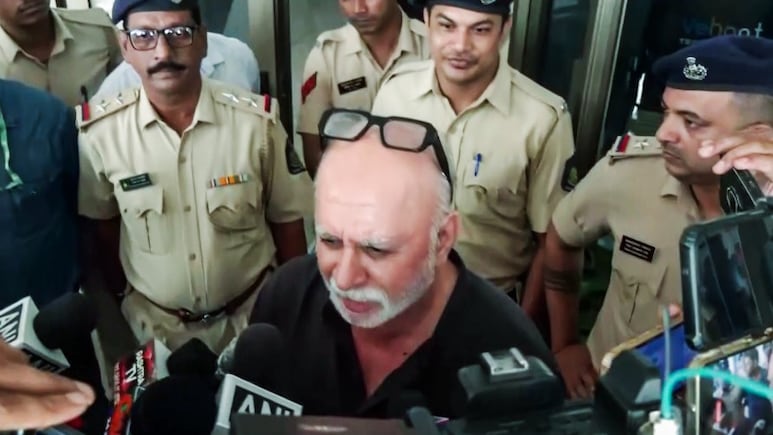
Last week, the Bombay High Court's Goa bench convicted Tejpal, the celebrated former editor of the now defunct Tehelka magazine, for raping a colleague in 2013, setting aside his acquittal by a Goa sessions court five years ago.
Tejpal, now 62, had assaulted her twice in the hotel elevator on the sidelines of ThinkFest, an annual event sponsored by the magazine, on November 7 and 8 in 2013.
"The trial that followed lasted 13 years and continues to upend my life from time to time. During my cross-questioning, a saga that filled up over 1000 pages, I was shown photographs and text messages from my 20-something self's phone, asked to justify why she was the way she was, why she wore what she did, why she said and wrote the things she did, why she didn't cry when she was raped, why she froze, why she continued to work and then why she vanished from work, what her politics were, what her motivation was in accusing this supposed 'liberal' 'hero' of rape'," she writes without mentioning the name of her rapist.
The Bombay High Court termed the trial court's verdict of acquittal as "perverse", and slammed it for falling prey to the notion that a complainant in such cases should be a "perfect victim" and behave in a certain way.
"A legal process publicly imposed a version of events in which my behaviour and credibility were scrutinised through stereotypes. I've survived two judgments: a single judge in a lower court that parroted the narrative of the perpetrator, and now a judgment from a two-judge bench from higher court that held the previous judgement as "perverse" - yes, that's an actual word used in jurisprudence," she said.
The survivor, who never mentions Tejpal by name in her piece, says "each judgment brought with it memories of the witness box, the 1000 page cross-examination, the humiliation, his many powerful and influential defenders and enablers who looked the other way".
She references a former boss of Tarun Tejpal, the late Vinod Mehta, whose memoirs spoke of "him (Tejpal) extracting non-consensual carnal favours" from his juniors and interns and how amid all this she powered through "unthinkable trauma".
No matter which side of the divide you are, she says, it does not erase the years "I spent frightened, publicly scrutinised, waiting, recovering, healing, and rebuilding".
"Things I'd studied and reported on - class, gender, sexuality, kinship - all of these political ideologies were in the room with me the night I was raped, but I didn't know that at the time. I knew only the truth of my body, frozen with fear, sexually assaulted by a man nearly twice my age, a man responsible for my livelihood, a man who my father knew and trusted, whose family I was close to. I was still trying to make sure he wouldn't get angry with me. I didn't know yet that I was allowed to feel angry too," she said.
Tejpal has said he would approach the Supreme Court against the Bombay High Court's judgment, asserting that the order was "wrong".
He initially expressed remorse about the incident, saying it had resulted from "an awful misreading of the situation." But after the charges were filed, he said he was the victim of a "political vendetta."
The survivor says that her father's anger turned her into an obedient and terrified woman and taught her to read the room, to keep smiling even when she wanted to cry, adding it all worked until, it didn't.
"I learned to soothe angry men, whatever the cost. I split myself. I mistook these partitions for my personality. In my public life, I became a journalist like my father, but poured anger into my work and my politics: into writing about the government, the systems that failed women, minorities, the climate, the culture that told us to stay small. In my personal relationships, I stayed small. Pleasing, light and non-threatening, still soothing men, still smiling when I wanted to cry and scream, still putting my feelings last, turning them inwards, to be dealt with, examined and cried away when I was alone," she said.
"I think of how nothing outside of me can soothe my anger, placate my rage. I think of how rage by itself is corrosive and will consume me like it consumed my father," she said.
Soon after the court covicted Tejpal to 10 years' rigorous imprisonment for rape, the suvivor's mother said it took a "lot of strength" to keep going all these years.
"The final verdict has lifted a heavy weight from my heart. It was painful long years and took a lot of strength to keep going," the survivor's mother said.
Track Latest News Live on NDTV.com and get news updates from India and around the world

