

)
Conversations about menopause in India rarely get past hot flushes, irregular cycles and disturbed sleep. Muscle almost never comes up. Yet the tissue that determines how a woman walks, lifts and recovers from a fall over the next three decades changes faster during this window than at almost any other point in adult life. By the time the change is visible, much of it has already happened.
What The Newest Research Shows
Muscle loss with age was long treated as a slow, uniform slide that affected men and women alike. Two papers published in the Journal of Physiology by researchers at Deakin University's Institute for Physical Activity and Nutrition complicate that picture. The team mapped muscle mass, function and gene expression in 100 women aged 18 to 80 against circulating sex hormones. In younger women, and in men of all ages, the decline was gradual. In middle-aged women several indicators dropped sharply, and the drop coincided with the onset of menopause. A companion paper traced the acceleration to the fourth decade of life.
The loss is now reasonably well quantified. Lean mass runs about 2.5 per cent lower in perimenopausal women and 5.7 per cent lower after menopause, measured against premenopausal comparison groups, according to a 2026 review in the Journal of Cachexia, Sarcopenia and Muscle. Oestrogen works on muscle in two ways, directly through receptors on the tissue and indirectly through growth hormone and IGF-1, so its withdrawal speeds up the breakdown of muscle protein. That same review cautions that a causal link between menopause and sarcopenia has not yet been established.
Strength Falls Faster Than Size
Women who track their weight through this period often conclude that nothing much is happening, which says more about the weighing scale than about them. Knee extension force in the Finnish ERMA cohort averaged 5 per cent lower among postmenopausal women than premenopausal ones, and grip force 8 per cent lower. Strength, that work noted, can fall up to three times faster than mass. Two measures track it better and neither takes a minute in a clinic: grip strength, and whether a woman can rise from a chair without pushing off with her arms.
Why The Indian Timeline Is Tighter
Indian women cannot simply borrow Western advice here. The Indian Menopause Society's pan-India survey put the average age of menopause at 46.2 years, roughly five years ahead of the 51 typical of Western populations, which drags everything downstream forward with it. Bone screening in Pune shows the cost. Among apparently healthy premenopausal women, 3.5 per cent had osteoporosis. Within five years of menopause the figure reached 18.4 per cent. Beyond five years, 37.3 per cent. Muscle tracks the same curve. Sarcopenia turned up in 10 per cent of 745 adults screened near Pune, at a mean age of 53, which is a rate normally seen in far older Western populations. South Asian adults also start from behind, carrying less muscle and more fat than Western counterparts at any given BMI.
What Resistance Training Changes
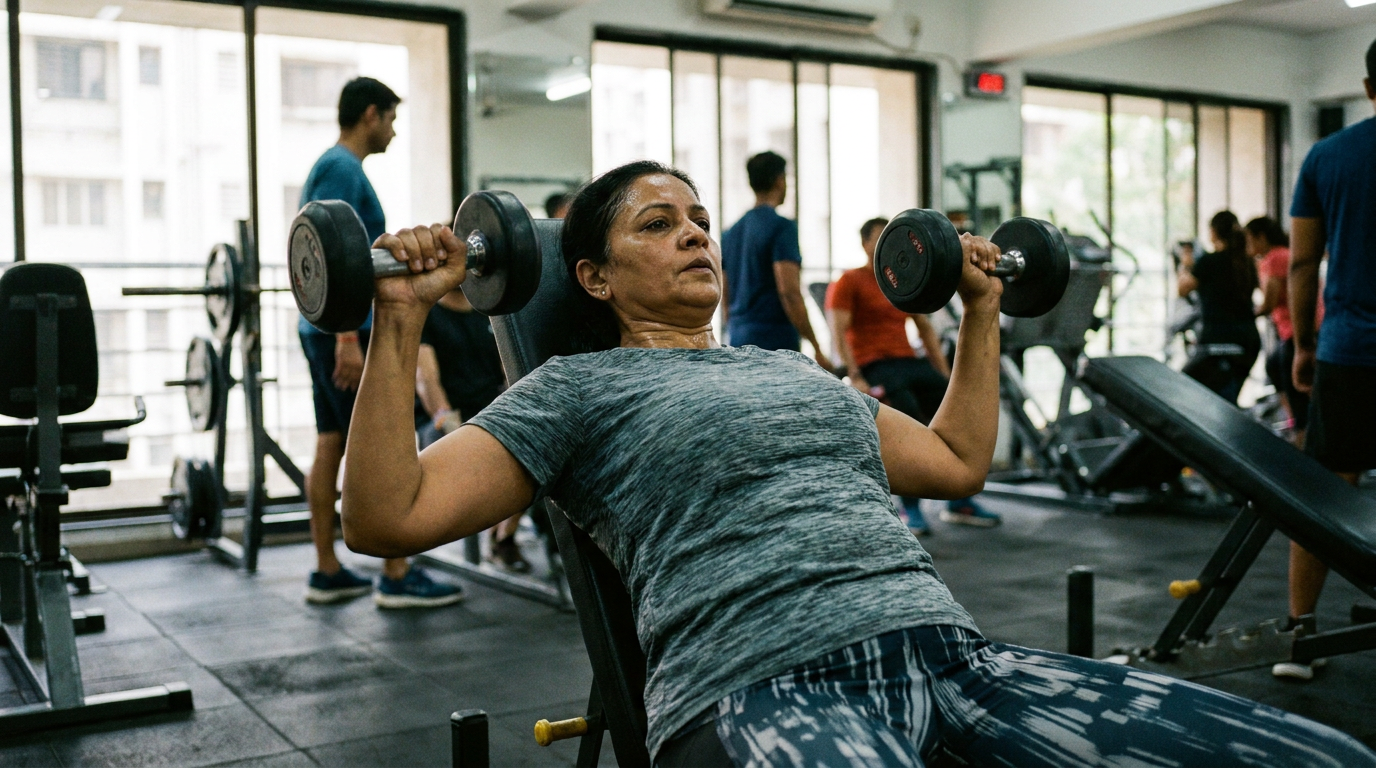
This has been tested directly. The LIFTMOR trial, in the Journal of Bone and Mineral Research, put 101 postmenopausal women with low bone mass, mean age 65, through eight months of supervised high-intensity resistance and impact training, twice a week for 30 minutes, against a low-intensity home programme. Lumbar spine bone mineral density rose 2.9 per cent in the training group; the comparison group lost 1.2 per cent. Femoral neck density gained 0.3 per cent against a 1.9 per cent loss. Across the whole trial there was one adverse event, a minor back spasm. Heavy loading, then, proved both effective and safe under supervision, against the caution that has long shaped advice for these women.
The gains are not confined to bone. In a randomised trial, postmenopausal women reporting several moderate to severe hot flushes a day saw that frequency almost halve over 15 weeks of resistance training. The untreated group saw no change, and sleep quality improved alongside the symptom relief. Vasomotor symptoms reach around three quarters of women after menopause, and hormone therapy suits only some of them.
The baseline set out in WHO's guidelines is muscle-strengthening work across all major muscle groups on two or more days a week, on top of 150 to 300 minutes of moderate aerobic activity. They cannot capture the other requirement: the load has to keep rising. Household work, walking and most forms of yoga carry real benefits, but none of them impose the increasing mechanical demand that drives adaptation. Timing matters too: muscle protein synthesis responses to training and to protein appear blunted in older women, so the same session buys less at 60 than at 42. Reviews of protein requirements in Asian Indian populations put the figure for healthy older adults at roughly 1.0 to 1.2 g per kg of body weight a day, well above what many Indian diets deliver. Women with reduced kidney function should set that target with a physician.
Anyone with diagnosed osteoporosis, a previous fragility fracture, uncontrolled hypertension or a cardiac history should begin with a clinical assessment rather than a gym membership. For Indian women, whose transition begins earlier than the global average, waiting for symptoms before acting means starting late.
(By Dr Baghat Dasi Hasija, HOD Gynaecology Department, Park Hospitals Sector 47 Gurgaon)
Disclaimer: The opinions expressed within this article are the personal opinions of the author. NDTV is not responsible for the accuracy, completeness, suitability, or validity of any information on this article. All information is provided on an as-is basis. The information, facts or opinions appearing in the article do not reflect the views of NDTV and NDTV does not assume any responsibility or liability for the same.