





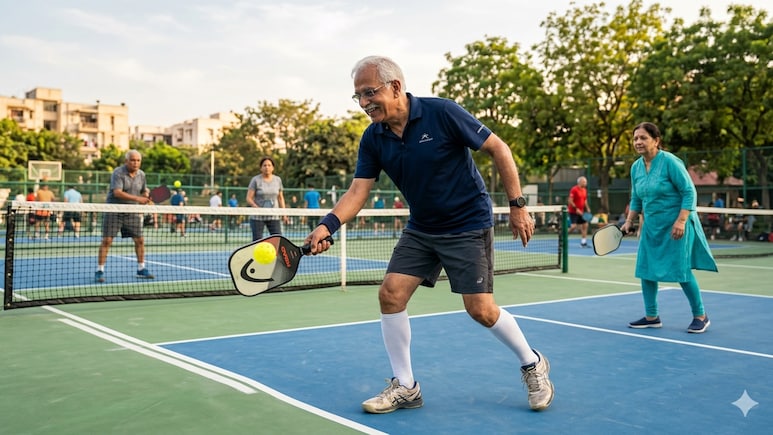
- Pickleball participation in India is rising due to its appeal as a fun, low-impact sport
- Experts warn pickleball poses injury risks, especially on hard or poorly maintained courts
- Common injuries include ankle sprains, meniscus tears, and patellar tendinopathy
Pickleball is having a moment in India. From gated societies to sports clubs of metro cities, more people are picking up a paddle, drawn by the sport's reputation as a fun, low-impact alternative to tennis. But orthopaedic experts are now warning that while pickleball may look gentle, it is not entirely risk-free, especially when played on hard or poorly maintained courts. The Sports & Fitness Industry Association's 2025 Topline Participation Report revealed that globally pickleball participation surged to 19.8 million players in 2024, representing a remarkable 45.8% increase from the previous year.
At first glance, pickleball appears simple and beginner-friendly. The smaller court size and slower pace compared to tennis make it appealing across age groups. However, the sport involves quick lateral movements, sudden stops, pivots, lunges, and short sprints, all of which can place significant stress on the lower body.
Why Pickleball Isn't As "Easy" As It Looks
"Pickleball is often seen as an easy sport to take up, but from an orthopaedic perspective, it places real stress on the knees and ankles," says Dr Rahul Salunkhe, Professor and HOD, Department of Orthopedics, Dr. D. Y. Patil Medical College, Hospital & Research Centre, Pimpri, Pune. He explains that these rapid, repetitive movements can strain joints and soft tissues, particularly when played on rigid surfaces like concrete courts.
One of the most overlooked aspects of pickleball safety is the court infrastructure. Many recreational courts are built on hard concrete or asphalt, often without proper cushioning or maintenance.
As per Current Physical Medicine and Rehabilitation Reports, athletes over 65 years represent 15.4% of the pickleball population, most existing research has concentrated on injury patterns in this age group. These older players experience a disproportionately high rate of injuries, with fractures being particularly common especially among women over 65.
Also read: Joint Pain Relief: Why Your Daily Walk Might Not Be Enough For Osteoarthritis
"The game demands frequent quick lateral movements, sudden stops, pivots and lunges. On rigid concrete surfaces with poor shock absorption, these actions transmit high impact forces directly to the ankles, knees and hips," says Dr Salunkhe. This repeated impact can lead to a range of injuries, including:
- Ankle sprains
- Achilles tendon strains
- Meniscus tears
- ACL and MCL ligament injuries
- Patellar tendinopathy
- Plantar fasciitis
According to experts, the problem is not just the sport itself but where and how it is played.
Poor Maintenance Increases Risk
Court condition matters as much as surface type. Uneven flooring, dust accumulation, or worn-out grip can make movement unpredictable, increasing the likelihood of slips and awkward landings. "If the surface is too hard, uneven, dusty or poorly maintained, the body is forced to absorb more impact and respond to less predictable movement," Dr Salunkhe explains. "A player may twist the ankle while changing direction or place extra load on the knee while trying to control balance." Footwear also plays a crucial role. Shoes that do not provide proper grip or support can further increase the risk of injury.
A Growing Concern Among Doctors
Doctors across India are beginning to see a rise in pickleball-related injuries, particularly involving the knees and ankles. "The way pickleball has gained popularity across the country is very good for physical activity. But awareness about injury risks and how courts are built, that is still lacking," says Dr Ravi Malik, Director, Malik Radix Healthcare. He adds that the sport's seemingly low-intensity nature can be misleading. "While the sport might look gentle and harmless, playing on concrete or asphalt sends constant stress through knees and ankles. We are seeing more meniscus tears, patellar tendinitis, Achilles tendonitis, and ankle sprains, all linked to hard surfaces."
Why Early Diagnosis Matters
When injuries occur, timely diagnosis and treatment are essential to prevent long-term damage. "In treatment, the first step is to assess whether the injury is mild, moderate or serious," says Dr Salunkhe. "Some cases improve with rest, ice, compression, bracing and physiotherapy." However, certain warning signs should not be ignored. These include:
- Persistent swelling
- Joint instability
- Locking or catching in the knee
- Difficulty bearing weight
"If these symptoms appear, timely medical evaluation is important. Ignoring them can worsen the injury and delay recovery," he cautions.
Prevention Is Better Than Cure
While treatment is important, experts emphasise that preventing injuries should be the priority. "Medically speaking, catching injuries early helps. But stopping them before they start matters more," says Dr Malik. He highlights a few key preventive strategies:
- Investing in better court materials with proper cushioning
- Ensuring regular maintenance of playing surfaces
- Choosing appropriate, well-fitted sports footwear
- Incorporating strength training, especially for legs and core
- Following a proper warm-up routine before playing
Lower-body strength, in particular, plays a crucial role in reducing stress on joints and improving balance during sudden movements. There is no doubt that pickleball has immense potential as a lifelong sport. It encourages physical activity, social interaction, and can be enjoyed across age groups. However, its rapid growth must be supported by better infrastructure and awareness. "Pickleball is a good sport, but it should be played on surfaces that support movement safely and reduce unnecessary strain on the joints," says Dr Salunkhe. Dr Malik adds,"Pickleball has immense potential as a lifelong sport. However, the sport's growth must be complemented by promoting safety and quality playing conditions to ensure its sustainability and keep players injury-free."
Also read: Joint Pain Relief: Why Your Daily Walk Might Not Be Enough For Osteoarthritis
Pickleball may be easy to pick up, but it is not entirely easy on your body. The combination of quick movements and hard playing surfaces can increase the risk of injuries, especially if precautions are ignored. As more Indians take to the sport, the focus must shift beyond just participation to safe participation. Because staying active should not come at the cost of long-term joint health.
Disclaimer: This content, including advice, provides generic information only. It is in no way a substitute for a qualified medical opinion. Always consult a specialist or your own doctor for more information. NDTV does not claim responsibility for this information.
Track Latest News Live on NDTV.com and get news updates from India and around the world

