





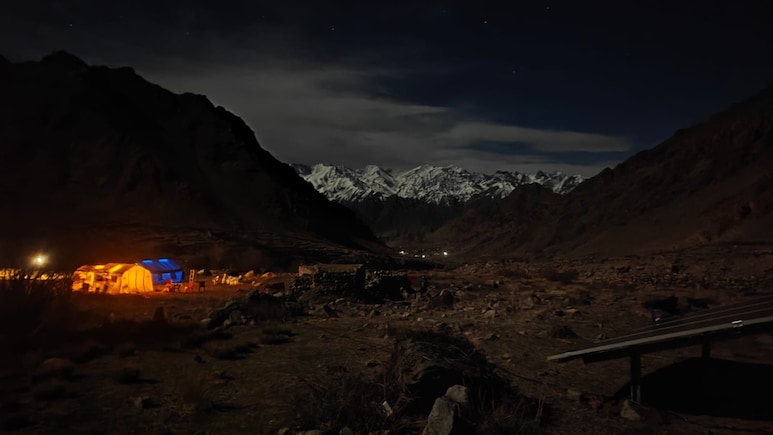
- India's Gaganyatris are undertaking a high-altitude analogue mission in the cold desert of Ladakh
- Ground-based analogue missions are a disciplined way of generating subject data
- The mission's emphasis is behavioural and operational, focusing on group dynamics in stressed environments
As NASA's Artemis II's Orion capsule, named 'Integrity', carries four NASA astronauts on a lunar voyage in a living space often described as a minivan-sized capsule, India's own "fabulous four" astronaut-designates, or Gaganyatris, are undertaking a rehearsal of a different kind - a high-altitude analogue mission in the cold desert of Ladakh, the stark 'moonscape' where oxygen is scarce and conditions are harsh.
This is Mission MITRA (Mapping of Interoperable Traits & Reliability Assessment), a field simulation jointly developed by ISRO's Human Space Flight Centre (HSFC) and Protoplanet - with the latter as the lead executing partner - and supported by specialists spanning engineering, medicine and psychology. The premise is simple: before India takes its next big leap in human spaceflight, it must understand the most complex system of all - the human being inside the mission.
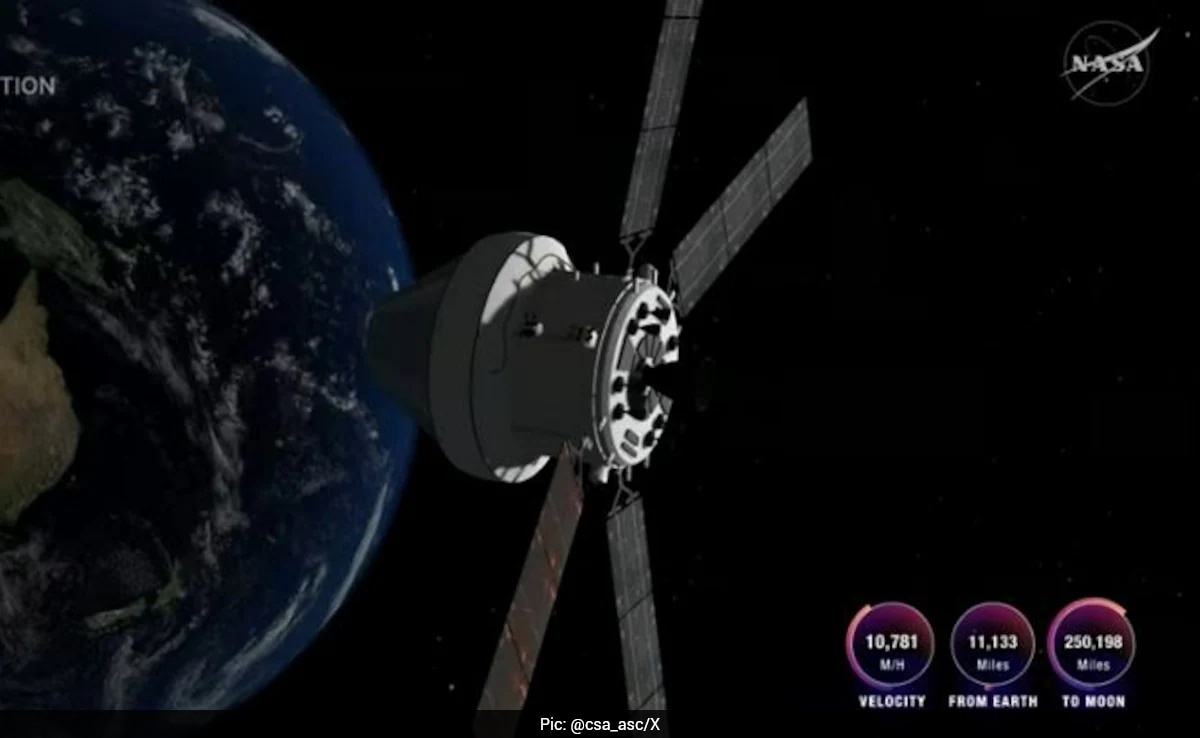
And that is why, even as the world watches Integrity sail outward, India is paying attention to a different but equally decisive variable: cohesion, the ability to stay aligned when the environment punishes the body and tests the mind.
Currently in Ladakh, India's astronaut-designate, Group Captain Prasant Balakrishnan Nair, has framed the moment with a philosophical clarity that echoes the very human purpose of exploration. "As Artemis II lifted off and disappeared into the black expanse, there was a peaceful joy in knowing that very soon we will once again have the point of view of Earth from the Moon that re-emphasises Vasudhaiva Kutumbakam. Sitting in Ladakh and experiencing its pristine peace, one realises why we in this ancient land were always rooted in this eternal philosophy of 'the world is one family'," he told NDTV.
Mission Mitra
"Mission MITRA represents a shift towards understanding the 'human machine' as deeply as the spacecraft itself," said Dr Siddharth Pandey, Director of Protoplanet, capturing the mission's core logic of behaviour under pressure. "By analysing how our astronauts and support teams interact in Ladakh's unforgiving climate, we are ensuring that future missions are backed by a foundation of psychological resilience and team unity."
For the astronauts, Ladakh is not merely dramatic geography; it is a deliberately chosen laboratory in India's high-altitude cold desert. In India's human spaceflight roadmap, ground-based analogue missions are a disciplined way of generating Indian subject data - physiological, psychological and operational - well before crews are sealed into spacecraft.
ISRO has explicitly framed these analogue missions as opportunities to understand human health and performance risks by simulating key aspects of mission life on Earth.
India's Gaganyatris
The four astronaut-candidates for India's first human spaceflight mission are Group Captains Nair, Ajit Krishnan, Angad Pratap, and Shubhanshu Shukla, all seasoned Indian Air Force test pilots.
They are the cohort that India hopes will open the door not just to low-Earth orbit missions but to a longer horizon: a crewed lunar landing by 2040, which is an ambition stated in the national human spaceflight programme outline that frames HSFC's analogue-mission effort.
One of them could well lead that journey when the moment comes. But before that future headline is written, Mission MITRA is asking a more immediate, practical question: how do teams behave when nature turns the dial up - cold, hypoxia, isolation, limited comfort - and the only way through is with discipline, empathy, clarity and trust?
The Ladakh 'Moonscape'
Ladakh's cold desert has long been described as a 'moonscape', a terrain that can feel extraterrestrial in its starkness. ISRO has previously highlighted why this region matters for analogues: high ultraviolet flux, low air pressure, extreme cold and saline permafrost, environmental traits that make parts of Ladakh an unusually good stand-in for planetary exploration stressors.
In the earlier 2025 Ladakh analogue setup at Tso Kar Valley, the facility was described as sitting at an altitude of about 4.3 kilometres above sea level, with air thin enough to remind the body, quickly and unambiguously, that it is not in control.
Mission MITRA draws from that same Ladakh logic: strip away routine comforts, place the teams in tents under the starlit sky, compress the environment, amplify the physical stressors, and watch what happens to teamwork, judgement, mood, communication and cohesion when the human system is pushed. Ladakh's conditions, including the freezing cold, low oxygen and isolation, are central to why it is being used to mimic elements of deep-space stress.
Testing The 'Human Machine'
The mission's stated emphasis is behavioural and operational, focusing on group dynamics in stressed, isolated environments. This includes how flight and ground teams maintain synergy, how stress responses unfold under cold and hypoxia, and how communication protocols between field crews and support stations hold up when the environment is unforgiving. Mission MITRA is prioritising psychological resilience, team dynamics and behavioural endurance, alongside tests of communication and logistics between crews and support teams. A dedicated psychologist is monitoring every move.
In other words, it is not just 'training', it is measurement - a structured attempt to build a framework for selecting, coaching and sustaining high-performance teams for longer missions, where the margins for error shrink and the cost of conflict multiplies.
HOPE: Rehearsal Before The Rehearsal
Mission MITRA hasn't taken place in isolation. It sits within a continuum of analogue efforts that HSFC has already articulated. ISRO notes that HSFC led the Ladakh Human Analogue Mission (LHAM) in November 2024, partnered in the ten-day isolation study 'Anugami' in July 2025, and then continued the endeavour with the HOPE analogue mission setup inaugurated at Tso Kar Valley on July 31 the same year by Dr V Narayanan, ISRO Chairman and Secretary, Department of Space.
In HOPE, the emphasis was explicitly scientific and operational. Partner institutions and specialists were to examine epigenetic, genomic, physiological and psychological responses, validate health-monitoring protocols, and refine sample collection and microbial analysis techniques, an indication of how seriously India is treating the human dimension of exploration.
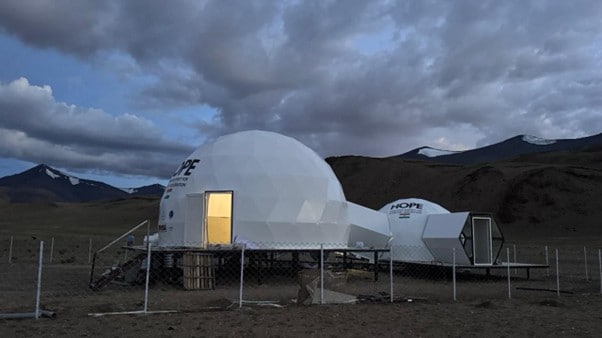
Photo Credit: Protoplanet
Dr Narayanan's framing of HOPE was unambiguous: "This analogue mission is more than a simulation, it is a rehearsal for the future," he said, describing it as a milestone in the journey toward sending Indians to the Moon and beyond, while acknowledging that such facilities can simulate many aspects of space missions, except microgravity.
That earlier HOPE phase also spotlighted the evolving public-private character of India's space ecosystem, with Protoplanet described as a key industry partner supporting HSFC's broader human spaceflight effort.
The Triangle Behind The Field Crew
Mission MITRA's execution rests on an important triangle: ISRO's HSFC as the lead human spaceflight body, Protoplanet as the lead executing partner, and an ecosystem of experts, including those associated with aerospace medicine.
ISRO's own analogue-mission outline for HOPE explicitly lists the Institute of Aerospace Medicine (IAM), Bengaluru, among partner institutions whose investigators examine physiological and psychological responses, and validate health-monitoring protocols and crew workflows.
That matters for Mission MITRA because harsh environments don't just test temperament; they test sleep, cognition, mood stability, decision-making under fatigue, and the subtle biological signals that only trained medical and psychological teams can read in real time. The field becomes a controlled stress chamber, and the data becomes the blueprint.
The Need For Teamwork
India's long-term ambition, a crewed lunar landing by 2040, is not simply a rocket equation; it is a leadership equation. The most advanced hardware can still be undermined by frayed teamwork, poor communication, avoidable conflict, or decision errors born of stress and isolation. That is why the Mission MITRA concept - mapping traits, assessing reliability, and strengthening interoperability - reads like outdoor leadership training with astronaut-grade consequences.
Ladakh is where those abstractions acquire texture. It is where "team cohesion" is no longer just a phrase, but a morning routine in low oxygen; where "stress resilience" is not motivational language, but the ability to think clearly when the cold bites and the day runs long; where "integrated logistics" is not a diagram, but the lived experience of depending on protocol, clarity and calm.
And if Artemis II's "Integrity" symbolises trust and teamwork for a crew sealed into a tiny capsule, Mission MITRA is India's way of building those same qualities, before the hatch closes.
The symmetry is striking: Artemis II flies an Orion capsule called Integrity, a name NASA itself says embodies trust, respect and humility across the crew and the thousands who enable the mission. Mission MITRA - which also means friend - puts India's own astronaut cohort in a place where friendship is not sentiment, it is survival-grade teamwork.
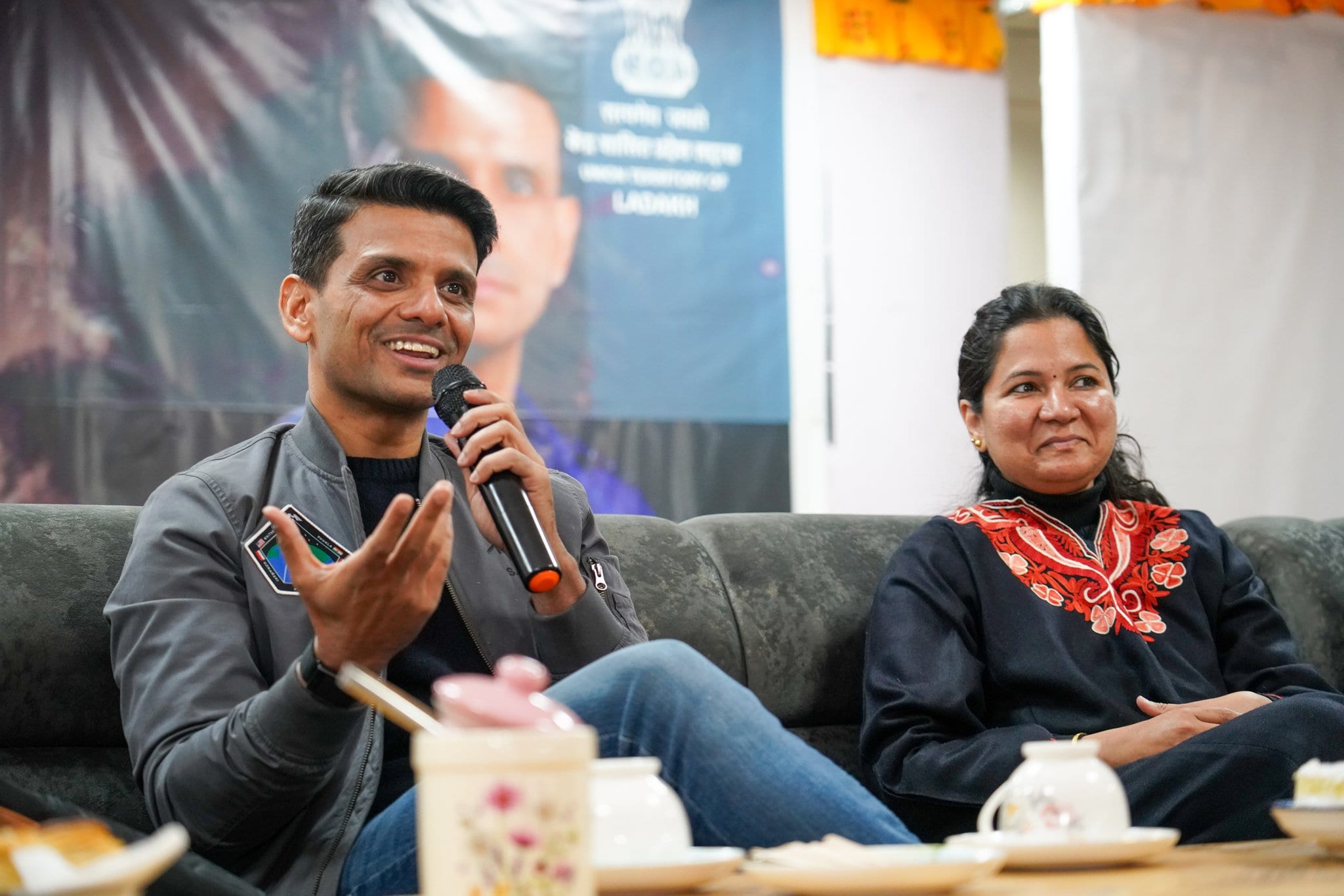
Photo Credit: Protoplanet
In Ladakh, the cold desert offers a kind of truth serum. It reveals what a team is made of when the environment removes comfort and amplifies stress. The purpose is not to dramatise hardship, but to standardise learning, to build a testing framework for long-duration missions, so that when India reaches for the Moon, the country's crews carry not just hardware readiness, but human readiness.
And it is here that Nair's reflection on 'Vasudhaiva Kutumbakam' lands with force. The view of Earth from the Moon has always been more than an image; it is a moral perspective. If the next generation of missions is to be sustained, by India, by the world, it will depend on a culture of teamwork that extends from crew cabin to mission control, from laboratory to launch pad, and from national pride to a shared planetary consciousness.
Group Captain Shubhanshu Shukla, India's only astronaut who has flown on a NASA-supported mission, told NDTV from Ladakh: "Once you leave the boundary of your planet, in a sense, you lose all boundaries. You don't introduce yourself as being from India or the USA. You introduce yourself as being from Earth."
Track Latest News Live on NDTV.com and get news updates from India and around the world

