





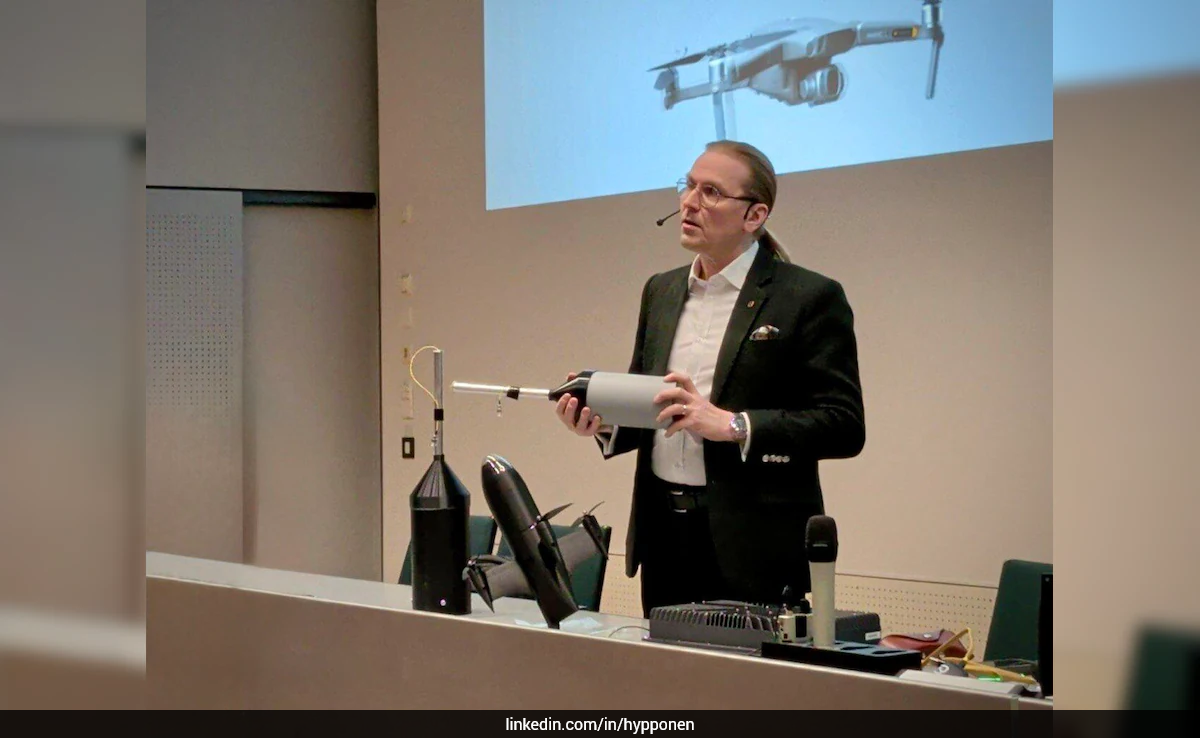
Mikko Hypponen, one of the world's best known cybersecurity figures, is shifting his focus from malware to drone threats after more than three decades in the industry, according to TechCrunch.
Speaking at Black Hat in Las Vegas, Hypponen described the invisible nature of cybersecurity work, comparing it to a game where successes disappear while failures remain visible. He said the biggest challenge is that when systems are secure, nothing happens, making achievements hard to notice.
According to TechCrunch, Hypponen began his career in the late 1980s, when computer threats were commonly called viruses or trojans and spread through floppy disks. Over the years, he has analysed thousands of malware samples and witnessed the evolution of cyber threats from hobbyist experiments to highly organised criminal operations.
He was among the first to investigate major global cyber incidents, including the ILOVEYOU virus, which infected millions of computers worldwide. He also tracked later attacks such as WannaCry ransomware attack and NotPetya attack, highlighting how cybercrime has become more sophisticated and financially driven.
Today, Hypponen believes traditional malware threats are better understood and controlled, with modern devices becoming harder to hack. He pointed to smartphones as an example, where vulnerabilities are costly to exploit and often accessible only to well-funded actors such as governments.
However, he warns that a new and less explored threat is emerging. In 2025, Hypponen joined Sensofusion, a Finland-based company developing anti-drone systems for military and law enforcement use.
Living near Finland's border with Russia, he said the war in Ukraine, where drones have played a major role, influenced his decision. He described drone warfare as a growing risk that requires urgent attention.
Hypponen explained that the principles of cybersecurity can be applied to drones. By analysing radio signals and identifying control frequencies, systems can detect, track and even disrupt drones. In some cases, vulnerabilities can be exploited to disable them.
Despite the shift in focus, he said the core challenge remains unchanged. It is a constant race between defenders and attackers adapting to each other's tactics. He added that the nature of the threat has also stayed similar, noting that he has spent much of his career countering Russian cyber activity and is now addressing drone-related risks linked to the same region.
Track Latest News Live on NDTV.com and get news updates from India and around the world

