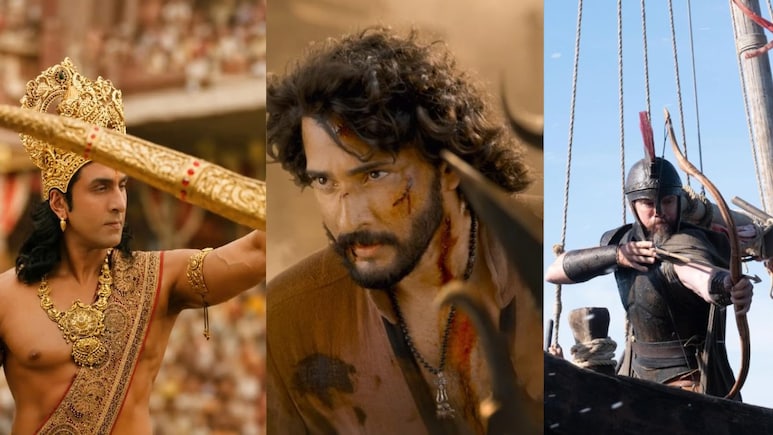
SS Rajamouli's Varanasi is set to take Indian cinema into uncharted territory. The magnum opus, starring Mahesh Babu and Priyanka Chopra, is one of the non-English films shot using IMAX-certified digital cameras.
And the timing couldn't be more interesting.
When Christopher Nolan's The Odyssey released in India, the film gave a huge boost to the IMAX experience. It also highlighted a very obvious gap, India simply doesn't have enough IMAX screens.
Audiences were willing to pay a premium to experience The Odyssey in IMAX. But India has only 34 IMAX screens, bringing the shortage of premium screens into sharp focus. So why don't we have more IMAX screens in the country?
PVR INOX Executive Director Sanjeev Kumar Bijli told NDTV that IMAX is an expensive technology, with each screen costing around Rs 10-11 crore to set up. And while films like The Odyssey performed strongly, not every Hollywood release delivers the same results in IMAX.
His argument is simple: India needs more local content made for the format.
"We need more Hindi and regional filmmakers, that is, Tamil and Telugu filmmakers, to make IMAX-worthy films. If we have more content, then I think we'll be more comfortable investing in the IMAX format," Bijli said.
That brings us to the other side of the equation, the filmmakers. If exhibitors need more content to justify investing in IMAX screens, filmmakers also need those screens to make the investment in creating films for the format worthwhile.
Namit Malhotra, Global CEO of DNEG and producer of Ramayana, which has been filmed for IMAX, believes premium-screen experiences are the need of the hour.
"I think IMAX, or the big premium-screen experiences that we talk about, are really the need of the hour," he said.
According to Malhotra, it is a chicken-and-egg situation. Filmmakers need to take the risk of making more films for premium formats, while exhibitors also need to invest in more screens. More screens give filmmakers the confidence to make bigger bets, and more IMAX-ready films give exhibitors a reason to invest.
But there is another hurdle - the cost of making films for the format.
Filmmaker Shekhar Kapur believes IMAX is currently too expensive for a normal-budget Indian film.
"At this moment IMAX is too expensive for normal budget for Indian Films," Kapur said.
However, he believes technology could eventually change that equation. As the world adapts to AI technology, Kapur says it may become possible to make every film available in different formats, from regular screens to premium formats.
"It's possible to make every film available in whatever format you want - normal screens and IMAX. That technology is here now," he said.
For now, though, shooting specifically for IMAX requires filmmakers and cinematographers to rethink the way they work.
IMAX isn't simply about putting a film on a bigger screen. The cameras themselves can be significantly heavier than conventional cinema cameras, so filmmakers and cinematographers need specialised rigs and crews who know how to handle them.
The cameras can also be extremely loud, particularly film-based IMAX cameras, which means special soundproofing equipment may be needed when recording sync sound.
Then comes framing. An IMAX screen can show a much taller and more expansive image, so directors and cinematographers have to be particularly careful about what they place within the frame.
Focus also becomes more demanding because the larger image reveals much more detail. Even a small focusing error can become obvious when projected on a giant screen.
Lighting needs to be precise as well, because details that may go unnoticed on a regular screen can become far more visible on an enormous IMAX canvas.
And when shooting on IMAX film, there are additional logistical challenges. The film stock is expensive, and each roll gives filmmakers only a limited amount of shooting time, making every take count.
So, shooting for IMAX isn't simply about making a film look bigger. It requires a different approach to the camera, framing, focus, lighting, sound and even production planning.
And now Varanasi is putting that approach to the test.
Rajamouli has already shown that Indian cinema can think on a global scale. With Varanasi, he could also be helping push the industry towards a future where IMAX isn't just a premium way of watching Hollywood films, but a format Indian filmmakers regularly create for.
Because ultimately, the future of IMAX in India depends on both sides of the screen, filmmakers willing to make bigger bets, and exhibitors willing to build the screens that allow those bets to pay off.
ALSO READ | The Biggest Twist In The Ramayana CGI Debate May Not Come From India, But China
