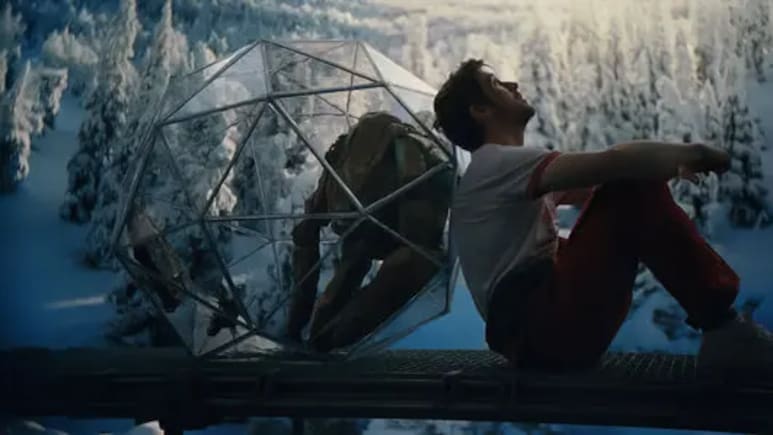
- Rocky's high-energy personality originated from a puppeteer's initial misunderstanding of time on his planet
- Directors used carved markings and tattoos to add emotional cues to Rocky's faceless design
- Rocky was created using a mix of practical puppetry and CGI for realism on set
Some characters are designed. Others are discovered somewhere along the way. And then there's Rocky, the kind of creation that feels less like it was built in a studio and more like it simply... showed up, fully formed, with a personality no one quite planned but everyone instantly loved.
Here's how Rocky from Project Hail Mary went from words on a page to one of the most memorable sci-fi creatures in recent cinema.
The Mistake That Shaped Rocky
Rocky's defining trait, his restless, high-energy personality, was never part of a calculated design. It began with a misunderstanding.
When puppeteer and voice actor James Ortiz first read Andy Weir's novel, he interpreted a key detail incorrectly. He believed time on Rocky's home planet, Erid, moved faster than on Earth. That assumption immediately informed how he approached the character.
"As an actor, I went, 'Oh my God, what a great piece of information, that's his internal metronome, that's his heart, his little hummingbird energy,'" Ortiz said in an interview, per the NY Times.
For months, Ortiz performed Rocky with that rapid, jittery rhythm in mind. Only later did he realise the truth, an Eridian second is actually slower than an Earth second. By then, however, something unexpected had happened: the "mistake" worked.
"At some point, I went, 'Well, Andy, he's just going to be anxious, OK?'"
That anxious, hummingbird-like energy became central to Rocky's charm, and ultimately, his identity.
Designing A Faceless Alien You Can Feel
Translating Rocky from page to screen was never going to be straightforward. In the book, he is described as a five-limbed, rock-like creature with no face, hardly the easiest design to make emotionally engaging.
Directors Phil Lord and Christopher Miller were determined to stay faithful to the source material while still making Rocky accessible to audiences.
They leaned into subtle visual cues. Rocky's body was given carved markings. Eridian "tattoos", each imagined to carry meaning, from a family crest to something resembling a wedding band. The idea was to give viewers something to read, even without traditional facial features.
"We thought, 'Let's give the audience as much help imagining a person in this rock face, kind of the way you look at what was formerly the Man of the Mountain in New Hampshire before it fell down,'" Lord said, adding, "You could imagine a face there. We kept saying, 'This side is the grouchy side, this one is the open side.'"
That approach helped turn a faceless alien into a character audiences could emotionally connect with.
Building Rocky
From the beginning, the filmmakers were clear about one thing: Rocky needed to exist physically on set.
Rather than relying entirely on CGI, the team opted for a hybrid approach that combined practical puppetry with visual effects. Creature effects supervisor Neal Scanlan and his team developed multiple versions of Rocky, including a fully functional puppet and animatronic builds.
The goal was simple: give Ryan Gosling something real to act against.
"Toward the end of the movie, like when we were watching sequences, all of us said the same thing, 'I can't remember if this is puppet or CG,'" the visual effects production supervisor Paul Lambert said, adding, "It was just a testament to the two worlds coming together."
Ortiz operated Rocky with a team of puppeteers, dubbed the "Rocketeers",-who controlled his multiple limbs. Hidden beneath the set through cleverly designed floor openings, they helped bring the alien to life in real time.
"I'm basically almost hugging him to my chest," Ortiz said.
Even when scenes required full digital animation, Ortiz continued to perform every moment and ensured continuity in movement and emotion.
Finding Rocky's Movement And Voice
Without a face, Rocky's emotions had to come through in other ways: primarily movement.
Ortiz was careful to avoid making him feel too insect-like or unsettling. Instead, he looked to unexpected inspiration.
"This sort of birdlike movement of the face became the language for how to communicate his feelings," Ortiz said.
That choice, drawing from the quick, expressive motions of baby owls, gave Rocky a softness that counterbalanced his unusual form.
His voice followed a similarly organic path. While the book describes Rocky communicating through musical tones, the film experimented with multiple approaches before settling on something simpler and more natural.
"We experimented with different voices, but what ended up being most successful was basically James being James," Miller said.
Ortiz infused the performance with subtle influences from pop culture but ultimately grounded it in his own instincts, creating a voice that felt both alien and oddly familiar.
Bringing Emotion To Motion
When Rocky transitioned into fully digital sequences, the responsibility shifted to the animation team at Framestore, including animator Arslan Elver.
What they discovered early on was that Rocky's emotional clarity depended entirely on how he moved.
"One thing we noticed very quickly is that his emotion comes through motion," Elver said of his faceless muse.
Every gesture was carefully considered. The way he used his limbs, the rhythm of his movements, even moments like his now-iconic "jazz hands" were designed to convey specific emotional beats.
The animators explored dozens of variations for key scenes, fine-tuning the balance between expressiveness and restraint.
Casting The Perfect Scene Partner
Before the final version of Rocky was even complete, the filmmakers began searching for the right performer to bring him to life.
Ortiz stood out immediately, not just for his technical skill, but for his chemistry with Ryan Gosling.
"He had this amazing chemistry with Ryan in the read, and he had this confidence to put Ryan on his heels," Miller said, adding, "You could just see that he was Rocky from the beginning."
That dynamic proved essential.
Making An Alien Feel Real
In the end, what makes Rocky work isn't just the technology or the design, it's the performance.
From a misunderstood detail that shaped his personality to the meticulous blend of puppetry and animation, every element of Rocky's creation was driven by a singular goal: to make audiences feel something.
"He doesn't understand that a joke is happening," Ortiz said. That, plus his impatience, is what makes him endearing. He shared, "He's sort of guileless despite the fact that he is so smart and so capable."
And perhaps that's the real achievement of Rocky. Not that he looks convincing, or even that he sounds unique, but that, despite having no face, he feels unmistakably alive.
Also Read | Why Everyone Is Obsessed With Rocky, And Why He Feels Like Koi... Mil Gaya's Jaadu
