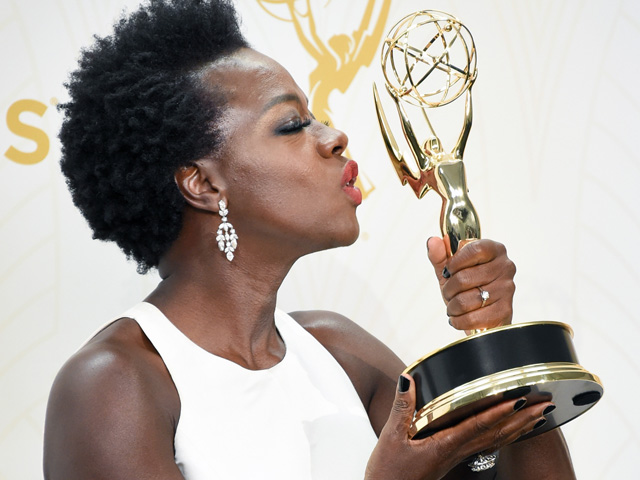
Viola Davis photographed with her Emmy trophy in Los Angeles. (Image courtesy: AFP)
Los Angeles:
It was a night of firsts, as well as one for establishment cable at the 67 Primetime Emmy Awards on Sunday.
Viola Davis became the first African-American woman to win an Emmy for best lead actress on a drama series, for her role as a defense lawyer in How to Get Away With Murder; Jon Hamm won his first Emmy after seven previous nominations for his role as the tortured Don Draper on Mad Men; and HBO, led by victories for the comedy Veep, the drama Game of Thrones and a four-part limited series, Olive Kitteridge, had a record-breaking night, with 14 victories, including best drama and outstanding comedy series.
It was the first time in eight years that HBO won in the best drama category, and was the first victory for the sprawling fantasy epic Game of Thrones, which is the most watched show in the network's history. HBO notched 43 awards overall, including 29 Creative Emmys last week, just one shy of CBS' record set in 1974. Of course, CBS competed against two other broadcast networks, while HBO faces a television landscape in which there are more original scripted shows - and more outlets on which to show them - than ever.
But it was a night that might be best remembered for a few emotional moments. In an impassioned speech, Davis quoted Harriet Tubman and paid tribute to other African-American actresses like Halle Berry and Gabrielle Union.
"Let me tell you something," she said. "The only thing that separates women of color from anyone else is opportunity. You cannot win an Emmy for roles that are simply not there." (Also Read: List of Winners)
Hamm climbed onto the stage, and said to a standing ovation, "There has been a mistake clearly." It was his last chance at winning the award for Mad Men, which concluded its celebrated run on AMC this year.
And in another touching moment, the comedian Tracy Morgan presented the best drama award. It was the first time he had been on a stage since a serious car accident last year that left him in a coma for eight days. "I miss you guys so much," he said as the audience rose from their seats to applaud. (Also Read - Emmy Awards 2015: Jon Hamm Finally, Finally Wins Best Actor)
Andy Samberg, in his first time as host, took the stage with a taped song-and-dance number poking fun at the rising number of scripted television shows, and with a joke that acknowledged one of the running themes of all awards shows this year.
"The big story this year is diversity," he said from the stage at the Microsoft Theater. "This is the most diverse group of nominees in Emmys history. Racism is over - don't fact check that."
And though many of the awards were won by the old guard - Julia Louis-Dreyfus won best actress in a comedy series for Veep for the fourth straight time - there was new diversity on the awards front.
Jeffrey Tambor won the Emmy for outstanding actor in a comedy series for his portrayal of a transgender woman in Amazon's Transparent, a notable victory for the streaming service. Tambor, who also won a Golden Globe in January, thanked transgender people for "your patience, thank you for your courage, thank you for your stories, thank you for your inspiration, and thank you for letting us be part of the change."
Jill Soloway, the creator of Transparent, won her first Emmy for directing, and echoed Tambor's sentiments, adding: "We don't have a trans tipping point yet. We have a trans civil rights problem."
Diversity - and a lack of it - has been a topic of intense discussion surrounding awards shows in the past year. There was an outcry at this year's Academy Awards over a lack of racial diversity among the nominees. The backlash was enough for the awards to earn a hashtag that spread on social media, #OscarsSoWhite. (Though Empire, with its largely black cast, was an enormous ratings success for Fox, the show received only one Emmy nomination in the major categories.)
With her victory for Veep, Louis-Dreyfus won her sixth Emmy overall.
"What a great honor it must be for you to honor me tonight," she said, before pausing for a beat. "I'm sorry, Donald Trump said that. It's getting trickier and trickier to satirize this stuff."
Tony Hale, who plays the president's bumbling aide on the show, won best supporting actor in a comedy series for the second time. Veep also won the award for outstanding writing in a comedy series. The show's victory for best comedy snapped a five-year winning streak for ABC's Modern Family.
HBO's "Olive Kitteridge, about a grumpy math teacher and her forgiving husband set in small town Maine, dominated the limited series categories, winning best actress (Frances McDormand), best actor (Richard Jenkins), best supporting actor (Bill Murray), for writing and for the series itself.
This was the 15th consecutive year that HBO scored the highest number of Emmy nominations - 126 - and its 43 victories far surpassed its previous high of 32 in 2004. The network with the second-highest number of awards on Sunday night was Comedy central, with four. Game of Thrones won four awards overall, including for best supporting actor in a drama for Peter Dinklage.
As an example of how streaming is becoming a front-and-center issue for television, Samberg also noted that HBO has shown no interest in policing how people share passwords for their apps, HBO Go and HBO Now. Samberg then posted a login - "khaleesifan3@emmyhost.com" - and password ("password1") for his HBO Now account, and invited everyone to use it.
It was also a year where many celebrated shows like Mad Men went off the air, including David Letterman's and Jon Stewart's late-night shows, and NBC's Parks and Recreation.
Jon Stewart got a big send-off as host of The Daily Show, which once again won the outstanding talk series category. It was the 13th consecutive year that Comedy Central has won the award, and the 10th win overall in that category for Stewart's show. Also, Comedy Central's Inside Amy Schumer won in the new sketch series category, yet another mile marker in a breakout year for Schumer. Allison Janney won outstanding supporting actress in a comedy for her role in Mom (CBS), in which she plays a recovering alcoholic. It was her second consecutive win in the category and her seventh Emmy overall.
In her acceptance speech, Janney told her fellow nominees, "I feel like I won the lottery because you are all amazing as well."
Uzo Aduba won in the best supporting actress category in a drama for her depiction of Crazy Eyes in Netflix's Orange Is The New Black. It was her second Emmy, and in a tearful speech, she said, "Thank you a thousand times, it would not be enough." It was the lone victory for Netflix, which had 34 nominations.
Despite the explosion of original programming in television, the Emmys, broadcast this year on Fox, can often feel predictable. But the Television Academy, which organizes the Emmys, made changes to the voting process that could potentially put an end to that feeling of familiarity. The group disbanded the so-called blue ribbon panel this year, opening the final vote for awards like best drama and comedy series to the entire pool of academy members, not a closed-off committee. There is certainly more television than ever for them to consider. An estimated 400 scripted shows are expected to be broadcast on TV and online services like Netflix this year, up from the 211 that were on the air in 2009. The chief executive of the Television Academy, Bruce Rosenblum, said last month that there had been a 40 percent increase in submissions for the best drama category this year.
Samberg nodded to the glut of offerings in his opening segment, when he played a character who was anxious about having not seen marquee shows like Empire and Game of Thrones and descends into a bunker for a year to finally catch up.
"So many shows and so little time," he sang. "I'm just one man. How can I possibly keep up?"
© 2015, The New York Times News Service
How may i help you today
Show full article
