
New Delhi: The National Council of Educational Research and Training (NCERT) has included a verse from the 'Manusmriti' in its Class IX Social Science textbook to illustrate that women were accorded respect in the Vedic period, while simultaneously stating that their status "fluctuated, even declined" as social and political conditions changed over time.
The reference appears in the chapter, 'State and Society up to 1000 CE', which describes the Vedic age as "often described as a period during which women held a high and respectful position in society".
According to the textbook, women participated in scholarly learning, took part in rituals alongside men in certain contexts, attended public assemblies, and several hymns of the Rig Veda are traditionally attributed to women sages such as Apala, Visvavara, Ghosha and Lopamudra.
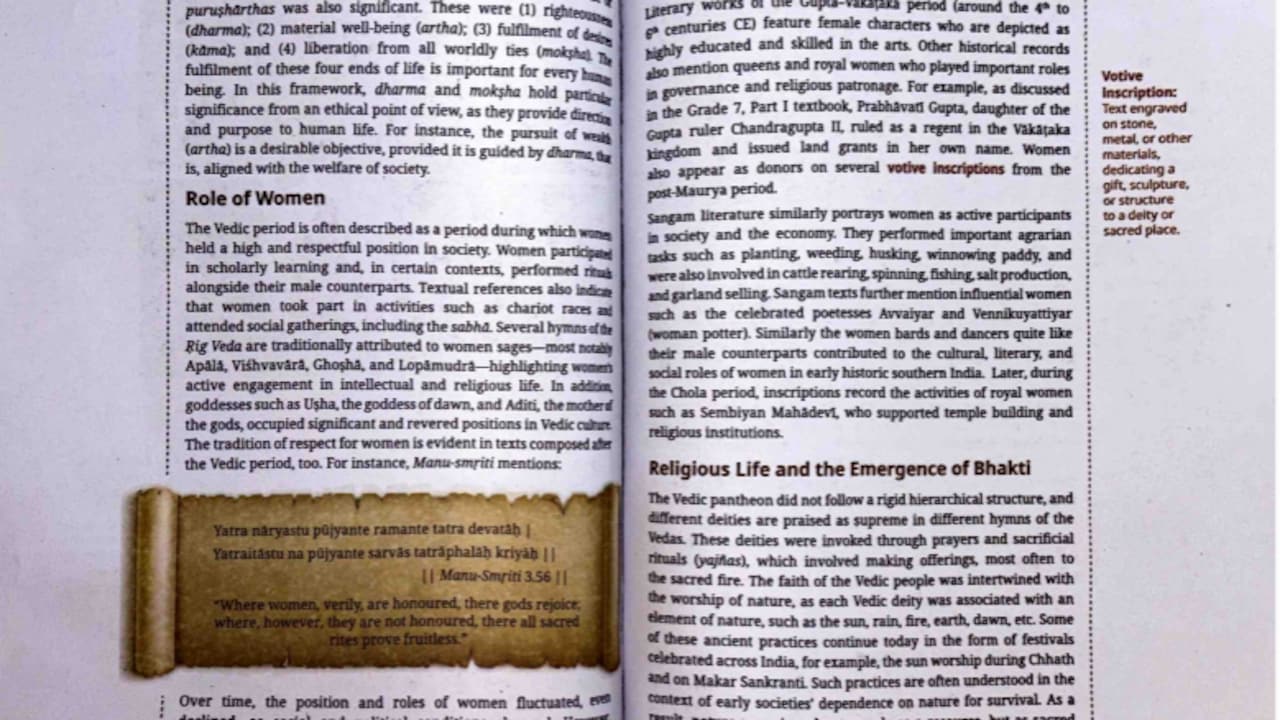
To underline this, the textbook cites Verse 3.56 of the Manusmriti, which states: "Where women, verily, are honoured, there gods rejoice; where, however, they are not honoured, there all sacred rites prove fruitless."
The Manusmriti, an ancient Sanskrit text prescribing social and legal norms, has long remained the subject of debate over its provisions relating to caste and gender.
However, immediately after quoting the verse, the textbook stresses that women's position was not static.
"Over time, the position and roles of women fluctuated, even declined, as social and political conditions changed. However, there are many examples of women continuing to contribute to household management, agriculture, crafts, and religious practices," it says.
The chapter also highlights examples from later periods to show women's continued participation in public life. It says literary works from the Gupta-Vakataka period portray educated women skilled in the arts, while historical records mention queens who played significant roles in governance and religious patronage. Among them is Prabhavati Gupta, who ruled as regent of the Vakataka kingdom. It also points to Sangam literature, which depicts women as active contributors to society and the economy.
The textbook also revisits the concepts of varna and jati, arguing that social identity in early Vedic society was not determined solely by birth.
"Early Vedic texts do not indicate fixed social status based on birth. Instead, it is generally agreed that social identity was shaped by several complex and overlapping factors including ethnicity, subgroup, region, village affiliation, language, occupation and especially cultural relationships," the chapter says.
As evidence, it cites a hymn from the Rig Veda describing occupational diversity within a single family: "I am a poet; my father is a physician; my mother is a grinder of corn."
Explaining the evolution of the social order, the textbook says the four varnas gradually became associated with specific roles but were originally conceived as functional rather than rigid categories.
"Thus, the concept of varna was based on a system of values in which knowledge was given the highest status, followed by political power and wealth," it says.
The chapter also quotes the Buddhist Sutta Nipata to reinforce the idea that status depended on conduct rather than birth: "No outcaste is such by birth but only by his deeds. A brahmana is such by his deeds."
According to the textbook, the social institution of jati evolved over time through intermarriage among communities, endogamy, and territorial differences. While the number of varnas remained fixed at four, it says there was no limit on the number of jatis, which continued to grow as new occupations and social groups emerged.
It further notes that varna and jati "were not always rigid social categories", citing examples of rulers from diverse social backgrounds as well as inscriptions indicating occupational mobility in later periods.
