
Nearly 50 years after the Emergency was imposed in India, the National Council of Educational Research and Training (NCERT) has included the topic for the first time in a Class 9 Social Science textbook. The new textbook, "Understanding Society: India and Beyond," describes the Emergency as "one of the major challenges" faced by Indian democracy.
The topic has been added in a chapter that discusses the strengths and challenges of democracy in India. An NCERT official confirmed that this is the first time a section on the Emergency has been included in a Class 9 textbook.
The addition comes as India recently completed 50 years since the declaration of the Emergency in 1975. The textbook explains the events that led to the decision and its impact on democratic rights.
The book states, "One of the major challenges to democracy in India was recorded when an Emergency was imposed in 1975-77. In the early 1970s, public dissatisfaction with the government led by Indira Gandhi was growing. Rising unemployment, inflation, and allegations of misgovernance led to widespread protests,"
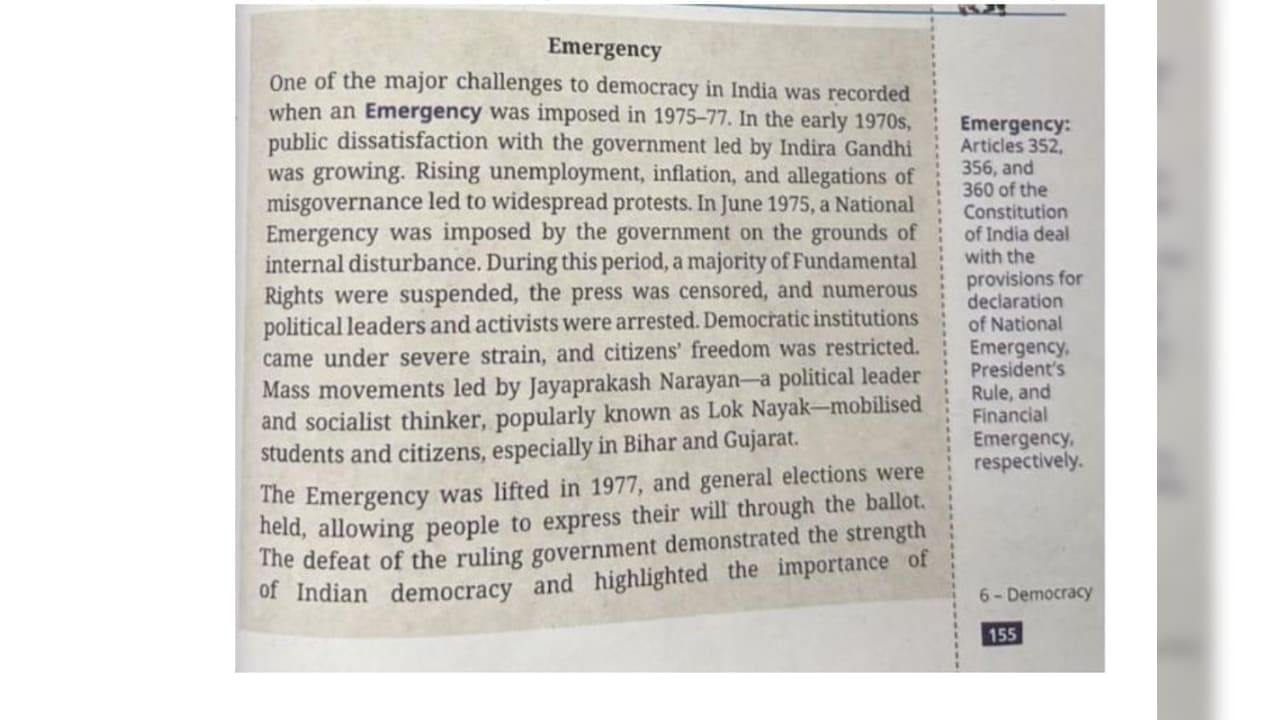
It further adds, "In June 1975, a National Emergency was imposed by the government on the grounds of internal disturbance. During this period, a majority of Fundamental Rights were suspended, the press was censored, and numerous political leaders and activists were arrested. Democratic institutions came under severe strain, and citizens' freedom was restricted,"
The textbook also highlights the role of Jayaprakash Narayan in the mo ()vement against the Emergency. It mentions how mass movements led by him mobilised students and citizens, especially in Bihar and Gujarat.
Marking 50 years since the Emergency, Prime Minister Narendra Modi paid tribute to those who defended democratic values during the period. In a social media post, he said, "Today, we pay homage to all those who steadfastly defended democratic values during one of the darkest chapters in India's history, the Emergency."
He further stated, "The Emergency was a direct assault on our Constitution. It witnessed the suspension of civil liberties, curbs on freedom of expression, arrests of political leaders, journalists, social workers and an assault on institutions that are the bedrock of our democracy."
The Prime Minister also highlighted the courage of citizens who opposed the Emergency, saying, "At the same time, it also revealed the extraordinary courage of countless citizens who refused to remain silent and upheld the ideals enshrined in our Constitution."
Today, we pay homage to all those who steadfastly defended democratic values during one of the darkest chapters in India's history, the Emergency.
— Narendra Modi (@narendramodi) June 25, 2026
The Emergency was a direct assault on our Constitution. It witnessed the suspension of civil liberties, curbs on freedom of…
The book says, "Mass movements led by Jayaprakash Narayan -a political leader and socialist thinker, popularly known as Lok Nayak-mobilised students and citizens, especially in Bihar and Gujarat. The Emergency was lifted in 1977, and general elections were held, allowing people to express their will through the ballot. The defeat of the ruling government demonstrated the strength of Indian democracy and highlighted the importance of Democracy,"
Apart from the Emergency, the revised textbook discusses other challenges to democracy, including fake news, misinformation, poverty, regionalism, social discrimination and gender inequality.
The chapter also introduces a new section titled "Democracy and You" to help students understand their role as citizens and connect classroom learning with democratic participation.
The textbook also focuses on India's democratic institutions, the role of media as the "fourth pillar of democracy," voter participation, polling systems and grassroots democracy through examples of panchayats. It also includes sections on women's voting rights and reservations in local bodies.
