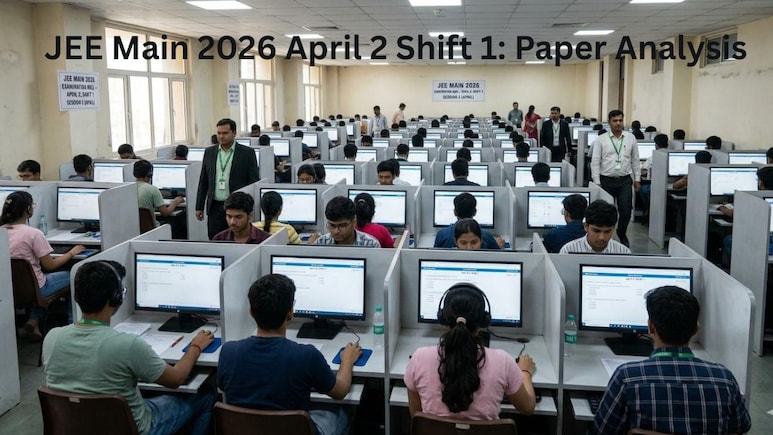

JEE Main 2026 April 2 Shift 1: The JEE Main 2026 Session 2, Shift 1 exam was conducted today from 9am to 12pm in online mode. The paper comprised 75 questions across Physics, Chemistry, and Mathematics, carrying a total of 300 marks.
According to the National Academic Director of Engineering at Aakash Educational Services Limited, the JEE Main 2026 paper was moderate to difficult, with Mathematics emerging as the most challenging section. Physics questions ranged from easy to moderate, while Chemistry was moderate to difficult, largely due to its calculation-intensive nature. Both the Mathematics and Chemistry sections were time-consuming, making it challenging for students to complete the paper within the three-hour duration.
"Overall, the paper was well-balanced in terms of question distribution and chapter coverage," he added.
Section-wise Analysis
PhysicsThe Physics section was comparatively easier. Questions covered most major chapters, with a heavier emphasis on Electromagnetism, while Optics and Waves had fewer questions. Mechanics had an average representation. Although a few questions were time-consuming, the section overall was manageable. Topics like Electromagnetic Waves, Thermodynamics, and Modern Physics were adequately tested.
ChemistryChemistry was moderate in difficulty. Questions were evenly spread across Organic, Inorganic, and Physical Chemistry, with slightly higher weightage on Inorganic Chemistry and fewer questions from Organic Chemistry. While most questions were straightforward, some calculation-intensive problems required extra time, impacting overall time management.
MathematicsMathematics was the most challenging and time-consuming section. Questions were well-distributed across the syllabus, with higher emphasis on Integral Calculus, Conic Sections, and Algebra. Topics such as 3D Geometry, Vectors, and Complex Numbers received average coverage. Lengthy calculations and tricky problems made this section the toughest for students, with Algebra appearing slightly dominant and Coordinate Geometry moderately represented.
Rajwant Singh, faculty at PhysicsWallah (PW), said that while Physics and Chemistry remained in the easy-to-moderate range, Mathematics continued to be more calculation-intensive and slightly tougher.
He added that students who had thoroughly practised previous years' questions and completed the syllabus would have found the paper familiar and manageable.
"For upcoming shifts, we advise students to focus on revising short notes, key formulas, and past discussions, while maintaining a calm and confident approach during the exam," he said.
Sachin Jakhar, faculty at PhysicsWallah (PW), said Mathematics followed a familiar pattern seen in previous papers. While the section was manageable in terms of difficulty, it was quite lengthy. Most questions were doable and based on key topics regularly discussed in class; however, time-consuming calculations made it challenging for students to attempt the entire section.
"Many students prefer to attempt Mathematics after Chemistry and Physics. However, it is important to understand that at least 1 hour and 15 minutes is required to solve a lengthy, calculation-based section, even with thorough preparation. In this session, those who managed their time effectively were better placed to complete the paper and score well," he added.
