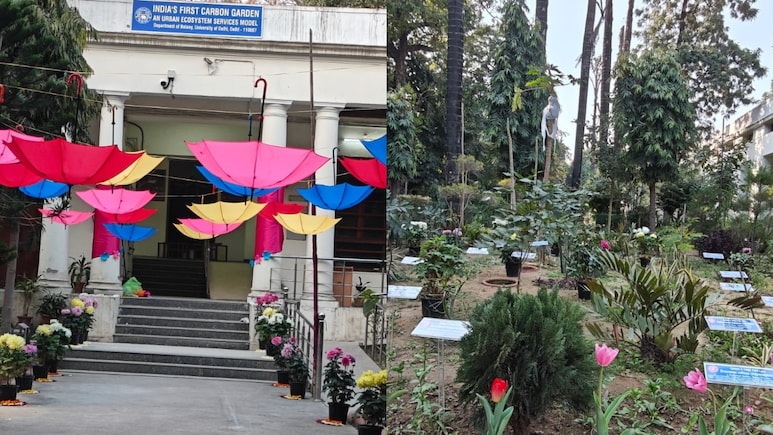

Delhi University (DU) has inaugurated what the university describes as India's first Carbon Garden at its Department of Botany. The initiative aims to address air and soil pollution while promoting biodiversity in an urban setting.
DU Vice-Chancellor Professor Yogesh Singh inaugurated the garden on Thursday and planted a Kalpavriksha sapling to mark the occasion. He also called for similar carbon gardens to be developed across the university's departments and colleges.
DU Carbon Garden: What Is Special?
The Carbon Garden has been developed on about 2,000 square feet of land in front of the Department of Botany. It has around 50 species of plants, including herbs, shrubs and trees, and has also been designed as a mini biodiversity park.
The garden brings together different forms of plant and microbial life, including algae, fungi and bacteria. It also includes Spirulina, while microorganisms found on tree bark can play a role in breaking down certain gases and pollutants.
According to the university, the idea is to use the natural ability of plants and microorganisms to absorb carbon dioxide and some pollutants, while also helping improve soil quality and support biodiversity.
DU VC Warns Delhi Could Become 'Pollution Capital'
Speaking at the inauguration, Professor Singh highlighted Delhi's growing pollution problem. He warned that if timely steps are not taken, the national capital could become the "pollution capital."
He said environmental problems caused by human activities cannot be addressed through technology alone and called for sustainable solutions.
Singh also spoke about the need for climate-sensitive urban planning. He said development plans should take India's environmental conditions into account instead of blindly following building designs used in other countries.
The Carbon Garden is intended to serve as an example of how a relatively small green space can support environmental efforts in a crowded city. The university has also encouraged its departments and colleges to consider setting up similar gardens on their campuses.
