




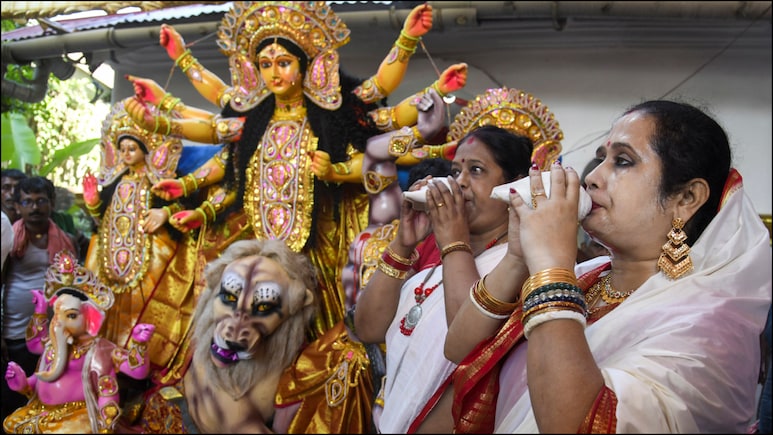
I have been observing Durga Puja in Kolkata for more than six decades. Like every cultural phenomenon, Durga Puja is not static. It changes constantly; it is dynamic and remains in a state of flux. However, Durga Puja 2026 has been distinctly different and represents a new cultural phenomenon.
One noticeable change has been the role played by the film industry, particularly Tollywood and television celebrities, in inaugurating Durga Pujas. With the BJP coming to power in West Bengal under Chief Minister Suvendu Adhikari, the festival has also acquired a different political and cultural character.
In previous years, celebrity appearances, especially those of actors and actresses, often became major attractions on the eve of Durga Puja. Their presence was accompanied by enthusiastic dancing, and during idol immersion, DJ music and loud, often raucous songs were almost obligatory. Compared with those earlier celebrations, this year's festivities appeared less dominated by such a film-oriented culture.
If Suvendu Adhikari and other BJP leaders repeatedly attempt to reshape Sanatani Durga Puja according to their own cultural preferences, they must remember that the festival is deeply rooted in Bengali society. For the Bengali middle class, Durga Puja has long been an integral part of its cultural identity, with roots that go back to the period when Kolkata was the capital of British India in the nineteenth century.
During the more than 34 years of government by the Communist Party of India (Marxist), or CPM, Durga Puja was never banned or deliberately stopped. However, from an ideological standpoint, a committed communist was expected to be an atheist. Such a person could be a humanist, but not a ritualistic Hindu. Consequently, Durga Puja was often presented as an autumn festival, with greater emphasis on its social character than on religious rituals.
This was different from the way Navaratri was celebrated in North India and the Hindi-speaking heartland, where the festival had a stronger religious character. In Bengal, Durga Puja developed into a broader social and cultural celebration.
During Mamata Banerjee's 15 years in power, this social dimension became particularly prominent. UNESCO recognised the festival's social bonhomie by inscribing Kolkata's Durga Puja on its Intangible Cultural Heritage list.
Under Mamata Banerjee, however, the celebrations also acquired a carnival-like character, particularly through the Durga Puja Carnival on Red Road. Film stars, actresses and other celebrities became prominent participants. Some of them would dance on stage to Rabindra Sangeet, while others would dance to Hindi songs. Over time, such performances became a familiar part of the festivities.
The Suvendu Adhikari government has approached Durga Puja differently this year. There are two sides to this change, and both deserve consideration.
On the one hand, I do not believe there is anything inherently wrong with emphasising the Sanatani Hindu character of the festival. I have lived in Delhi for 40 years and have observed how Navaratri is celebrated there. Understandably, people may want Bengali Durga Puja to reflect some of the dignity and religious significance associated with Navaratri.
However, the traditional form of Durga Puja in Bengal is not necessarily identical to the Sanatani form of worship practised elsewhere. Even the traditional image of Goddess Durga does not conform entirely to what might be described as a strictly Vedic form. Durga Puja, as it is celebrated today, has developed through several layers of religious and cultural practice. The Rigveda did not contain the Durga Puja tradition as it exists today; earlier forms of worship had their own historical and cultural contexts.
These distinctions should not be forgotten in the current debate. This year, one can see an attempt to bring Bengali Durga Puja closer to an all-India celebration of Navaratri and Dussehra, associated particularly with the Hindi-speaking heartland. Vijayadashami is observed on a different date in some regional traditions, and the difference in calendars can sometimes be seen when comparing Bengali and Hindi-speaking celebrations. In Nagpur, for instance, people may be occupied with Navami on the day that corresponds to Vijayadashami in another calendar.
The BJP, the CPM and the Trinamool Congress in Kalighat may all have their own views on the cultural character of Durga Puja. However, there is a concern that Suvendu Adhikari's approach may be influenced by electoral calculations, particularly the desire to appeal to the Hindi-speaking vote bank. This could explain the greater emphasis on Navaratri and related traditions.
There has also been a serious administrative failure in the way some established Durga Puja committees have been handled. This is one of the major shortcomings of Suvendu Adhikari's government during its first five years in office.
Many long-established Durga Puja committees had people close to Mamata Banerjee associated with them. The new administration appears to have tried to break up these existing arrangements and take over or reorganise the committees. However, the people who had managed these Pujas for years also possessed valuable experience in security, administration and the practical responsibilities involved in organising large public celebrations.
When they were moved aside, that experience was not adequately used by the new administration, which happened exactly in Chorbagan Puja, and the outcome is quite visible to us. Suvendu Adhikari's advisers could have drawn on their knowledge instead of relying solely on the police. A change of government should not automatically mean an abrupt change of personnel and arrangements without understanding how the existing system works.
There was a sense that the matter was being handled hastily, as though every Puja had to be classified as either Mamata Banerjee's Puja or the BJP's Puja. Durga Puja should not become a contest over political ownership. This year's experience suggests that it is time to reassess how the festival is organised and understood in Bengal.
The Debate Over Theme Pujas and Traditional Worship
Another important issue is the relationship between theme-based Pujas and traditional worship. In recent years, theme Pujas have become increasingly prominent, often attracting attention from across the world. Against this backdrop, BJP leader Kaustav Bakshi suggested that all theme Pujas should be abolished.
However, the question is whether that is the right approach.
Many people appreciate the traditional ekchala image of Goddess Durga, in which the deity and her accompanying figures are arranged together within a single structure. Such an image has a distinctive traditional appeal. But whether one calls this form 'Sanatani' or 'shabeki'—traditional—the two terms do not necessarily mean the same thing.
The meaning of Sanatani itself is not always clearly understood by those who use the term. At the same time, describing a Puja as shabeki is not a criticism. The word refers to an older, traditional form of worship, and there is considerable beauty in preserving practices that have continued for generations.
Of course, these Pujas can sometimes go too far. There have been instances in which the form of Goddess Durga has been recreated using unusual materials or concepts. In one such approach, fried snacks and food items have been used to create the goddess's image, including items such as beguni and fuluri. Such experiments may appear excessive or inappropriate to some people.
Nevertheless, many theme Pujas communicate important social and cultural messages. They can encourage people to reflect on different issues and present creative interpretations of contemporary life. Their contribution should not be dismissed simply because some themes may be excessive. Abolishing all theme Pujas would therefore be an inappropriate response.
There is no doubt that Durga Puja 2026 has been distinctive. There appears to be an attempt to change the festival's cultural atmosphere, and I have noticed several positive developments this year.
First, the loud DJ music and shouting that often accompanied the celebrations on Bijoya Dashami have reduced considerably. I would not say that these practices have disappeared completely, but they have become much less prominent.
Second, there has been greater attention to Durga Pujas in the districts. In previous years, the distribution of financial assistance often seemed to favour those who were already influential. Kolkata's prominent Pujas were frequently associated with political leaders, including the Pujas linked to Bobby Hakim and Aroop Biswas. The result was a culture in which established and politically connected committees received considerable attention and support.
This year, that pattern appears to have changed, with greater emphasis on Pujas outside Kolkata. This is a welcome development. The only concern is that the change should not simply result in a new set of Pujas becoming associated with BJP leaders in the future.
Finance Minister Swapan Dasgupta has said that several people asked him to become the president of Durga Puja committees, but he declined. His response was that this was not the politicians' job; their role was to visit the Pujas rather than head their organising committees.
That is a reasonable position. However, the question remains whether Swapan Dasgupta's approach will become a model for the BJP as a whole. There is a concern that the party could become Trinamoolised—in other words, reproduce the same political culture that it previously criticised in the Trinamool Congress.
Another positive development this year has been the apparent reduction in internal disputes and factional conflicts within Puja committees. In earlier years, disagreements and clashes between different groups often became major problems during the festival. This time, such conflicts appear to have been less frequent.
The saddest incident was the one involving the Chorbagan Puja. One hopes that the Suvendu Adhikari government will learn from that experience and use the lessons to prevent similar incidents in the future.
(The author is Contributing Editor, NDTV)
Disclaimer: These are the personal opinions of the author
Track Latest News Live on NDTV.com and get news updates from India and around the world

