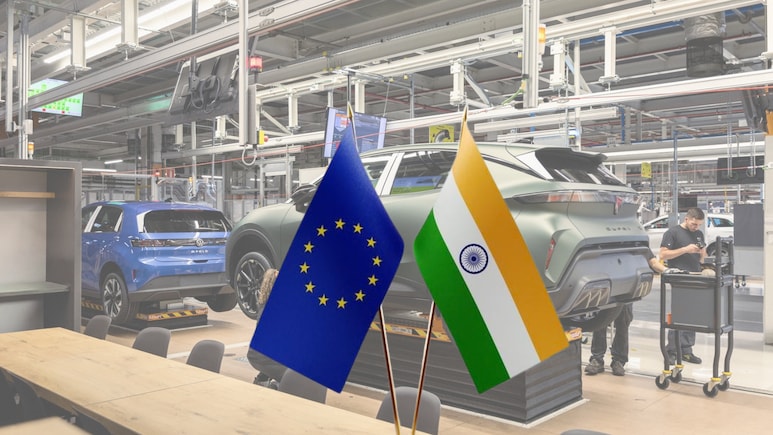
The India-EU free trade agreement will allow European Union carmakers to export up to 1 lakh passenger vehicles a year to India initially at concessional import duties, with the quota rising gradually to 1.6 lakh vehicles from the 10th year, according to the draft text of the pact released on Friday.
The tariff-rate quota (TRQ) covers EU-origin internal combustion engines (ICE) and hybrid electric vehicles (HEVs), with the concessional duty varying according to the vehicle's CIF (cost, insurance, freight) value.
The concession applies only to cars priced above Euro 15,000 (around Rs 16.6 lakh). Cars priced below this price will receive no concession.
ALSO READ - All Toll Booths On National Highways To Be Barrier-Free By March 2027: Nitin Gadkari
For cars priced between Euro 15,000 and Euro 35,000 (Rs 16.6 lakh and Rs 38.8 lakh), the in-quota duty falls from 110 per cent to 35 per cent in Year 1 (of implementation of the pact) to 10 per cent in Year 5.
And for cars priced above Euro 35,000 (around Rs 38.8 lakh), it declines from an MFN (most favoured nation) tariff of 66 per cent to 30 per cent in the first year to 10 per cent over the same period.
The quota is divided among three price bands, with 43,000 units reserved for cars priced above Euro 50,000 (around Rs 55.40 lakh) from Year 5 onward.
ALSO READ - Renault Duster-Based Niagara Pickup Unveiled: Gets 4x4, Hybrid To Come Later
The total quota for ICE and HEV passenger cars will increase from 1 lakh in the first year to 1,07,500 in the second year, 1,15,000 in the third year and 1,22,500 in the fourth year. It will rise to 1.3 lakh in the fifth year and then progressively reach 1.6 lakh from the 10th year onwards.
As per the text, India will also reduce tariffs on EU cars imported beyond the quota. Depending on whether the current tariff is 110 per cent or 66 per cent, the out-of-quota duty on cars priced between Euro 15,000 and Euro 50,000 will gradually fall to 35 per cent by Year 10.
For cars priced above Euro 50,000, it will fall to 30 per cent.
India has separately offered a quota for completely knocked-down internal-combustion and hybrid cars.
This quota is 75,000 units annually for the first five years and then declines gradually to 50,000 units from the 10th year of the implementation of the agreement.
ALSO READ - Renault Duster-Based Niagara Pickup Unveiled: Gets 4x4, Hybrid To Come Later
The in-quota duty on these vehicles falls from 13.75 per cent in Year 1 to 8.25 per cent from Year 3, compared with the current 16.5 per cent.
Concessions for battery-electric vehicles, plug-in hybrids and cars using other technologies begin in Year 5 and apply only to vehicles priced at Euro 20,000 (around Rs 22 lakh) or more.
Their CBU (completely built units) quota starts at 20,000 cars in Year 5, rises to 50,000 in the 10th year and gradually reaches to 90,000 from Year 14 onward.
The in-quota duty falls from 30 per cent in Year 5 to ten per cent in Year 10 and remains at that level, compared with the listed base duty of 110 per cent.
ALSO READ - Volkswagen Explores Partnership With JSW Group In Key India Market
Electric and other eligible cars priced below Euro 20,000 receive no concession.
Commenting on this, think tank GTRI Founder Ajay Srivastava said that the EU becomes the second major trade partner after the United Kingdom to secure automotive tariff concessions from India under an FTA.
Having established these precedents, India should soon receive similar demands for preferential market access and generous TRQs from other key trade partners such as Japan and South Korea, he said.
"India imported only 17,191 cars from the EU in 2025. Yet the trade agreement gives European automakers a first-year tariff-rate quota of 100,000 completely built-up internal-combustion and non-plug-in hybrid cars -- almost six times current imports," he added.
Srivastava said that under the agreement, India has opened parts of several sensitive markets through tariff-rate quotas and price-based concessions rather than unrestricted tariff cuts.
"These commitments cover automobiles, wine and selected alcoholic products, pork, apples, kiwifruit, pears and peaches. Imports meeting the prescribed origin, price and quantity conditions will enter at lower duties, while most imports outside these limits will continue to face the normal tariff," he said.
(Except for the headline, this story has not been edited by NDTV staff and is published from a syndicated feed.)
Track Latest News Live on NDTV.com and get news updates from India and around the world
