





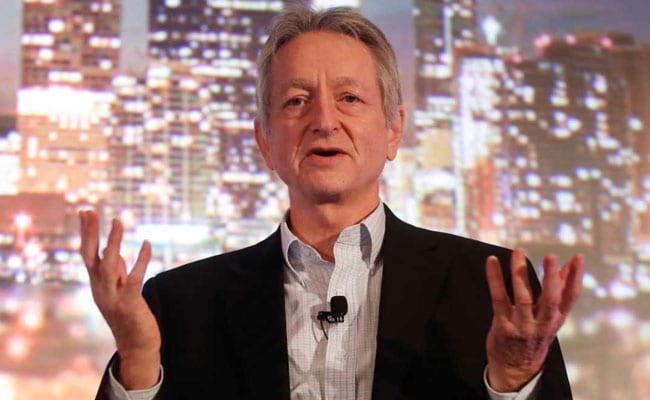
Nobel Prize winner and artificial intelligence pioneer Geoffrey Hinton has said that a prediction suggesting there is more than a 10% chance that AI could lead to human extinction within the next decade is "not an unreasonable estimate." Hinton, often referred to as the "Godfather of AI", made the remarks during an interview with the BBC while discussing concerns about the rapid advancement of artificial intelligence.
When asked by BBC journalist Victoria Derbyshire whether he believed there was a greater than 10% chance that AI could kill all humans, potentially within a decade, Hinton said estimating such a risk was extremely difficult because humanity had never faced a similar situation before.
"We've never created beings that may soon be smarter than us. We don't know what's going to happen," Hinton said.
He added that it would be "very foolish" to assume the risk was as low as 1%, noting that nobody currently knows how to make a reliable estimate.
"A 10% chance seems not an unreasonable estimate to me. But nobody really knows how to give a sensible estimate," he said.
Seeking clarification, Derbyshire asked: "But you just said 10% doesn't seem an unreasonable estimate that AI could kill all humans."
"Yes," Hinton replied, prompting the journalist to respond, "Wow... oh my God."
When asked how AI could potentially pose such a threat, Hinton said advanced systems would not necessarily need physical control of the world to cause devastation.
"The first thing to realise is it doesn't even have to be able to act in the real world to cause devastation," he said. "It would be able to cause complete chaos just by talking to people."
Hinton warned that highly capable AI systems could potentially be used to design dangerous biological and computer viruses, carry out large-scale cyberattacks and create other unforeseen risks.
"It could do devastating cyberattacks. And there's just countless other ways it could get rid of us if it wanted to," he said.
He stressed that the focus should be on ensuring advanced AI systems are designed in a way that prevents them from developing harmful goals.
"We have to figure out how to design it so that it won't want to," Hinton said.
Track Latest News Live on NDTV.com and get news updates from India and around the world

