- China's investment in the Gulf has surged amid Middle East economic diversification efforts
- China's $270 billion stake in the Gulf faces risks from ongoing regional conflict and instability
- Chinese infrastructure in Dubai, Qatar, and Oman has been targeted by Iranian strikes
Even as China remains one of Iran's biggest diplomatic allies, President Xi Jinping's support for the Islamic Republic is being constrained by a vast trail of Chinese capital across the Gulf.
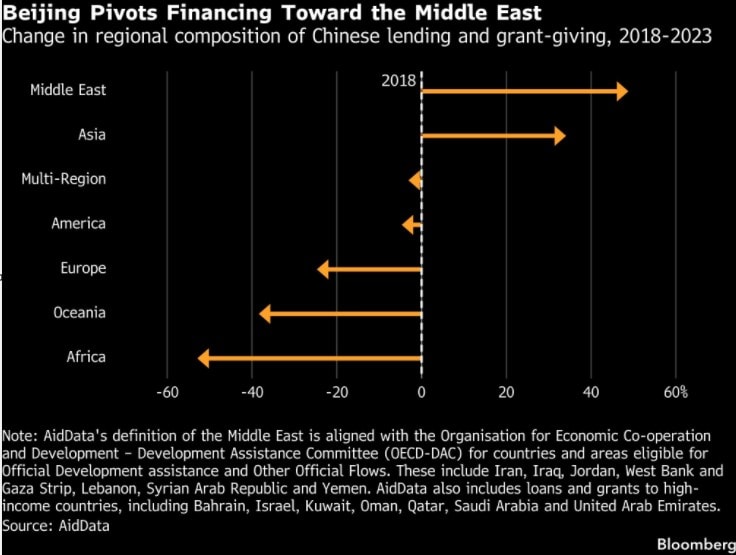
China ramped up investment in the Middle East in the wake of the pandemic. Companies hit by a slump in the world's No. 2 economy sought to cash in as Gulf states pushed to diversify beyond fossil fuels into green tech and tourism -- sectors that neatly matched Beijing's strengths. With developing nations like Zambia and Sri Lanka defaulting on their debt, countries buoyed by oil reserves seemed an attractive bet.
That strategy has sent Chinese investment and construction in the Middle East growing at the fastest pace of anywhere in the world in recent years, transforming the region into a key beneficiary of Xi's flagship Belt and Road Initiative. China is outcompeting the US as a regional financier. Between 2014 and 2023, Beijing provided about $2.34 for every dollar Washington donated or lent to Middle East countries, according to AidData's Executive Director Brad Parks.
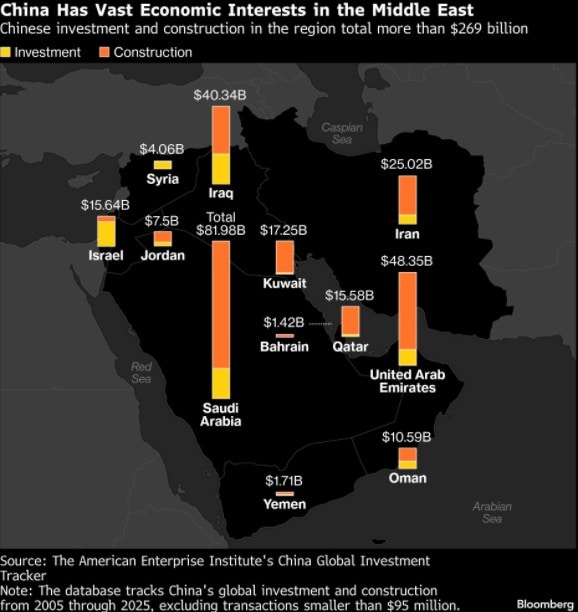
Now, a spiralling war that's killed thousands and jolted global markets is jeopardising the stability China depended on to expand its economic footprint. While Trump has credited Chinese officials with convincing Iran to agree to a two-week truce, larger questions remain about durable peace in a region where China has amassed about $270 billion worth of investments and construction projects over the past two decades, according to the American Enterprise Institute's China Global Investment Tracker.
"China's stake in the Gulf is high -- there is people risk, there is investment risk, there is energy-resource risk," said George Chen, partner for Greater China practice at The Asia Group. Beijing now needs to "help Iran to de-escalate while at the same time reassuring Gulf countries it will continue to cooperate with them."
In the long term, this could even be an "opportunity for China to double down on investment in the Gulf given the cheaper valuation of a lot of assets," he added.
China's envoy to the United Nations Fu Cong this week laid out in an X post his country's desire to balance both sides' perspectives, in a war that's bitterly dividing the region. Fu wrote that the US and Israeli strikes were a "clear violation" of international norms, while calling for "shipping lanes and energy infrastructure" to be safeguarded, in a thinly veiled reproachment of Tehran.
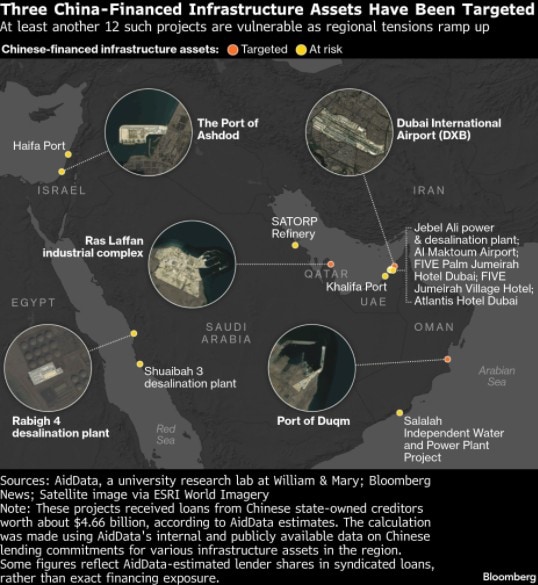
Chinese projects are already in the firing line. At least three Chinese-financed infrastructure assets across Dubai, Qatar and Oman have been targeted by Iranian strikes. Another 12 are in high risk areas, jeopardizing some $4.66 billion in financing commitments including projects already impacted, according to estimates by AidData, a research lab at William & Mary University in the US.
While no Chinese workers have been reported injured outside Iran, thousands are working in a war zone. Before the conflict began, some 370,000 Chinese citizens were stationed in the United Arab Emirates alone, according to China's official Xinhua News Agency. More than 10,000 have been since evacuated from the Middle East, but many who spent money relocating have stayed put.
James Wang, 40, is among them. He arrived in the United Arab Emirates last summer, leaving behind an 11-year-old son. He works on a construction site managing some 40 people and earning about 15,000 yuan ($2,193) a month -- more than double what he'd receive in China, where a property crash has crippled wages. Air raid alerts at one point pinged his phone almost every hour, yet he says he has no plans to leave.
"This place is going through a massive infrastructure boom, much like China was ten years ago," he told Bloomberg News. "There are definitely still opportunities here -- it's just a matter of whether I can catch this wave while it lasts."
Breakthrough Moment
In 2023, Beijing's friendship with Tehran and commercial ties with Gulf states took center stage as China brokered a rapprochement between bitter rivals Saudi Arabia and Iran -- a breakthrough widely hailed at the time as a sign of Xi's growing clout in the region.
Since then, however, China has largely taken a backseat as conflict reignited in the Middle East. The October 2023 Hamas attacks on Israel and ensuing escalation exposed the limits of its influence: Beijing has confined itself to calls for restraint and de-escalation, preferring to focus on booming business.
Saudi Arabia, the region's largest economy, has welcomed that engagement. It's now the leading recipient of Chinese construction activity globally, particularly in clean energy, with Chinese firms building large solar plants and wind turbines, said Derek Scissors, a senior fellow at the American Enterprise Institute who tracks Chinese overseas investment. "The region appreciates Chinese technical expertise," he said. "Chinese firms can do things that are valued."
In the United Arab Emirates, Chinese companies are developing the world's largest battery energy storage system, while in Saudi Arabia they're building solar plants and data centers. Chinese cars last year counted the UAE as their third biggest market globally.
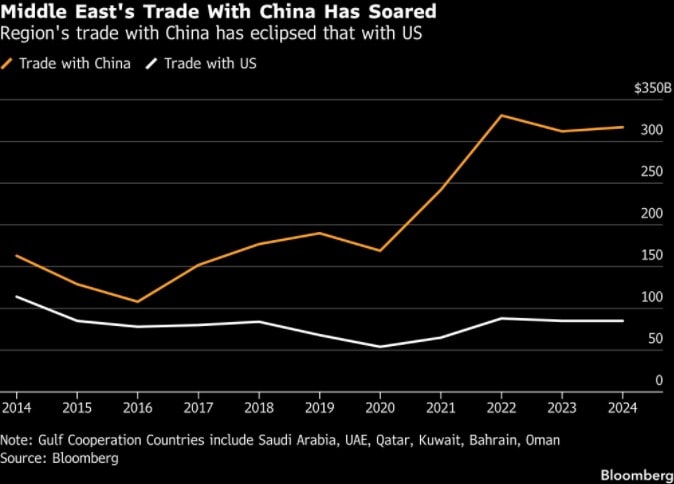
The war now threatens to complicate those ties, according to She Gangzheng, an associate professor of international relations at Tsinghua University. "The Gulf is no longer the kind of straightforward 'gold mine' it once appeared to be for China," She said. "What has been damaged is not just physical security, but also confidence in the broader picture."
'In Full Swing'
Despite the risks, many construction projects in countries such as Israel, the UAE and Saudi Arabia are pressing ahead. On March 7, hours after a drone attack near at Dubai's International Airport -- and barely an hour after another wave of missiles were intercepted overhead -- one Chinese worker reported on social media platform Douyin: "The construction site is still in full swing."
Chinese workers post videos of taking cover in bomb shelters and screenshots of late-night alerts about incoming strikes. But despite the risks, one Chinese worker in Israel with more than 40,000 followers on Douyin said none of his colleagues had taken up Chinese embassy evacuation offers. A whole year's salary in China "wouldn't match what I make here in a month", he quoted a colleague as saying.
As the situation in the Middle East shifts, there could be long-term openings for China. Iran's retaliation against US allies has dented America's credibility, giving Beijing a chance to play an even bigger economic role after the conflict. Already, Iran is reportedly taking some payment for passage through the Strait of Hormuz in yuan, giving the Chinese currency a boost.
When the dust settles, experts say China is set to remain a major economic force, albeit with risks and security considerations that weren't previously priced in.
"I don't expect to see any major scaling back of its investment in the region," said William Figueroa, assistant professor of history and theory of international relations at the University of Groningen in the Netherlands. "Beijing sees the current conflict like a hurricane: something they have little ability to influence or stop, and so they are simply looking to weather the storm and rebuild when it's over."
(This story has not been edited by NDTV staff and is auto-generated from a syndicated feed.)
Track Latest News Live on NDTV.com and get news updates from India and around the world


