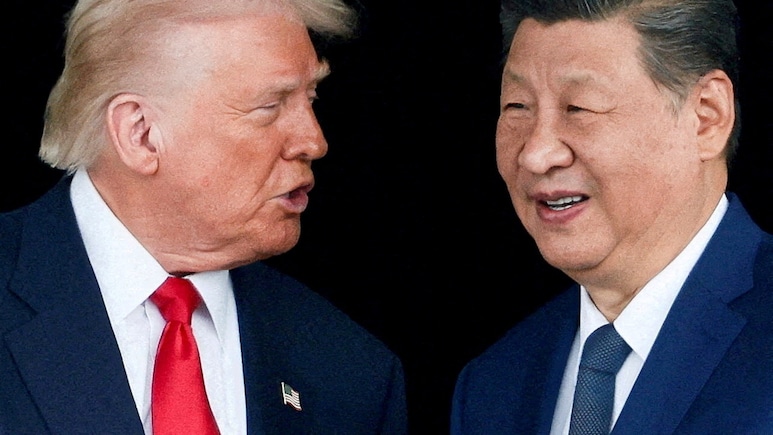
As Donald Trump neared his self-imposed deadline to extinguish Iran's "entire civilization," it became apparent one country had enough clout to convince Tehran to deescalate: America's biggest rival, China.
In the hours after a ceasefire publicly brokered by Pakistan was announced, Iranian officials reportedly credited a last-minute push by China with securing their acceptance, a claim soon after validated by Trump. Pakistani Prime Minister Shehbaz Sharif thanked China for its support, while the White House said Beijing's role in the truce took place at the "top levels" of the US and Chinese governments.
-

-
 Who Is Rajiv Mehta? Lilavati Hospital Trustee To Speak At NDTV World Summit 2026
 -
 Ex-CIA Director To Decode 'War In Times Of AI' At NDTV World Summit
 -
 From Call Centre To Billion-Dollar Disruptor: Nikhil Kamath At NDTV World Summit
 -
 'Every 5 Years, You'll See A New India': Swami Sarvapriyananda Ahead Of NDTV World Summit
 -
 AI Can Think, But Can It Be Conscious? Swami Sarvapriyananda Weighs In
 -
 Alain Ebobisse, Africa50 CEO, To Attend NDTV World Summit 2026. All About Him
 -
 Kriti Sanon At NDTV World Summit: A Look At Her Career And Business Ventures
 -
 Ex-CIA Director To Decode 'War In Times Of AI' At NDTV World Summit
 -
 Who Is Vikram Rai, CEO, South Asia GE Aerospace, Set To Attend The NDTV World Summit 2026
 -
 Rahul Kanwal: The World Is Changing. What Comes Next? | NDTV World Summit 2026
China hasn't confirmed — or denied — reports of its pivotal part in brokering the detente, and President Xi Jinping still hasn't publicly commented on the conflict that's choked a fifth of global oil supply. But the decision to step in reflects Beijing's ability to straddle strong ties with Iran, Gulf nations and Trump, and marks a departure from China's long-held preference of staying on the sidelines.
The shift came down to economics, as the conflict risked disrupting China's energy supplies, said Zongyuan Zoe Liu, senior fellow for China studies at the Council on Foreign Relations. Data due next week is expected to show a slowdown in industrial output and exports in the month after the US and Israel triggered the war.
"China acted because the war in Iran was directly threatening the economic conditions it depends on for growth and political stability at home," Liu said. "Trump publicly crediting China is precisely the kind of political capital Beijing wanted ahead of a rescheduled summit."
A pause to the fighting would smooth Trump's visit to Beijing next month, with China's role leaving the US leader in debt to his Chinese counterpart. Trump is already heading to Beijing with his punitive tariffs struck down by the Supreme Court, and with the US military presence in Asia diminished by resources diverted to the Middle East.
For Beijing, however, wading into negotiations over a war with no easy resolution carries risks, even if that action is limited to behind-the-scenes pressure on a friend reliant on Beijing's support. China is Iran's largest trading partner and the primary buyer of its oil.
Underscoring the risks, Pakistani officials reportedly told the Guardian that while Islamabad acted as mediator in recent talks, China functioned as "guarantor," promising Iranian officials they wouldn't be assassinated during any future negotiations. It's unclear how Beijing would offer such an assurance, or the motivation for doing so given the repercussions should something then go wrong.
When asked about the report, Chinese Foreign Ministry spokeswoman Mao Ning sidestepped the question at a regular briefing on Thursday, saying China "always advocates an early end to hostilities and resolve differences through diplomatic and political means to restore stability and peace in the Middle East."
Mediation Efforts
For years, Xi has brushed off appeals from Western leaders to use his friendship with Vladimir Putin to help end the war in Ukraine, instead supplying Moscow with diplomatic and economic support as he bolstered a key partner in opposing the US-led world order.
While China did burnish its credentials by presiding over a detente between Saudi Arabia and Iran in 2023, it's unclear how big Beijing's role was in reaching that deal.
Other mediation efforts have been confined to conflicts on China's doorstep, such as in Myanmar where officials have played a key role in brokering ceasefire talks for the regime or, more recently, hosting seven days of peace talks between Afghanistan and Pakistan. That move could help calm tensions in Islamabad ahead of the first round of planned Iranian-US talks in the Pakistani capital on Saturday, with Vice President JD Vance leading the American delegation.
Ahead of those talks, Trump described Iran's leaders as "much more reasonable" than their public comments would suggest in a phone interview with NBC News.
Bringing Iran to the negotiation table, however, is only the first step to end hostilities. Tehran is seeking security guarantees that it won't be attacked again, and has publicly asked Beijing to play such a role — a request analysts say China is unlikely to accept.
"It is difficult to imagine China offering explicit security guarantees to Iran during or after a ceasefire," said Tong Zhao, a senior fellow at the Carnegie Endowment for International Peace. "Such commitments would run counter to its longstanding aversion to military risk — especially where confrontation with the United States is conceivable."
Beijing could provide economic support to stabilise Iran's economy or assistance in rebuilding aspects of its defense capacity, he said, adding that reports China continues to export sodium perchlorate to Iran — a precursor for missile fuel — point in this direction.
A China-Arab summit long planned for this year will give officials from the Middle East another chance to press Beijing to take a bigger role, said Wang Yiwei, a professor of international relations at Renmin University and a Chinese former diplomat.
"China definitely isn't happy about the blockage of the Hormuz Strait," he added. "But how to guarantee the future of the Hormuz Strait, or the Red Sea, as a public good for the whole world is a big question."
(This story has not been edited by NDTV staff and is auto-generated from a syndicated feed.)
Track Latest News Live on NDTV.com and get news updates from India and around the world


