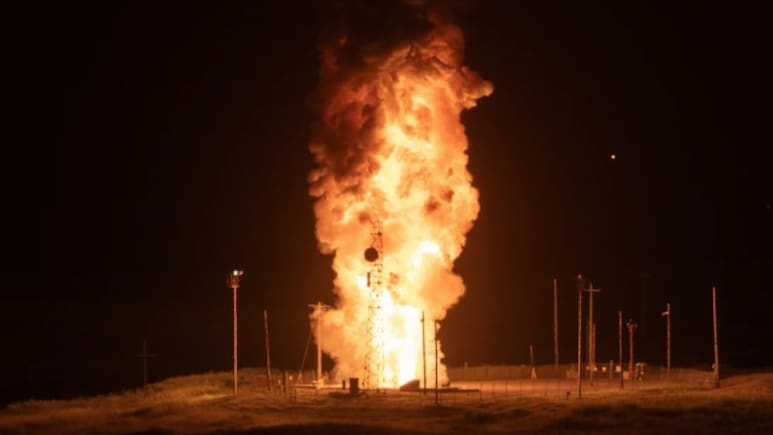
Almost a week into the US-Israel's war on Iran, America tested a ballistic missile off the California coast on Tuesday night.
The unarmed Minuteman III intercontinental ballistic missile was launched from the Vandenberg Space Force Base near Santa Barbara, the US Space Force said. The two reentry vehicles on the missile travelled thousands of miles to hit a predetermined target at the Kwajalein Atoll in the Marshall Islands.
The US Space Force stated that the launch, designated GT 255, had been planned for years and was not in response to world events.
The Minuteman weapons system was first conceived in the 1950s. The newest missile in the range is an element of the US' strategic deterrent forces under the Air Force Global Strike Command's control.
All About Minuteman III missiles
The LGM-30G Minuteman III can carry nuclear warheads 20 times more powerful than the atomic bomb dropped on Hiroshima, the NY Post reported.
The Minuteman III is the sole land-based component of America's nuclear triad. With a fast launch time, almost 100 per cent testing reliability, and backup airborne launch controllers to preserve retaliatory capabilities, the non-mobile, silo-based, land-based weapon is classified as an intercontinental range ballistic missile (ICBM) as its range is over 5,500 km.
The missiles are stored in silos scattered across the American West. They are designed to deter nuclear attacks and ensure that the US will be able to strike back if it is ever hit with such weapons.
It can travel at speeds of over 15,000 mph (24,000 kmph) and strike anywhere in the world, including North Korea and Iran.
They can carry up to three independently targeted Mk 12A nuclear warheads up to a maximum distance of 13,000 km (8,000 miles), including North Korea and China.
The present Minuteman III missiles have only one warhead due to a nuclear weapons reduction treaty with Russia.
Coming to the name, the "L" in LGM stands for the Department of Defence designation for silo-launched; "G" denotes surface attack; "M" means guided missile; the 30 in the name stands for the Minuteman missile series and the G after “30” signifies the current Minuteman III, as per the US Air Force.
The current ICBM force consists of 400 Minuteman III missiles located at the 341st Missile Wing at Malmstrom AFB, Montana, the 90th Missile Wing at F.E. Warren AFB, Wyoming, and the 91st Missile Wing at Minot AFB, North Dakota.
Why Did The US Conduct The Test?
Lt. Col. Karrie Wray, 576th Flight Test Squadron commander, stated in a press release that the launch allowed the US military to assess the “performance of individual components of the missile system”.
Kray explained, “By continually assessing varying mission profiles, we are able to enhance the performance of the entire ICBM fleet, ensuring the maximum level of readiness for the land-based leg of the nation's nuclear triad.”
Gen. S.L. Davis, commander of AFGSC, said that the data gathered from the launch would ensure that “long-range strike capabilities are not just a theoretical concept, but a proven, reliable, and lethal force, ready to defend the nation at a moment's notice.”
Multiple government partners were involved in the preparation of the launch, with airmen from the 91st Missile Wing at Minot AFB providing direct air support.


