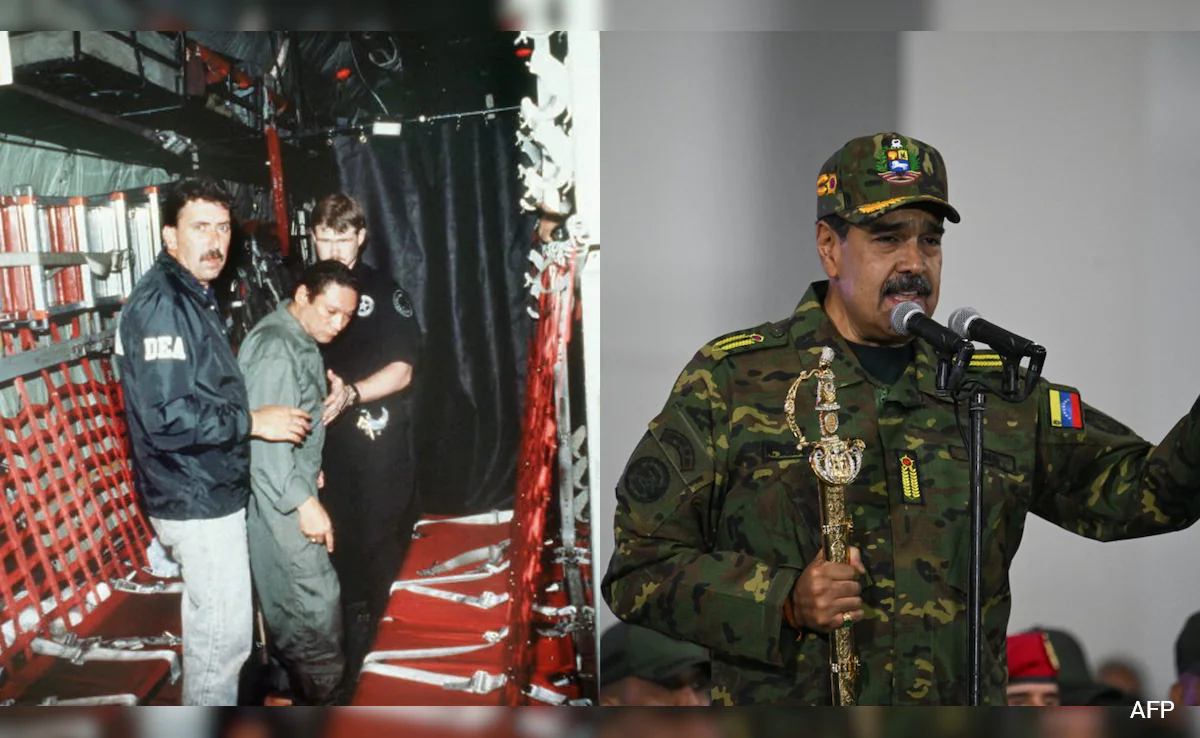
The United States launched what President Donald Trump described as 'large-scale strikes against Venezuela' on Saturday, an action that was said to be carried out "in conjunction with US law enforcement".
The operation follows weeks of pressure from Washington aimed at removing Venezuelan President Nicolas Maduro, whom US authorities accuse of sending drugs and gang members into the country.
The attack marks Washington's first direct military action in Latin America since 1989, when US forces entered Panama to topple military ruler Manuel Noriega, a campaign that would become infamous not just for its firepower but for its soundtrack.
READ | Venezuela President Maduro, Wife Captured, Flown Out Of Country: Trump
Back then, former US President George H.W. Bush authorised troops to move into Panama to "protect the lives of American citizens" and bring Noriega "to justice". The mission, formally named Operation Just Cause, saw more than 20,000 American soldiers deployed to seize strategic locations across the country.
The invasion followed the killing of an American serviceman by Panamanian forces and came as Noriega faced a US indictment on drug trafficking charges and allegations that he had manipulated the 1989 election.
Official figures later put the deaths at 514 Panamanian soldiers and civilians, though local organisations have claimed the number was closer to 1,000. Twenty-three US military personnel were killed.
READ | Why US Attacked Venezuela, Captured President Nicolas Maduro
As US forces closed in, Noriega sought refuge inside the Vatican's diplomatic mission. What followed was one of the most unusual episodes of modern warfare. Troops stationed outside the building blasted rock music at high volume to force him out. This was a form of psychological pressure that drew global attention.
Tracks included "Give It Up", by K.C. And The Sunshine Band, "No More Mister Nice Guy", by Alice Cooper, "Paranoid", by Black Sabbath, "Welcome to the Jungle", by Guns N' Roses, "Wanted Dead or Alive", by Bon Jovi, and "The End", by The Doors.
It was a controversial tactic even within Washington. The music was eventually switched off after several days, with Bush's national security adviser Brent Scowcroft later calling the move "undignified".
After 11 days inside the embassy, Noriega surrendered on 3 January 1990. He was flown to Miami by US Drug Enforcement Administration officials, where he stood trial and was convicted of drug trafficking, racketeering and money laundering.
Noriega spent the remainder of his life in detention, first in the US, then in France, and later under house arrest in Panama. He died in 2017 at the age of 83 due to complications following surgery to remove a brain tumour.
Track Latest News Live on NDTV.com and get news updates from India and around the world


