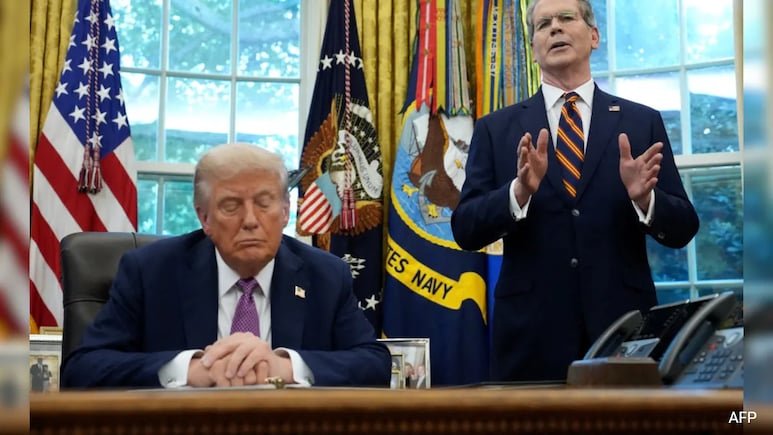
- US Treasury Secretary Scott Bessent criticised Europe’s new trade deal with India.
- Bessent accused Europe of indirectly funding the Ukraine war by buying refined products from Russian oil
- The US imposed a 25% tariff on India for Russian oil, but Europe declined to join similar sanctions
US Treasury Secretary Scott Bessent has criticised Europe's newly signed free trade agreement with India, accusing European leaders of undermining their own stance on the Ukraine war by prioritising economic interests over geopolitics and energy security.
In a wide-ranging interview with US media, Bessent reacted to the landmark EU-India trade deal by arguing that while countries are free to pursue their own economic interests, Europe's choices have exposed what he called a "deep contradiction" at the heart of its Ukraine policy.
"Europe and India signing this massive trade deal--does that threaten America? Again, they should do what's best for themselves," Bessent said. "But I find the Europeans very disappointing because they are on the front line of the Ukraine-Russia war."
Bessent accused European countries of indirectly financing the conflict they publicly condemn. After Russia invaded Ukraine and the imposition of Western sanctions, India significantly increased its purchases of discounted Russian crude oil. According to Bessent, Europe then became a major buyer of the refined products made from that oil.
"India started buying sanctioned Russian oil, and guess who was buying the refined products? The Europeans," he said. "So the Europeans have been funding the war against themselves, something you couldn't have made up."
The US Treasury secretary said the United States responded by imposing a 25 per cent tariff on India for purchasing Russian oil, but Europe declined to join Washington in similar measures. He suggested that the reluctance was driven in part by Europe's desire to keep the trade negotiations with India on track.
"The Europeans were unwilling to join us, and it turns out because they wanted to do this trade deal," Bessent said. "Every time you hear a European talk about the importance of the Ukrainian people, remember that they put trade ahead of the Ukrainian people. Trade, European trade, more important than ending the war in Ukraine."
Bessent acknowledged that Europe's heavy dependence on energy imports has shaped its decisions, but he framed the issue as a moral and strategic trade-off. "They need energy, I guess, which is part of their issue. At a price, they want cheap energy," he said, adding that the US could also benefit from cheaper energy "if we were willing to buy sanctioned Russian oil."
The comments highlight growing tensions within the Western alliance over how strictly to enforce economic pressure on Russia while managing domestic economic and political costs. European officials have argued that energy security and economic stability are critical, even as they maintain support for Ukraine.
Bessent also briefly touched on relations with Canada, acknowledging a recent "rift" and differing accounts between Washington and Prime Minister Mark Carney about a recent call following the Davos meetings, though he did not elaborate further.
The EU-India trade pact, one of the largest such agreements in years, is expected to deepen economic ties between the two sides. But Bessent's remarks underscore how the deal is also being interpreted in Washington as a symbol of Europe's increasingly complex and controversial balancing act between geopolitics, trade, and energy security.
Track Latest News Live on NDTV.com and get news updates from India and around the world


