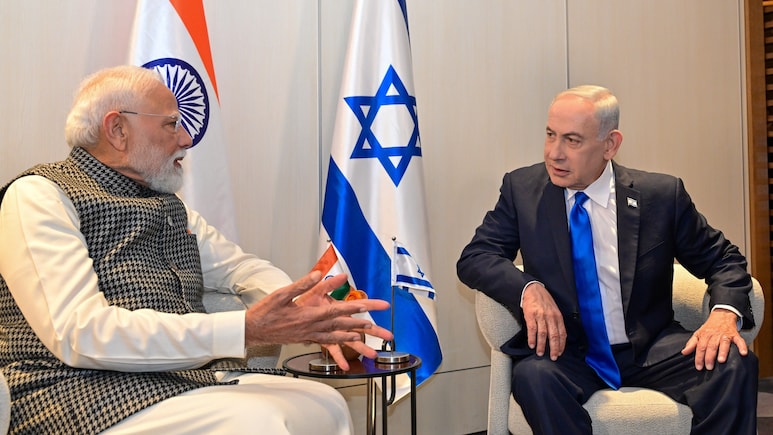
The joint US-Israeli strikes on Iran were conducted during an "operational opportunity" that arose "only after Prime Minister Narendra Modi left" Tel Aviv, Israeli envoy Reuven Azar told The Indian Express. LIVE UPDATES
According to Azar, the Israeli Ambassador to India, it was not known during PM Modi's visit that the strikes on Tehran would be undertaken.
"It was an operational opportunity that came up only after Prime Minister Narendra Modi left. Of course, during the conversations with PM Modi during the visit, we talked about regional development, but we couldn't have actually shared something that we didn't know," he told The Indian Express.
He added that it took about two days after PM Modi left to decide to attack Iran, and that they received the approval of the security cabinet on Saturday (February 28) morning.
PM Modi was in Israel for a two-day state visit on February 25 and 26 - his second trip to the country after the landmark 2017 visit that ended decades of diplomatic restraint and brought India-Israel ties fully into the open. The two countries elevated their ties to a 'Special Strategic Partnership' and signed 17 pacts after talks between PM Modi and his Israeli counterpart Benjamin Netanyahu.
Video: Drone Strike Near US Consulate In Dubai Causes Massive Fire
On February 28, the US and Israel, in a joint operation, attacked Iran, targeting many cities, including the capital, Tehran. The strikes, named 'Operation Epic Fury', were launched after stalled nuclear talks and claims that Tehran had resumed its nuclear activities. Over 700 people have been killed in the strikes.
Hours after the joint attack, Iran launched missiles - many of which hit Gulf regions including Dubai, Abu Dhabi, Qatar, and Bahrain. Tensions in the Middle East continued to escalate as Iran vowed to avenge the killing of its Supreme Leader, and US President Donald Trump warned it was "too late" for Iran to seek talks to "escape a war".
According to the Israeli envoy, they had to "create the intelligence capability to understand the Iranian regime, their military machinery, and to have all the means necessary to know what they are intending to do next, including who are the people there making decisions, where exactly they are located, and all the capabilities that are threatening Israel".
"So, only towards that effort, we have invested billions of dollars throughout the years because of the nature of the threat. Israel had to build up its military and develop the technologies that allow it to overcome the air defence systems of Iran. In terms of defence capabilities, we had to develop different systems to try to stop the barrage of missiles, ballistic missiles and rockets that were being fired at Israel, not only from Iran itself, but also from other countries where the proxies of Iran were residing," Azar said.
Who's Mojtaba Hosseini Khamenei, Set To Become Iran's Next Supreme Leader
Crediting the Abraham Accords (a set of agreements that established diplomatic normalisation between Israel and several Arab states), Azar said they were able to coordinate their military operations and the surveillance of the air of the Middle East, together with CENTCOM, the Central Command of the US Forces in the region.
"And now, before this operation, we've been coordinating with the United States for a long time and been waiting for the right moment, which we didn't know when was going to happen," he said.
Iran's Supreme Leader dead
Iran's Supreme Leader, Ayatollah Khamenei, was killed in the joint US-Israel strikes on Tehran - when he was in his 'compound'. Along with him, his daughter, son-in-law, and granddaughter were killed. Khamenei's wife, Mansoureh Khojasteh Bagherzadeh, also died after succumbing to wounds sustained during the strikes.
Khamenei, who ruled Iran for 36 years, had no designated successor.
A three-member Iran's interim Leadership Council comprising - Ayatollah Alireza Arafi, President Masoud Pezeshkian, and Chief Justice Gholamhossein Mohseni Ejei - had assumed the Supreme Leader's responsibilities. However, Israeli media reported today that Khamenei's second-eldest son, Mojtaba Hosseini Khamenei, has been elected as the next Supreme Leader of Iran by the country's Assembly of Experts.
Track Latest News Live on NDTV.com and get news updates from India and around the world


