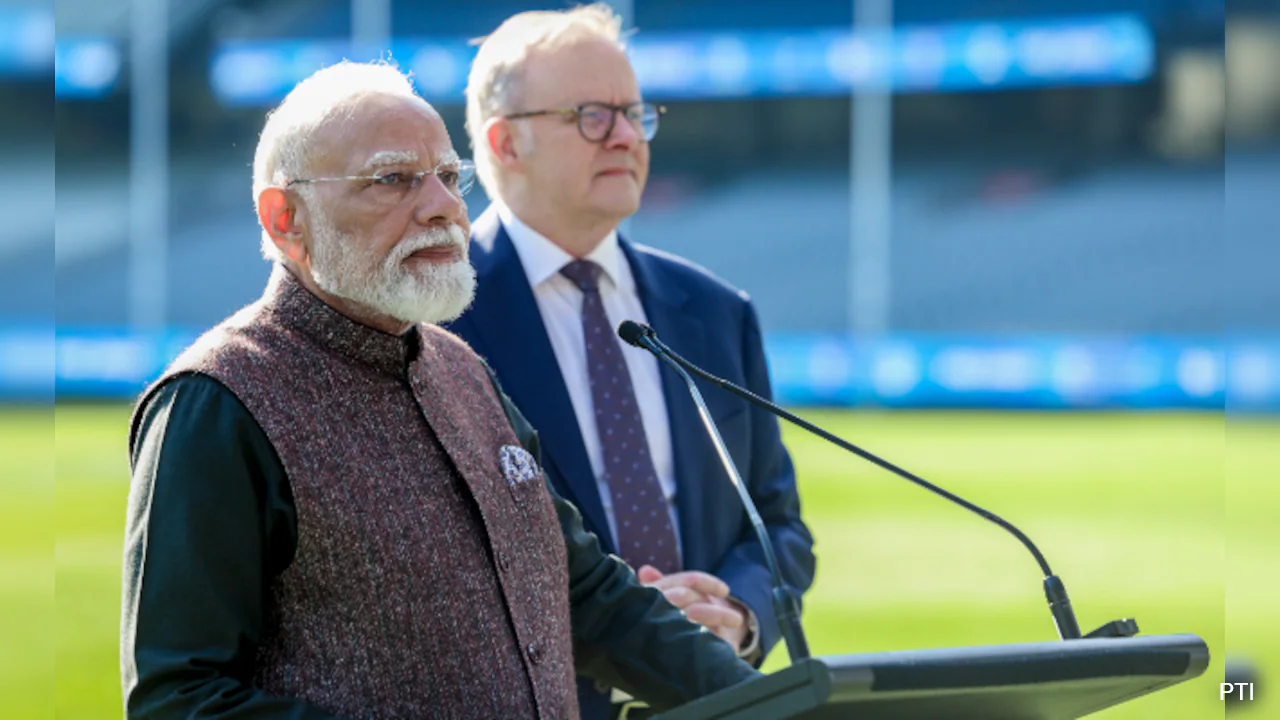
Prime Minister Narendra Modi wrapped up his third visit to Australia this week, a trip that culminated in a high-profile appearance at the Melbourne Cricket Ground and produced a fresh framework of cooperation spanning trade, defence, cybersecurity and critical minerals.
In an exclusive interview with NDTV's Senior Executive Editor Aditya Raj Kaul, Australia's Assistant Minister for Science, Technology and the Digital Economy, Andrew Charlton, called it a landmark moment in the India-Australia relationship, the very first time an Indian prime minister has visited the country three times.
At the heart of the visit is the newly unveiled PACTS framework, an agreement built around supply chain resilience, critical technology sharing, cybersecurity and defence research collaboration.
Charlton described it as the next chapter in a partnership that already includes more than a dozen digital collaborations built up over recent decades. He said the two countries were now looking to deepen cooperation in newer frontier areas, cyber, quantum computing and artificial intelligence, describing Australia and India as fellow democracies in the Indo-Pacific with "lots of mutual opportunities" to work together.
Space Emerges As A New Frontier
One of the more striking threads to emerge from the conversation was space collaboration, tied closely to India's Gaganyaan human spaceflight programme, which is set to send three missions into orbit. Charlton said Australia was eager to support India's space ambitions through technology transfer and the involvement of the Australian Space Agency, calling India's rise as a spacefaring nation something that would "benefit the whole world."
AI Diplomacy And The Shadow Of Global Conflict
Charlton also reflected on India's hosting of the AI Impact Summit in New Delhi earlier this year, an event he attended in person, with the next edition slated for Switzerland. He framed India's role at that summit as one of moral leadership, pointing to the country's digital public infrastructure, its payments systems and identification platforms, as proof that technology can be built to serve ordinary citizens rather than concentrate power.
That framing, he argued, mattered at a moment when publics worldwide are anxious about AI's effect on jobs and democratic institutions.
Pressed on whether critical technologies risk being weaponised on modern battlefields, Charlton did not dodge the question. He acknowledged that AI carries real risks alongside its productivity gains, and argued those risks cannot be contained within any single country's borders, making multilateral cooperation, including through forums like India's AI summit, essential to managing them.
China, The Quad And A Shifting Indo-Pacific
The conversation also turned to the region's more difficult undercurrents, China's own rapid advances in AI and digital infrastructure, and questions over whether the Indo-Pacific still commands the same strategic priority in Washington, especially after the US military's renaming of its Indo-Pacific Command back to Pacific Command.
Charlton pushed back gently on the premise, describing Australia as sitting at the literal centre of the Indo-Pacific, bordered by both the Indian and Pacific Oceans, and said Canberra was committed to working with India, China and the United States alike to keep the region's growth engine running.
Bondi Beach And Online Radicalisation
Kaul also raised the Bondi Beach terror attack, one of the worst in Australia's history, and the broader problem of lone-wolf radicalisation driven by social media rather than organised terror networks.
Charlton acknowledged the challenge as a global one, saying Australia was working to strengthen social cohesion and reduce radicalisation while insisting the country remained fundamentally multicultural and peaceful.
Diaspora, Trade And Cricket Diplomacy
Charlton was emphatic about the role of the roughly one-million-strong Indian diaspora in Australia, crediting its contribution to business and technology as one of the real strengths of the bilateral relationship, alongside its presence in media, sport and the arts. On trade, he confirmed a senior Australian trade delegation is set to travel to India in December, building on the momentum of PM Modi's visit.
The trip's symbolic close at the MCG, complete with photo opportunities alongside cricketing legends from both nations, underscored a theme Charlton returned to repeatedly: a rivalry that has evolved into partnership.
He pointed to the growing number of Australian players and coaches in the IPL, and noted an upcoming league to be played in Chennai later this year, as evidence that cricket, once purely a contest between the two nations, is increasingly becoming something they build together.
Taken together, the interview suggests a relationship moving well beyond the traditional pillars of trade and diaspora ties into a more strategic partnership on technology, space and security, even as both sides navigate a region contending with China's rise and shifting American priorities.
Track Latest News Live on NDTV.com and get news updates from India and around the world


