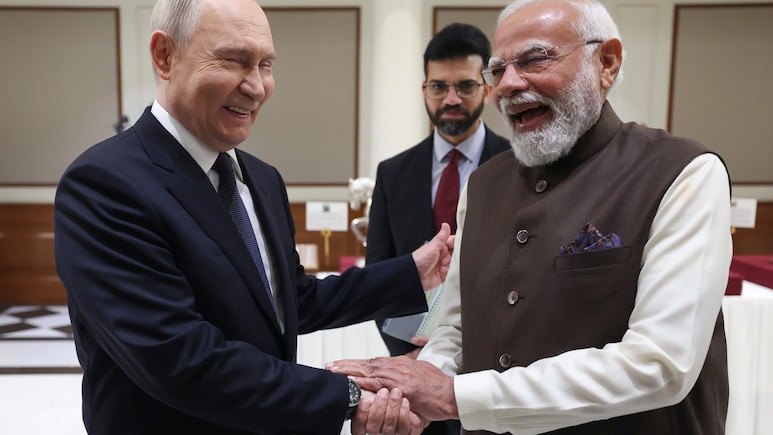
India and Russia on Friday used their 23rd Annual Summit to put a sharper economic, defence and technological edge on what both sides described as a "time-tested progressive partnership", unveiling a 2030 roadmap that links trade expansion, energy security, nuclear and space cooperation with a shared pitch for a multipolar world order.
President Vladimir Putin's state visit to New Delhi, marking 25 years of the India-Russia Strategic Partnership first declared in 2000 - ended with a joint statement that stressed mutual trust, "respect for core national interests" and a relationship both leaders said had remained "resilient" despite a "complex, challenging and uncertain geopolitical situation".
Big Economic Bet: $100 Billion Trade And Rupee-Ruble Style Payments
On the economic front, Prime Minister Narendra Modi and President Putin reaffirmed an ambitious target of US$100 billion in bilateral trade by 2030, with a clear emphasis on making that trade "balanced and sustainable" and boosting Indian exports to Russia.
A new "Programme 2030" for strategic areas of economic cooperation was adopted, and both sides welcomed progress on negotiating a Free Trade Agreement in goods between India and the Eurasian Economic Union, covering sectors of mutual interest. They also tasked negotiators to speed up work on a bilateral investment protection agreement.
Calling for an open and non-discriminatory multilateral trading system with the WTO at its core, the statement zeroed in on practical bottlenecks: tariff and non-tariff barriers, logistics, connectivity gaps, payment mechanisms, and insurance and reinsurance issues - all flagged as key to hitting the 2030 trade target.
Notably, Moscow and New Delhi agreed to continue joint work on using national currencies for bilateral settlements, and to explore interoperability between national payment systems, financial messaging networks and even central bank digital currency platforms - a signal that both sides want to de-risk trade from third-country financial restrictions.
The leaders also highlighted long-term fertilizer supplies to India and the possibility of joint ventures in the sector, and welcomed new agreements on mobility of skilled workers. Two new Indian consulates in Yekaterinburg and Kazan are set to deepen regional economic and people-to-people links.
Energy, Arctic And Connectivity: Strategic Depth
Energy cooperation was described as a "significant pillar" of the relationship, with the statement listing a wide spectrum - oil and petroleum products, refining and petrochemicals, upstream services and technologies, LNG and LPG infrastructure, underground coal gasification and nuclear projects. Both sides acknowledged investment-related issues in this space and pledged to resolve investor concerns more quickly.
The summit put fresh emphasis on connectivity and regional resources. The two sides agreed to deepen cooperation on the International North-South Transport Corridor, the Chennai-Vladivostok maritime corridor, and the Northern Sea Route, including training specialists for polar shipping.
In the Russian Far East and Arctic, India and Russia reaffirmed plans to expand trade and investment in agriculture, energy, mining, diamonds, pharmaceuticals, maritime transport and manpower under an existing 2024-2029 cooperation programme. The statement also underlined growing collaboration on critical minerals and rare earths, seen as crucial for emerging technologies and advanced manufacturing.
Nuclear And Space: Kudankulam, New Site And Joint Tech
Civil nuclear cooperation featured prominently. The two sides pledged to broaden work across the nuclear fuel cycle, life-cycle support for the Kudankulam Nuclear Power Plant (KKNPP) and non-power applications of nuclear technology. Russia's role was explicitly linked to India's goal of ramping up nuclear generating capacity to 100 GW by 2047.
They welcomed progress on KKNPP and committed to sticking to timelines for equipment and fuel supplies. India will "strive to finalise" the formal allotment of a second nuclear power plant site for a Russian-designed project, with both sides agreeing to accelerate technical and commercial discussions on VVER reactors, joint R&D, localization and joint manufacturing of nuclear equipment and fuel assemblies.
In space, the statement pointed to an "enhanced partnership" between ISRO and Roscosmos in peaceful uses of outer space, including human spaceflight programmes, satellite navigation, planetary exploration and rocket engine development and production.
Defence Ties Pivot To Make In India And Exports
Defence and military-technical cooperation - long described as a pillar of the relationship - is set for a structural shift. While reaffirming the centrality of the India-Russia Intergovernmental Commission on Military & Military-Technical Cooperation, the leaders said the partnership is "reorienting" towards joint R&D, co-development and co-production of advanced defence technologies and systems, in line with India's push for self-reliance.
Both sides agreed to encourage joint manufacturing in India of spares, components and aggregates for Russian-origin equipment under the Make in India framework, not only to meet Indian forces' needs but also for export to "mutually friendly" third countries. They expressed satisfaction over regular high-level defence contacts and committed to maintaining the momentum of INDRA joint military exercises and military delegation exchanges.
Visas, Culture And Tourism: Soft Power Gains
Cultural and educational ties were projected as an "important component" of the partnership. The two sides agreed to hold Cultural Exchange Festivals on a parity basis, expand cooperation in the film industry through co-productions and festival participation, and deepen academic mobility and joint research between universities.
Tourism has seen a "steady increase", and both countries welcomed simplified visa formalities, including e-visas, with a promise to work towards further visa liberalisation. The statement also noted longstanding educational links and pledged continued efforts to ensure the well-being of students.
Multilateral Message: UNSC Reform, Global South And BRICS
On the global stage, India and Russia reaffirmed their close coordination at the UN, G20, BRICS and SCO, calling for "reinvigorated multilateralism" and stressing the primacy of the UN Charter and international law.
Crucially, Russia reiterated its strong backing for India's bid for permanent membership of a reformed and expanded UN Security Council, and both called for comprehensive UNSC reform to reflect contemporary realities.
They lauded the "practical legacy" of India's G20 Presidency in 2023, including spotlighting Global South priorities and the admission of the African Union as a full G20 member. Russia pledged full support for India's BRICS chairship in 2026, as both sides backed an expanded BRICS focused on political-security, economic-financial and people-to-people pillars.
In security and arms control, both countries underscored their commitment to non-proliferation of weapons of mass destruction, Russia again supporting India's membership of the Nuclear Suppliers Group. They also called for negotiations on a legally binding instrument to prevent an arms race in outer space, building on a Russian-sponsored draft treaty and a 2024 UN expert group report.
Counter-Terrorism, Regional Crises And Climate
The joint statement devoted substantial space to counter-terrorism, with both leaders condemning attacks in Pahalgam (Jammu & Kashmir) on April 22, 2025, and at Crocus City Hall in Moscow on March 22, 2024, and calling for zero tolerance. They demanded concerted action against all UN-listed terrorist groups, urged adoption of the long-pending Comprehensive Convention on International Terrorism, and flagged the need to tackle misuse of new technologies by terror networks.
On regional issues, India and Russia highlighted close coordination on Afghanistan, supported counter-terrorism measures there and stressed the need for uninterrupted humanitarian aid. On West Asia and Gaza, they called for restraint, protection of civilians, adherence to international law and commitment to agreements that can ensure cessation of conflict and sustainable peace.
Climate change and green transitions also featured, with both sides backing the UNFCCC and Paris Agreement, welcoming the work of a Joint Working Group on climate change and low-carbon development, and promising cooperation on Article 6 mechanisms, low-carbon technologies and sustainable finance. They noted new BRICS platforms on climate research and trade-climate-development, and welcomed Russia's move to join the International Big Cat Alliance, while India encouraged Moscow to also join the International Solar Alliance and the Coalition for Disaster Resilient Infrastructure.
'Anchor Of Stability' In A Multipolar Asia
Closing the summit, the joint statement framed the India-Russia "Special and Privileged Strategic Partnership" as both resilient and evolving, with "convergent and complementary" foreign policy priorities aimed at global peace and stability in a multipolar world and multipolar Asia.
President Putin thanked Prime Minister Modi for New Delhi's hospitality and invited him to Russia in 2026 for the 24th Annual Summit, signalling that, despite shifting global alignments, both sides intend to keep their long-standing relationship firmly on a forward track.
Track Latest News Live on NDTV.com and get news updates from India and around the world


