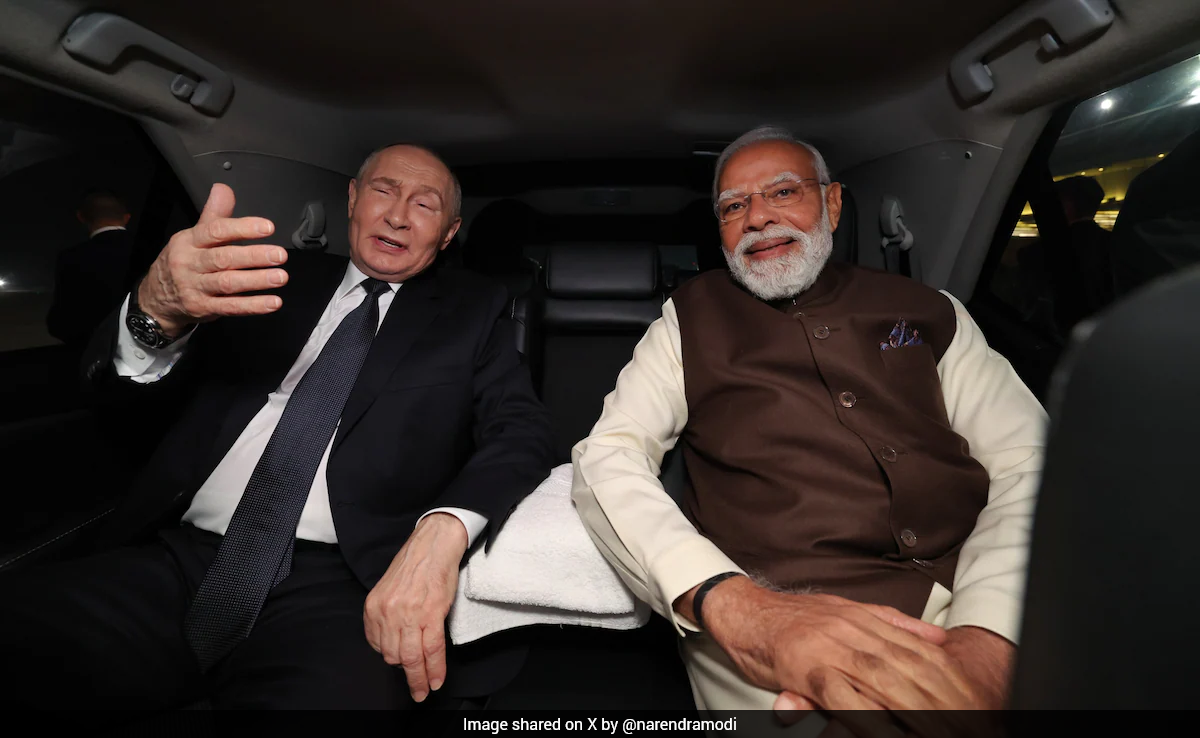
The viral car photo of Prime Minister Narendra Modi with Russian President Vladimir Putin, taken during the latter's recent visit to India, made its debut in the US Congress, with a Democrat lawmaker warning that President Donald Trump's tariff regime and confrontational approach toward New Delhi are pushing one of America's most vital alliances to Moscow.
During a Congressional hearing by the House Foreign Affairs Subcommittee on South and Central Asia on the US-India strategic partnership, Democratic Ranking Member Sydney Kamlager-Dove used PM Modi and Putin's photo as a poster and said it was the United States and not India which was undermining the partnership.
"Trump's policies towards India can only be described as cutting off our nose to spite our face, and this is doing real and lasting damage to the strategic trust and mutual understanding between our two countries," Kamlager-Dove said.
"Trump's policy towards India can only be described as cutting our nose to spite our face..."
— Wolverine (@hyperhigh) December 11, 2025
– US representative Sydney Kamlager-Dove, while showing photo of PM Modi with President Putin.
Source: House Foreign Affairs Committee Republicans/YouTube#TARIFFSBackfiring… pic.twitter.com/NfxL76meah
Gesturing toward the poster, she said, "Being a coercive partner has a cost, and this poster is worth a thousand words."
ALSO READ: Putin Visit Raised US Concern On India-Russia Ties: Expert To NDTV
"You do not get a Nobel Peace Prize by driving US strategic partners into the arms of our adversaries," she noted.
The Democratic politician also accused Trump of unravelling decades of bipartisan progress. She said the Biden administration had handed Trump "a bilateral relationship at the height of its strength," citing "a revitalised Quad, a budding defence tech partnership and a trusted supply chain partner," only for it to be "flush, flush, flush down the toilet."
She warned that history may judge Trump harshly. "Unless he changes course, Trump will be the American President who lost India," she said. "You do not get a Nobel Peace Prize by driving strategic partners into the arms of our adversaries."
At issue were Trump's 25 per cent "Liberation Day tariffs", followed by an additional 25 per cent levy on India's imports of Russian oil -- a cumulative 50 per cent tariff burden. "The tariff rate on India is currently higher than the tariff rate on China," she said, calling the policy self-defeating.
ALSO READ: Opinion | Why Putin's India Visit Was Bigger Than Just 'Deals'
PM Modi-Putin Car Rides
During Russian President Putin's two-day Delhi visit last week, PM Modi personally received him at the airport following his arrival in the country, underscoring how significant the New Delhi-Russia relationship is. The two leaders also shared the same car ride, which took them to the Prime Minister's residence at the Lok Kalyan Marg, a gesture both sides cast as a sign of personal warmth.
The leaders last shared a car during the Shanghai Cooperation Organisation (SCO) Summit in China, when they travelled in a made-in-Russia Aurus sedan -- a moment widely read as a display of their close rapport.
ALSO READ: Opinion | Putin's Visit Wasn't All Fireworks. But It Still Mattered
Democrats Warning
Democrats also faulted Trump for attacking people-to-people ties through a $100,000 fee on H-1B visas, "70 per cent of which are held by Indians," which she described as "a rebuke of the incredible contributions Indians have made" in the US.
Dhruva Jaishankar from ORF America testified that trade negotiations "began before February 13" and that by July, "the two sides had reached quite close" to an agreement. He said India is actively pursuing free trade deals and that "a solution... is at hand" if there is political will in Washington.
Witnesses cautioned that tariffs risk overshadowing urgent strategic priorities, including countering China and stabilising supply chains. "This has been a low-cost, high-benefit partnership for the United States," Smith told the panel. "It would be strategic malpractice of the highest order to discard the trust we have built."
The hearing made clear that the tariff confrontation has become the most politically charged issue in the US-India relationship -- and one with broad geopolitical consequences.
Track Latest News Live on NDTV.com and get news updates from India and around the world


