






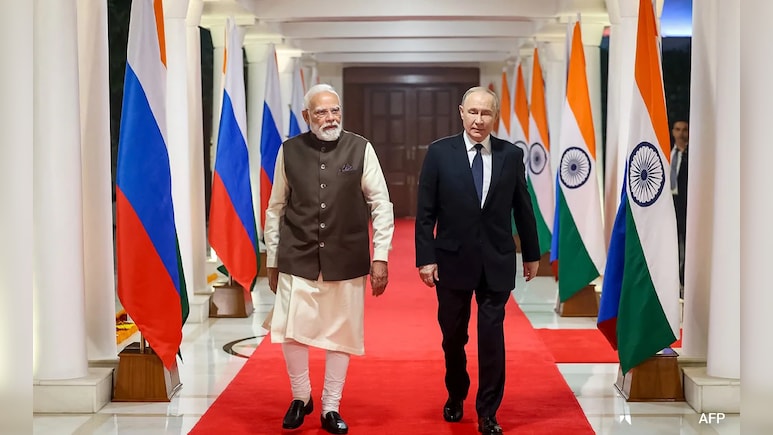
After a hiatus of four years, Russian President Vladimir Putin's landmark visit to New Delhi was viewed as a significant development in the India-Russia relationship. Prime Minister Narendra Modi's decision to receive Putin personally on the tarmac of Palam Airport underscored Moscow's continued relevance in India's strategic calculus. Its significance was further amplified in light of strong geopolitical headwinds, particularly against the backdrop of Washington's punitive actions aimed at constraining the development of India-Russia relations.
The theme of the 23rd annual India-Russia summit further signalled an evolution of the longstanding partnership, with the economic pillar of the bilateral partnership being increasingly prioritised. Ultimately, the significance of the 27-hour-long visit lies less in the agreements concluded and more in the strategic message it conveyed, that the bilateral partnership retains its own momentum, largely insulated from external constraints.
Economic Ties in Pole Position
During the summit, the leaders examined the broad contours of the partnership encompassing political, military, trade and investment, energy, connectivity, space, cultural, and education aspects. The discussions reflected a growing impetus to strengthen cooperation.
Building on this momentum, the discussion on the economic dimension assumed particular prominence. The recent uptick in economic engagement, catalysed by the vacuum createdfollowing the exit of Western businesses from Russia, has seen an enhanced focus on the economic aspect of the bilateral partnership. During the summit, both countries adopted the programme for the Development of Strategic Areas of India-Russia Economic Cooperation till 2030. The asymmetry in bilateral trade, favouring Moscow, was a point of discussion during the summit; the Russian delegation identified comparative advantages in the Indian export basket, which included consumer goods, food, agricultural products, pharmaceutical products, and telecom equipment.
In light of Russia's growing demand for skilled labour, both sides concluded an agreement on labour mobility. They also reiterated their commitment to enhancing trade facilitation, including the establishment of smoother payment mechanisms. The removal of bottlenecks in logistics and addressing tariffs and non-tariff barriers remained central on the agenda.
There was a mutual understanding that addressing these concerns would remain a priority for meeting the trade target of $100 billion by 2030. Further, both leaders expressed interest in the early conclusion of the Free Trade Agreement with the Eurasian Economic Union.
Strengthening energy relations emerged as a considerable priority given New Delhi's interest in securing its energy security needs. Along with the existing projects, the prospect of Indian investments in new projects, including oil refining, petrochemical technologies, oilfield services, and scaling up nuclear energy, was discussed. Both sides further deliberated on strengthening the bilateral partnership in the realms of science and technology, as well as space cooperation.
Military Technical Partnership
Leading up to the summit, the Indian government expressed interest in purchasing additional batteries of the S-400 missile defence system and jointly producing the recent S-500 system. However, the government's position reflected that these deals would not be concluded at the summit. Russia's stance on supporting India's bid for indigenising production through technology transfers and co-production dealsremains unchanged. Crucially, Russia's offer of platforms such as the Su-57, with the possibility of joint manufacturing, suggests that its growing alignment with China has not eroded its strategic space for India. For New Delhi, this is both reassuring and strategically useful, providing further impetus to sustain and deepen the defence partnership.
Arctic and Far East
This visit further signalled the continued relevance of strategic areas of cooperation, such as the Arctic and the Russian Far East. New Delhi has expressed interest in enhancing cooperation in the region's political economy, given its access to critical minerals, rare earths, and hydrocarbons. Moscow welcomes India's interest in the Arctic and views New Delhi as a key player in Arctic affairs.
What Does it Mean for India-Russia relations?
In sum, these developments are indicative of a sustained convergence of interests between the two countries. The visit is rooted in symbolism and reflects the primacy of Russia in India's calculus as a reliable partner. Subsequently, for Moscow, its ability to sustain its partnership with an influential non-Western power such as India, amidst fighting an almostfour-year-long conflict in Ukraine, increases Russia's clout in the World Order. At the same time, certain concerns will persist in the bilateral partnership in the near future, such as on the status of the existing deliverables or questions of trade parity. What remains clear is that under the current geopolitical matrix, New Delhi is less likely to be risk-averse in deepening its relationship with Moscow.
(Harsh V Pant is Vice President, ORF. Rajoli Siddharth Jayaprakash is Junior Fellow, Eurasia, at ORF.)
Disclaimer: These are the personal opinions of the author

