






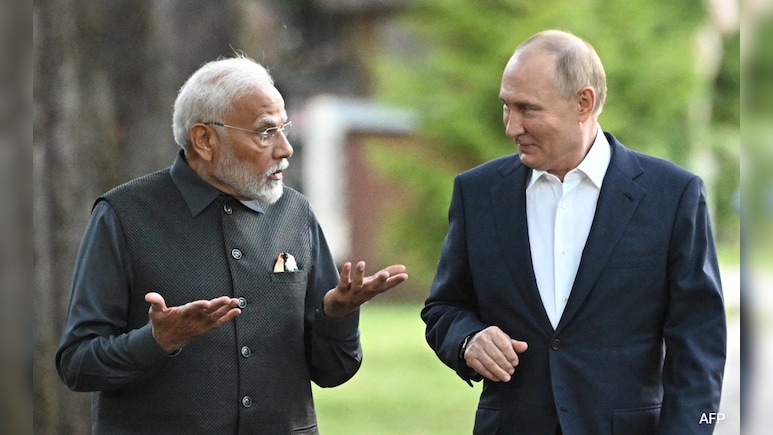
The biggest visit of the year is now over. Russia President Vladimir Putin, after all, is no ordinary head of state. Few leaders have had an arrest warrant against them from the International Criminal Court; fewer still have held their own against the rest of the West in a dangerously escalatory war. For Delhi, however, he is, primarily, the President of a country that has been steadfast in its support to India for decades. But the visit proved that this is not just about bilateral relations. This is political theatre with an international audience watching. And here's what all this translated into for everyone involved.
That Joint Statement
First, the joint statement itself, which, while being all of 70 paragraphs, mostly just lauded existing cooperation in various areas. Despite excitement around ‘massive' defence deals and possibly the purchase of the Su-57, the section on military cooperation is the shortest, though a separate read-out from the meeting between Defence Ministers Rajnath Singh and Andrei Belousov seems to have borne fruit.
The main joint statement agreed to ‘encourage' joint manufacturing in India of spare parts through transfer of technology and setting up of joint ventures for meeting the needs of the Indian armed forces as well as for subsequent export to mutually friendly countries. Sure, those are not the fireworks that many were expecting. But if this arrangement goes through, it will fill a long-persisting gap for the Indian forces, the army in particular. Though Russia has always been upfront in terms of emergency supplies, the need to get spares made in the country has been felt for a long time. This requires private investment, given the now-reinvented Ordnance Factories are yet to find their feet.
Meanwhile, it is as well to remember that there is already a deal in place for the S-400s, of which two more batteries are awaited. Buying more of these will, in all probability, merely require an extension of the existing deal. The interest in Su-57 fighters, on the other hand, has always been uncertain. The Air Force had rejected these years ago for a far larger radar signalling system it has developed indigenously. Besides, given that a trade deal with the US, the largest trading partner, remains imperative, a great defence deal with Russia always seemed a bit improbable.
The Real Issue Of Trade
Fortunately, the longest section is on trade. A country that accounts for only 2% of its trade volume is not the healthiest of relationships. This section lists one significant commitment, “to continue their consultations on enabling the interoperability of the national payment systems, financial messaging systems, as well as central bank digital currency platforms”. That's something, given that neither side wants to pile up their currencies with each other. This need to bone up trade is a direct factor driving the discussions with the Eurasian Economic Union on a Free Trade Agreement.
All that is nice. But remember that Russia's own bilateral trade with Armenia, Belarus, Kazakhstan, and Kyrgyzstan is in the low millions. Indian companies would thus much rather target Europe, if they turn to actual manufacturing there. Meanwhile, ventures in consumer goods will benefit from an impressive internet penetration of 92% in Russia and the exit of prominent brands.
Meanwhile, the Russian enterprise software sector is growing fast, with domestic solutions falling short of meeting demand. This opens up an opportunity for vendors from friendly countries, especially India, to fill this promising niche. And the beauty of it is that it doesn't need a physical trade route.
Improving Trade Routes
Even so, given the $59 billion trade deficit between India and Russia, a good route is indeed necessary. There have been many positive reports about the International North-South Transport Corridor (INSTC), which point to a rapid growth in imports through this route. However, this apparent ‘rise' has yet to reflect in total figures. That, in turn, will depend heavily on whether Washington lifts its sanctions on Iran or not (a temporary waiver has been in place for Chahbahar, which limits it to trade with only Afghanistan).
Then there is the remaining Chennai-Vladivostok Maritime Corridor, which reduces shipping time between India's East Coast and Russia's Far East from 40 to 24 days. So far, that hasn't really led Indian businesses to increase trade with the Far North, given its sparse population. But there is enough potential for mineral wealth, including rare earths, especially since Moscow has thrown the market open to all. India needs to move quickly to get into this market before the Ukraine war ends and American and European companies troop in.
There is also the Northern Sea Route, which ties into a 2024 deal to develop ice-breaker vessels at Mumbai's Mazagaon Docks and other shipyards. Nothing seems to have come of this, too, so far. There is, however, an agreement for ‘Training of Specialists' for ‘Ships Operating in Polar Waters'. These are highly tricky areas.
But there is potentially more to all of this. The recently ratified Reciprocal Exchange of Logistics Support (RELOS), which will grant Indian naval and commercial vessels access to all Russian ports, all of which lie now towards the Arctic for refuelling and repairs and request Russian icebreaker escorts through icy passages. Russian officials have said that the pact may eventually give India access to more than 40 Russian naval and air bases, all the way from Arctic waters to the Pacific. Sure, that's in the future, but, if materialised, it could certainly make a difference.
Energy Gets Short Shrift
The much awaited ‘energy' package is short and to the point, though it rather defiantly, notes ‘current and potential' cooperation in the entire range of oil and oil products, including oil refining. Also, notwithstanding a 30% drop in imports of oil from Russia - mostly because profit margins have dropped due in part to use of ‘ghost ships' in transport - it seems both sides have an eye to the future.
The good news, meanwhile, is that Russia is going to expand nuclear energy in India. The country perhaps has the largest pie of nuclear reactors. India, under its ‘Viksit Bharat' vision, aims to generate a total of 100 GW of power from nuclear sources, a tenfold increase from its current capacity of 8.8GW, with the Russian collaboration on the Kudankulam nuclear reactor being just the beginning. There's clearly more where that comes from, and other countries are likely to join the race. This is big business, especially with India's quest for Small Modular Reactors (SMRs), for which Rs 20,000 crore have been allocated in this year's Union Budget. France, Japan, South Korea and, of course, the United States, are in fray.
In sum, Putin's visit may be pegged as an ordinary - though not unsuccessful - bilateral summit, with its significance derived from the sheer unease of the West and from the fact that Delhi chose to emphasise that it was not ‘neutral' on the Ukraine war and wanted peace. That phrasing was clearly for the rest of the world. While no verbal eruptions occurred in Washington, a controversy was fuelled by an entirely different set of people. A joint article in an Indian daily by the German, French and British ambassadors to India delivered a diatribe against the Russian President, accusing him, among other things, of a total disregard for human life. India's Ministry of External Affairs was understandably annoyed at what it called an unacceptable diplomatic practice. While each of these countries have strong relations with India, their sheer lack of presence in terms of ending the Ukraine war has never been more obvious. A meeting of NATO foreign ministers on December 3 had already reiterated not only their decision to continue supporting Ukraine - ironically through US defence equipment - but also to raise the defence expenditure by 5%. The US Secretary of State, Marco Rubio, did not attend this meeting even as his parleys with both Ukraine and Russia continue. All this is European politics as usual.
But here's the bottom line. Peace between Russia and Ukraine is necessary to give the much-needed spur to India's trade with Russia, including for defence supplies. Delays are now rampant, and the necessity of getting more of the S-400s imminent. The deadline for the deal, which was 2023 originally, has now been pushed. The S-500, while a formidable weapon, reportedly has just one unit in operation as of now.
In the final analysis, disappointed observers should look at the 2018 joint statement. It's almost the same, except that it has one line welcoming the S-400 deal. Russia-India official documents have always been long in text, and quietly substantive when it comes to actual cooperation. The underlying trust between the two is the real clincher. This is not an advantage that either side would want to lose. But neither India nor Russia can run only on sentiment in the perilous geopolitical climate of the day. For both, it'll have to be about the actual numbers, too.
(Dr Tara Kartha is a former Director, National Security Council Secretariat)
Disclaimer: These are the personal opinions of the author

