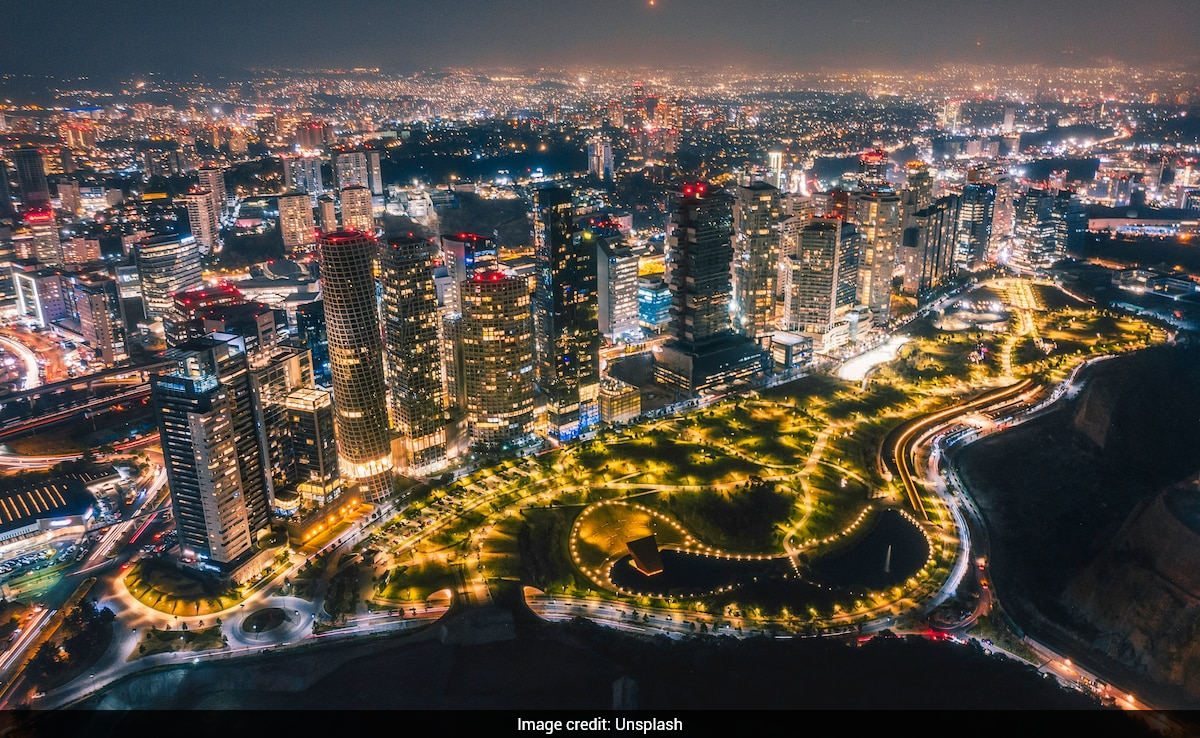
One of the world's largest cities is sinking, and it's so prominent that it's even visible from space. New satellite imagery from NASA reveals Mexico City is subsiding nearly 10 inches (25 centimetres) per year. The city, home to over 22 million people and spanning 3,000 square miles, is now sinking at an average rate of 0.78 inches (2 centimetres) a month in some areas. That includes critical infrastructure like the main airport and the iconic Angel of Independence monument.
"Overall, that means a yearly subsidence rate of about 9.5 inches (24 centimetres)," said Enrique Cabral, a geophysics researcher at the National Autonomous University of Mexico. "We have one of the fastest velocities of land subsidence in the whole world."
Also read | 'Spirit 2.0' Explained: How Travellers Are Trying To Buy The Defunct Airline
Over less than a century, parts of the city have dropped more than 39 feet (12 meters). The Metropolitan Cathedral, where construction began in 1573, is visibly tilted. Some downtown buildings now require additional steps as the ground around them falls away.
"It's a very big problem," said Cabral. "It damages part of the critical infrastructure of Mexico City, such as the subway, the drainage system, the water, the potable water system, housing and streets."
How satellites caught a city sinking
The data comes from NISAR, a powerful new satellite system launched jointly by NASA and the Indian Space Research Organization (ISRO). Using dual radar instruments, NISAR measures changes on Earth's surface down to the centimetre, twice every 12 days.
NISAR mapped Mexico City's subsidence in detail between October 2025 and January 2026. Dark blue areas on NASA's released map show zones sinking by more than half an inch per month. "You can see the full magnitude of the problem," said NISAR scientist Paul Rosen.
"Mexico City is a well-known hot spot when it comes to subsidence, and images like this are just the beginning," added David Bekaert, a NISAR project manager.
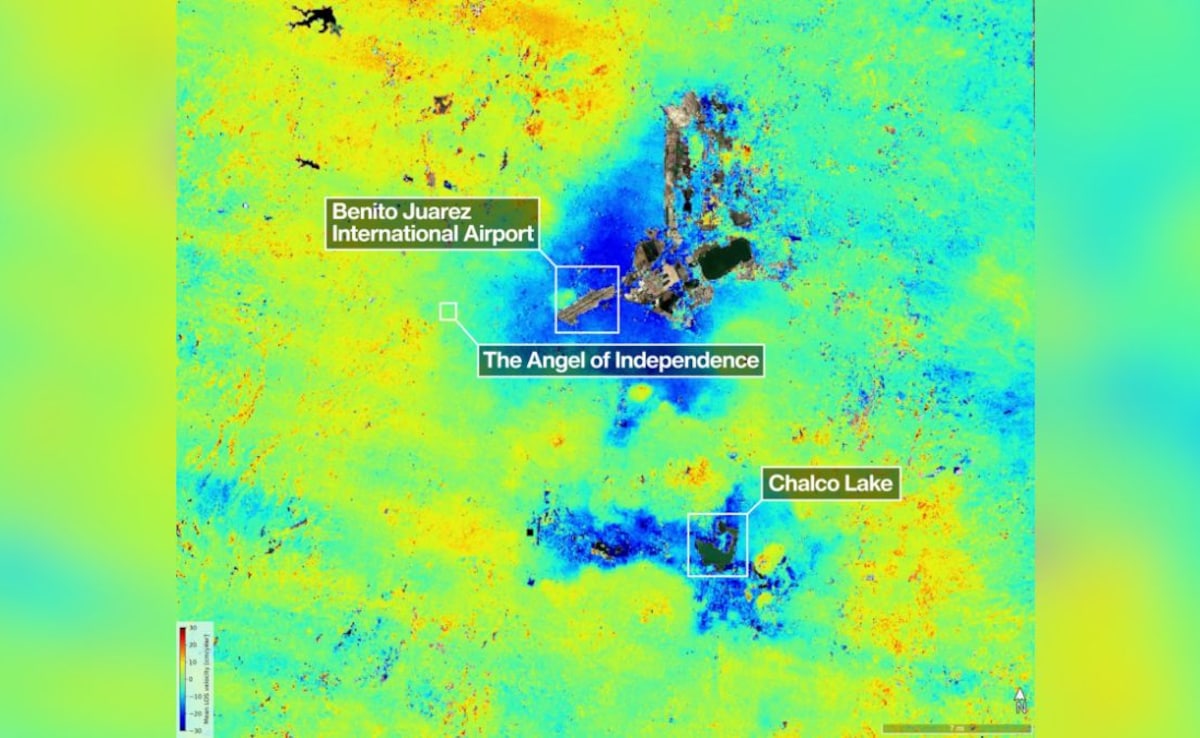
New data from NISAR shows where Mexico City and its environs subsided by up to a few centimeters per month (shown in blue) between Oct 25, 2025, and Jan 17, 2026.
Photo Credit: NASA/JPL-Caltech/David Bekaert
Why is Mexico City sinking?
The city was built atop an ancient lake bed. Many downtown streets were once canals, and the soft clay soil is still compacting naturally. But we, humans, are the real drivers of this change.
For over a century, Mexico City has drained its aquifer for drinking water and commercial use. As water is extracted, the clay layers compress, and the land above it sinks. Urban development adds weight, speeding the process.
The city was subsiding at roughly 2 inches per year in the late 1800s. By 1950, that had jumped to 18 inches annually. While rates have slowed slightly since, the cumulative effect is staggering. Some areas have sunk hundreds of feet total.
Track Latest News Live on NDTV.com and get news updates from India and around the world


