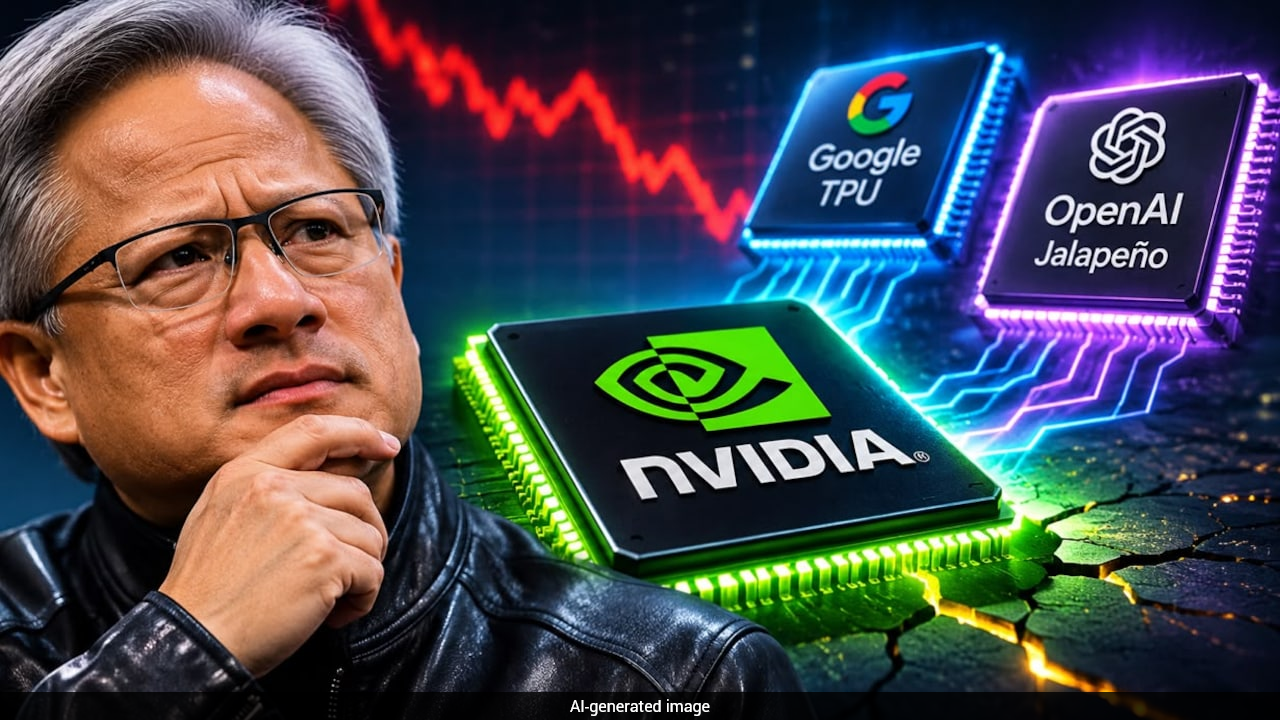
Nvidia has been ruling the artificial intelligence boom with its powerful chips, but its biggest customers may be preparing to challenge that dominance. According to a report in Wall Street Journal (WSJ), companies such as Google and OpenAI are investing in their own AI chips, hoping to reduce their dependence on Nvidia. The development came to light in the wake of the brief ouster of Nvidia co-founder and CEO Jensen Huang. He is back at the helm, but things are not expected to go the same way for Nvidia.
The WSJ report also says that custom-made chips are gaining ground and competitors are looking to grab a bigger slice of the market.
Though Huang's old team, which includes his son-in-law Nico Caprez, is assuring some of the chip maker's most important customers that business is stable, Nvidia faces a challenge that is hard to ignore.
And Huang has his task cut out: To prove that he is qualified to run the company. The AI trade is volatile than ever, and customers are diversifying their supply of chips. Plus, there is the ongoing investigation into his behaviour.
Shares fell about six per cent on Tuesday after rallying Monday on news of Huang's return.
The WSJ report said that Huang is already concerned about Nvidia's big customers making plans to lessen their reliance on the chips made by the company. At a staff meeting, he called the developments an "avalanche".
Colette Kress, who had a brief run as Nvidia CEO before returning to her earlier position of CFO, said the company would remain "thoughtful" and "disciplined," adding that the firm is "rigorously evaluating" future deals, as per WSJ.
Nvidia is facing competition from OpenAI's new Jalapeno chips and new generations of Google's TPU processors, designed for AI workloads.
READ | Nvidia Board Under Scrutiny After Reinstating Jensen Huang As CEO
Both the companies want to avoid their reliance on Nvidia chips. If Nvidia raises prices, faces supply constraints or changes its commercial terms, these companies will have limited alternatives. Therefore, developing its own chips gives OpenAI and Google greater control over costs, supply and computing infrastructure.
A projection by Bernstein Analysts claims that custom AI accelerators, or the chips that power AI data centres, could rise to 20 per cent of the market in 2027, up from 10 per cent this year.
Track Latest News Live on NDTV.com and get news updates from India and around the world


