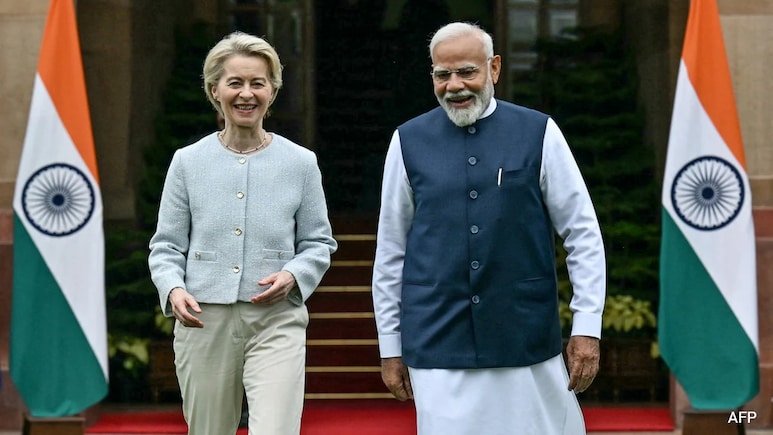
Austria's Ambassador to India, Robert Zischg, described the newly announced EU-India Free Trade Agreement political declaration as the "mother of all deals", one that, he says, will "affect close to two billion people" and fundamentally reshape business, mobility, and strategic alignment between Europe and India.
In a candid conversation with NDTV's Aditya Raj Kaul, Zischg said that the agreement was "18 years in the making" and underlined that while the political announcement has generated excitement, the road to implementation is complex and painstaking. "This is a very complicated agreement," he noted, pointing to the extensive legal scrubbing ahead. "Every word is important because once implemented, it becomes law applicable in 27 countries."
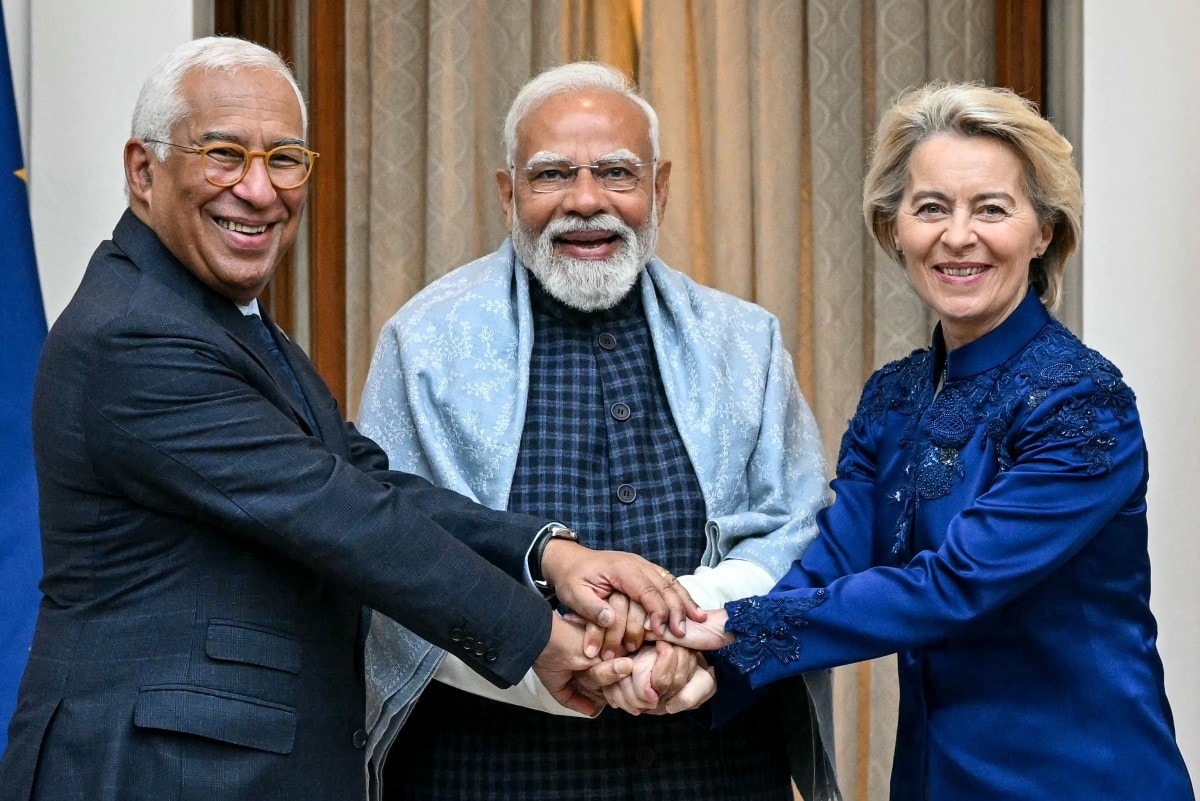
PM Modi poses for a photo with European Commission President Ursula von der Leyen and European Council President Antonio Costa
Photo Credit: AFP
The announcement followed the visit to India by Ursula von der Leyen, alongside senior EU leaders, and signals what the envoy called a decisive pivot in Europe's trade and strategic thinking amid global turbulence, tariff wars, and supply-chain disruptions.
Read | How India's "Mother Of All Deals" With EU Wipes Out Pakistan's Trade Advantage
Ratification Marathon Before 2026 Target
Zischg explained that the EU's internal processes will require translation of the agreement into all 24 EU languages, followed by ratification across all 27 member states. "The official aim is to conclude it in 2026. That is not just about signing – it is about implementing it and bringing it to the people," he said.
For businesses, the agreement promises a structural shift. From automobiles to food products and advanced machinery, tariffs that have long acted as trade barriers are expected to ease. "Cars are dear to Austrians," Zischg smiled, referring to the enthusiasm in Europe's auto sector. "But it is not only about cars. It is about the entire automotive supply chain behind them."
He was particularly animated when speaking about Austrian wine. "I was quite surprised to learn how high the tariffs on wine are in India. We are a major wine-producing country with high-quality wine. These heavy tariffs are an impediment to trade. I think Indian consumers will love Austrian wine."
Austria's Expanding Footprint In India
Austria, though smaller in size compared to major EU economies, already has a significant presence in India. "We have 160 Austrian companies operative here," Zischg revealed. "There is hardly any month where there is no new Austrian company opening in India."
Austria's strengths, he said, lie in machinery, infrastructure technology, rail systems, and advanced engineering – sectors that align closely with India's infrastructure boom under Prime Minister Narendra Modi. "Airports, railways, roads – the scale of infrastructure being built here is unimaginable in Europe. This is where Austrian expertise fits naturally."
Green technologies, digitalisation, AI, fintech, and medical devices are also priority sectors for Vienna's engagement with New Delhi.
Read | Piyush Goyal Explains How India-EU Trade Deal Will Benefit New Middle Class
High-Level Austrian Visit In The Works
The envoy hinted at significant diplomatic movement ahead. Confirming that Austria's State Secretary for Digitalisation will attend an upcoming AI summit in India, Zischg added, "We are working on a really high-ranking visit from Austria in the coming months," hinting at a possible visit of the Austrian Chancellor to India later this year. This follows Prime Minister Modi's historic visit to Vienna, the first by an Indian PM in over four decades.
De-Risking From China, Rediscovering India
On Europe's strategic recalibration, Zischg was blunt. "Partners whom we thought were very reliable are not that strong anymore. Some partners are very difficult. India is the world's largest democracy. That matters."
He linked the speed of the EU-India FTA push directly to a changing multipolar world order and Europe's effort to de-risk supply chains away from over-dependence on China.
Russia-Ukraine War: "A Question Of Survival For Europe"
Turning serious, Zischg described Russia's invasion of Ukraine as not merely a regional conflict but a defining moment for Europe's security architecture. "The border to Ukraine from Vienna is 600 kilometres. This is geographically very close to us."
Referencing Austria's history under Soviet occupation, he stressed why the rule of international law is existential for smaller countries. "If rules don't apply, smaller nations need to be scared. They can be manipulated."
He expressed hope that India, as a major global player, could help when the time comes to forge a compromise. "One cannot speak about Ukraine without Ukraine. They are the masters of their own game."
On Russian Oil And Trump's Claims
Asked about claims by US President Donald Trump that India may halt Russian oil purchases, Zischg was cautious. "We always wait for the final details. But from our point of view, any reduction of Russian oil imports helps, because it reduces the revenue financing the war."
Greenland, NATO Tensions, And Europe's Defence Rethink
On Trump's past remarks about Greenland, Zischg admitted how unthinkable such scenarios once seemed. "If someone had said five years ago that the US might consider invading Greenland, people would have laughed. Today, we have learnt that even the impossible is possible."
He said the episode has accelerated Europe's push for defence self-reliance. "We would prefer to invest in education and health. But now we see we must invest more in defence."
Mobility, Visas, And Indian Students In Austria
People-to-people ties, Zischg emphasised, are at the heart of India-Austria relations. There are already 1,500 Indian students in Austrian universities, a number Vienna wants to grow rapidly.
"The Austrian embassy in Delhi processes 57,000 visa applications a year – the highest for us anywhere. We would actually like that number to go down because visas are no longer needed," he said, hinting at long-term mobility easing.
For students, Austria is working on fast-track mechanisms. "Indian students are exceptionally well prepared, especially in AI and digital fields. Our companies are looking for this young talent."
A Month In India – And Loving It
Having taken charge on January 5, Ambassador Zischg has wasted no time immersing himself in India – from Jaipur literature events to Goa summits and morning runs at Nehru Park in Delhi.
"I shouldn't say it too loudly; otherwise, people back home will think I am on vacation," he laughed. "But this country is incredibly dynamic. I am enjoying my life enormously here."
As the EU-India FTA moves from political promise to legal reality, Austria appears poised to ride the new wave of engagement – with wine, wheels, and world-class engineering ready for India, and a renewed strategic partnership taking shape between Vienna and New Delhi.
Track Latest News Live on NDTV.com and get news updates from India and around the world


