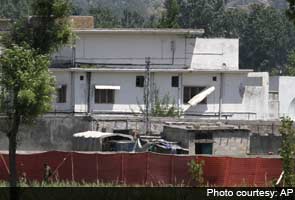
File photo of the compound where Osama bin Laden lived in Abbottabad, Pakistan
London:
Osama bin Laden lived unmolested in Pakistan for almost a decade because of the "collective incompetence and negligence" of the country's security forces, according to a scathing Pakistani government report that was leaked to the news media on Monday.
The four-member Abbottabad Commission, led by a Supreme Court judge, interviewed 201 people, including the country's intelligence leaders, in an effort to piece together the events around the American raid on May 2, 2011, that killed bin Laden, the leader of al-Qaida, and embarrassed the Pakistani government.
But although the commission's report was completed six months ago, Pakistani authorities suppressed it, and the first leaked copy was made public by Al-Jazeera on Monday.
The broadcaster published the 336-page report on its website, while acknowledging that it contained one omission - a page of testimony from a Pakistani spy chief that appeared to describe elements of Pakistan's security cooperation with the United States.
Hours later, Pakistan's telecom regulator blocked access to Al-Jazeera's website inside Pakistan.
In some ways, the commission, led by Supreme Court judges, hewed to expectations. In its findings, it leaned toward incompetence rather than conspiracy in explaining Pakistan's failure to catch bin Laden after he arrived in the country in mid-2002, having fled the American assault at Tora Bora in Afghanistan.
But in other ways, the report was a surprise. It contained flashes of visceral skepticism about the testimony of key government officials, noted that key questions remain unanswered, and allowed for the possibility that some security officials covertly helped bin Laden.
"Connivance, collaboration and cooperation at some levels cannot be entirely discounted," it said.
The report offered tantalizing new details about life on the run for bin Laden, as he shifted among six addresses in Pakistan from 2002 to 2011, when his American pursuers finally caught up with him. At times the al-Qaida leader is said to have shaved his beard and worn a cowboy hat to avoid detection by Pakistani or American forces.
Once, a vehicle he was riding in was stopped for speeding, but the police officer failed to recognize him, and he was let go.
The report also took Pakistani officials to task for failing to shut down CIA operations in the country, and variously portrayed American actions as illegal or immoral. The CIA used mainstream aid agencies as cover to spy on the al-Qaida leader, employed "hired thugs" and grossly deceived its allies in the Pakistani government.
"The US acted like a criminal thug," the report said.
For all its untempered rhetoric and institutional constraints, the report offered the most comprehensive official account yet of bin Laden's time on the run in Pakistan and the US Navy SEALs raid that took his life.
The four-member commission was led by Justice Javed Iqbal of the Supreme Court, a retired police officer, a diplomat and an army general. It first met in July 2011, two months after the American raid, and has held 52 hearings and conducted seven field visits.
American officials did not cooperate with the commission, and on Monday, Jen Psaki, a State Department spokeswoman, declined to comment on the leaked report. One senior American official who follows Pakistan said he had not yet read a copy of the commission's report, but he said that from summaries he had seen, the document appeared to offer "the Pakistan people some accounting of how bin Laden came to end up where he did."
In many places, the Pakistani report seems to seethe with frustration at the failures of Pakistani officials to find bin Laden before the Americans could get to him.
It highlighted border officials who allowed one of his wives to pass into Iran, municipal officials who failed to spot the unusual construction at his house, intelligence officials who hoarded information, and senior police officials who it deemed guilty of a "grave dereliction of duty."
The commission interviewed military officials who failed to detect American aircraft entering Pakistani airspace, and it noted that on the night of May 2, the first Pakistani fighter jets were scrambled 24 minutes after the Americans had left Pakistan with bin Laden's body on board.
"The extent of incompetence, to put it mildly, was astounding, if not unbelievable," the report said.
The report noted that the military's powerful Inter-Services Intelligence directorate "completely failed to track down OBL" and contained detailed testimony from Lt. Gen. Ahmed Shuja Pasha, then head of the spy agency.
The commission highlighted how the ISI operates largely outside civilian control. Pasha, in turn, retorted that the CIA shared only disjointed intelligence about bin Laden after 2001. The report noted that the Americans provided false information about bin Laden's presence in four cities - Sargodha, Lahore, Sialkot and Gilgit - before alighting on Abbottabad.
"American arrogance knows no limits," Pasha was cited as saying, as well as that Pakistan was "a failing state, even if we are not yet a failed state."
The missing page of testimony from the leaked version published by Al-Jazeera related to Pasha's testimony. Al-Jazeera noted on its website that, judging from the context, the missing material appeared to contain a list of seven demands the country's military leader, Gen. Pervez Musharraf, made to the United States after the September 11, 2001, terrorist attacks.
Pakistani government officials did not comment on the veracity of the Al-Jazeera report.
Also on Monday, The Associated Press reported that the top US special operations commander had ordered military files about the bin Laden raid to be purged from Defense Department computers and sent to the CIA, where they could be more easily shielded from public scrutiny.
The four-member Abbottabad Commission, led by a Supreme Court judge, interviewed 201 people, including the country's intelligence leaders, in an effort to piece together the events around the American raid on May 2, 2011, that killed bin Laden, the leader of al-Qaida, and embarrassed the Pakistani government.
But although the commission's report was completed six months ago, Pakistani authorities suppressed it, and the first leaked copy was made public by Al-Jazeera on Monday.
The broadcaster published the 336-page report on its website, while acknowledging that it contained one omission - a page of testimony from a Pakistani spy chief that appeared to describe elements of Pakistan's security cooperation with the United States.
Hours later, Pakistan's telecom regulator blocked access to Al-Jazeera's website inside Pakistan.
In some ways, the commission, led by Supreme Court judges, hewed to expectations. In its findings, it leaned toward incompetence rather than conspiracy in explaining Pakistan's failure to catch bin Laden after he arrived in the country in mid-2002, having fled the American assault at Tora Bora in Afghanistan.
But in other ways, the report was a surprise. It contained flashes of visceral skepticism about the testimony of key government officials, noted that key questions remain unanswered, and allowed for the possibility that some security officials covertly helped bin Laden.
"Connivance, collaboration and cooperation at some levels cannot be entirely discounted," it said.
The report offered tantalizing new details about life on the run for bin Laden, as he shifted among six addresses in Pakistan from 2002 to 2011, when his American pursuers finally caught up with him. At times the al-Qaida leader is said to have shaved his beard and worn a cowboy hat to avoid detection by Pakistani or American forces.
Once, a vehicle he was riding in was stopped for speeding, but the police officer failed to recognize him, and he was let go.
The report also took Pakistani officials to task for failing to shut down CIA operations in the country, and variously portrayed American actions as illegal or immoral. The CIA used mainstream aid agencies as cover to spy on the al-Qaida leader, employed "hired thugs" and grossly deceived its allies in the Pakistani government.
"The US acted like a criminal thug," the report said.
For all its untempered rhetoric and institutional constraints, the report offered the most comprehensive official account yet of bin Laden's time on the run in Pakistan and the US Navy SEALs raid that took his life.
The four-member commission was led by Justice Javed Iqbal of the Supreme Court, a retired police officer, a diplomat and an army general. It first met in July 2011, two months after the American raid, and has held 52 hearings and conducted seven field visits.
American officials did not cooperate with the commission, and on Monday, Jen Psaki, a State Department spokeswoman, declined to comment on the leaked report. One senior American official who follows Pakistan said he had not yet read a copy of the commission's report, but he said that from summaries he had seen, the document appeared to offer "the Pakistan people some accounting of how bin Laden came to end up where he did."
In many places, the Pakistani report seems to seethe with frustration at the failures of Pakistani officials to find bin Laden before the Americans could get to him.
It highlighted border officials who allowed one of his wives to pass into Iran, municipal officials who failed to spot the unusual construction at his house, intelligence officials who hoarded information, and senior police officials who it deemed guilty of a "grave dereliction of duty."
The commission interviewed military officials who failed to detect American aircraft entering Pakistani airspace, and it noted that on the night of May 2, the first Pakistani fighter jets were scrambled 24 minutes after the Americans had left Pakistan with bin Laden's body on board.
"The extent of incompetence, to put it mildly, was astounding, if not unbelievable," the report said.
The report noted that the military's powerful Inter-Services Intelligence directorate "completely failed to track down OBL" and contained detailed testimony from Lt. Gen. Ahmed Shuja Pasha, then head of the spy agency.
The commission highlighted how the ISI operates largely outside civilian control. Pasha, in turn, retorted that the CIA shared only disjointed intelligence about bin Laden after 2001. The report noted that the Americans provided false information about bin Laden's presence in four cities - Sargodha, Lahore, Sialkot and Gilgit - before alighting on Abbottabad.
"American arrogance knows no limits," Pasha was cited as saying, as well as that Pakistan was "a failing state, even if we are not yet a failed state."
The missing page of testimony from the leaked version published by Al-Jazeera related to Pasha's testimony. Al-Jazeera noted on its website that, judging from the context, the missing material appeared to contain a list of seven demands the country's military leader, Gen. Pervez Musharraf, made to the United States after the September 11, 2001, terrorist attacks.
Pakistani government officials did not comment on the veracity of the Al-Jazeera report.
Also on Monday, The Associated Press reported that the top US special operations commander had ordered military files about the bin Laden raid to be purged from Defense Department computers and sent to the CIA, where they could be more easily shielded from public scrutiny.
© 2013, The New York Times News Service
Track Latest News Live on NDTV.com and get news updates from India and around the world


