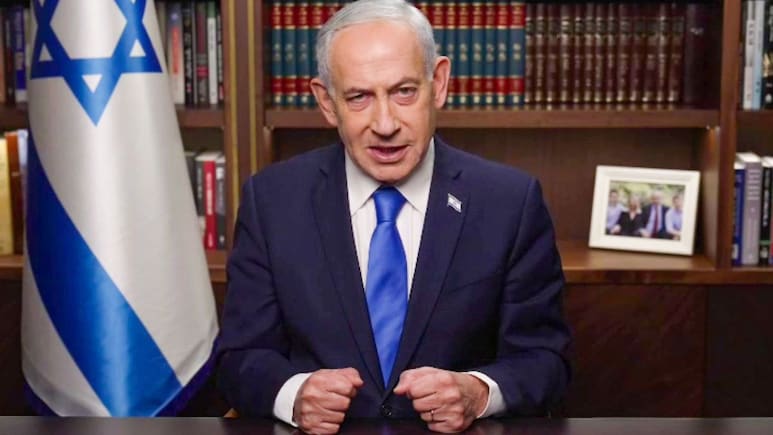
Israelis are due to hold a national election on October 27. It will be the first since the deadly October 7, 2023 Hamas attack that shook the country and plunged the Middle East into turmoil as Israel went to war in Gaza, Lebanon and Iran.
Although polls predict a clear defeat for Prime Minister Benjamin Netanyahu, elections in Israel can be complex with a fragmented political system in which anyone can emerge as kingmaker.
What Do The Polls Show?
Successive surveys show that Netanyahu is on course to lose the election. The October 7 attacks shattered his security credentials. While the public has largely supported the wars on Hamas, Hezbollah and Iran, polls have shown low trust in Netanyahu's leadership.
His government's policies on matters of religion and state are also unpopular among many Israelis.
However, Israel's longest-serving leader is a consummate political survivor and polls so far are not showing a clear path to power for his rivals either.
Who Are Netanyu's Main Rivals?
* Former military chief Gadi Eisenkot, who lost a son in Gaza, has been surging in polls. Eisenkot has projected an image as a political outsider, soldier and security hawk whose humble background and family sacrifices stand in vivid contrast to Netanyahu's decades in high office and lingering corruption cases.
* Former Prime Ministers Naftali Bennett and Yair Lapid, whose alliance despite being on opposite sides of the political spectrum ousted Netanyahu in a 2021 election. They formed a patchwork government of liberal and conservative parties, and, for the first time in Israel's history, an Islamist Arab party. It lasted 18 months.
* Former defence minister Avigdor Lieberman was once a Netanyahu aide and ally. Even more hawkish than his former boss, Lieberman quit Netanyahu's government in 2018, accusing the prime minister of being too soft on Palestinian militants in Gaza and has since become one of Netanyahu's sharpest critics.
How Do Israeli Elections Work?
Israel's elections are parliamentary. A ballot for parliament, the 120-seat Knesset, is meant to be held every four years. In practice, few Knessets have filled out a full term.
Israel was trapped in a cycle of short-lived governments and elections that began in 2019 and ended in 2022, when Netanyahu secured a solid parliamentary majority and returned to power at the head of Israel's most right-wing government ever.
The upcoming election will mark one of the rare cases in which a Knesset completed a full term.
Why Coalition Governments?
The Knesset seats are allocated by proportional representation to national party lists that pass a threshold of 3.25% of the national vote, equal to four seats.
No single party in Israel has ever won an outright majority, so governments are formed by a coalition of parties. When divisions emerge, coalitions can quickly unravel.
This gives small parties a lot of sway over who will be appointed prime minister and how long they remain in office. Prime ministers have often had to contend with sectarian demands to keep their government in power.
Netanyahu has relied on ultra-Orthodox Jewish parties for his political survival. Their demands for their community to be mostly exempt from compulsory military service have been a heated topic in Israel, all the more so at a time of war.
Who Are The Main Parties?
Parties have a September deadline to submit their candidate lists. This means that the political landscape may change, with more parties expected to join the race, merge or even drop out.
Netanyahu's coalition comprises his own right-wing Likud, Finance Minister Bezalel Smotrich's pro-settler Religious Zionism and National Security Minister Itamar Ben-Gvir's far-right Jewish Power.
The ultra-Orthodox Jewish parties United Torah Judaism and Shas quit the government in 2024 but have helped prop it up.
Vying to unseat Netanyahu are Eisenkot's Yashar (Hebrew for "honest", or "straight"), Bennett and Lapid's Together, Lieberman's Israel Our Home, which draws support from Israel's ex-Soviet immigrant community, four parties largely representing the 20% Arab minority - Hadash, Taal, Raam and Balad, and left-wing Democrats, headed by former general Yair Golan.
(This story has not been edited by NDTV staff and is auto-generated from a syndicated feed.)
Track Latest News Live on NDTV.com and get news updates from India and around the world


