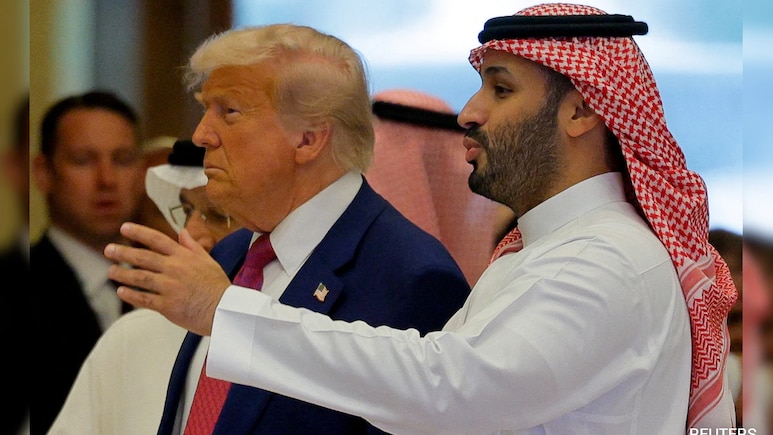
- Trump called Saudi Crown Prince Mohammed bin Salman a warrior fighting alongside the US against Iran
- The NYT report states MBS supports a sustained campaign to dismantle Iran's hard-line Shia regime
- Saudi Arabia fears a failed Iran could trigger chaos and security risks in the Gulf region
US President Donald Trump has suggested that Saudi Arabia's de facto leader, Crown Prince Mohammed bin Salman, has been encouraging the United States' actions against Iran, calling him "a warrior" fighting alongside American efforts. The remarks followed a New York Times report that claimed the Saudi prince has been arguing that the US-Israeli military campaign presents a "historic opportunity" to remake the Middle East and that Trump should continue the war against Tehran.
While talking to reporters at the Oval Office, Trump was asked if the prince MBS was encouraging him to do "certain things" related to Iran. He replied, "He does --he is a warrior. He is fighting with us, by the way."
What The Report Said
According to the NYT report, over the last week, the Crown Prince has championed a decisive, sustained campaign aimed at dismantling Iran's hard-line Shia regime. People familiar with the matter told the publication that MBS has told Trump that Iran poses a long-term threat to the Gulf that can only be eliminated by getting rid of the government.
The views align with Israeli Prime Minister Benjamin Netanyahu's assertion that Iran is a long-term threat to the Middle East region. However, analysts believe that while Israel may tolerate a weakened or internally unstable government in Tehran, Saudi Arabia fears that a failed Iranian state could trigger regional chaos, empowering militias and posing direct security risks to Gulf nations, the report said.
Trump's Changing Stance
In recent days, Trump has given mixed signals on the future of war, sometimes suggesting it may end soon, while also indicating an escalation. On Monday, he posted on social media that his administration held "productive conversations regarding a complete and total resolution of our hostilities" with Iran, an idea disputed by Tehran.
Now, senior officials in both the Saudi and American governments are also reportedly worried that if the conflict drags on, Iran could deliver ever more punishing attacks on Saudi oil installations and the United States could be stuck in an endless war.
In public, Saudi officials have also maintained a very cautious stance over the war. In an official statement, the kingdom reiterated its support for a peaceful resolution, stressing that defending civilian infrastructure and halting ongoing attacks remain its top priorities.
"Iran has chosen dangerous brinkmanship over serious diplomatic solutions. This harms every stakeholder involved, but none more than Iran itself," it said.
The consequences of the war are massive for Saudi Arabia's economy and national security. Iranian drone and missile attacks launched in retaliation against the American-Israeli assault have already created huge disruptions in the country's oil market.
MBS' Gamble
The Saudi prince, an authoritarian royal who has led a sustained crackdown on dissent, has maintained a good relationship with Trump and is said to have previously influenced the president's decision-making. According to US officials, MBS has suggested that Trump should consider putting troops in Iran to seize energy infrastructure and force the government out of power.
According to the latest reports, the US military is preparing to deploy at least 1,000 troops from the 82nd Airborne Division to the Middle East in the coming days. The unit is considered the Army's emergency response force and can typically be deployed on short notice.
Analysts familiar with Saudi government thinking told NYT that while MBS probably preferred to avoid a war, he is concerned that if US forces pull back now, Saudi Arabia and the rest of the Middle East will be left to confront an "emboldened and furious" Iran on their own.
Such a scenario could give power to Iran to periodically close the Strait of Hormuz-- the strategic waterway through which a fifth of the global oil supply passes. A majority of Saudi, Emirati and Kuwaiti oil passes through the strait to reach international markets.
Since the start of the war, Iran's retaliatory attacks have essentially choked off the strait, hobbling the region's energy industry.
Track Latest News Live on NDTV.com and get news updates from India and around the world


