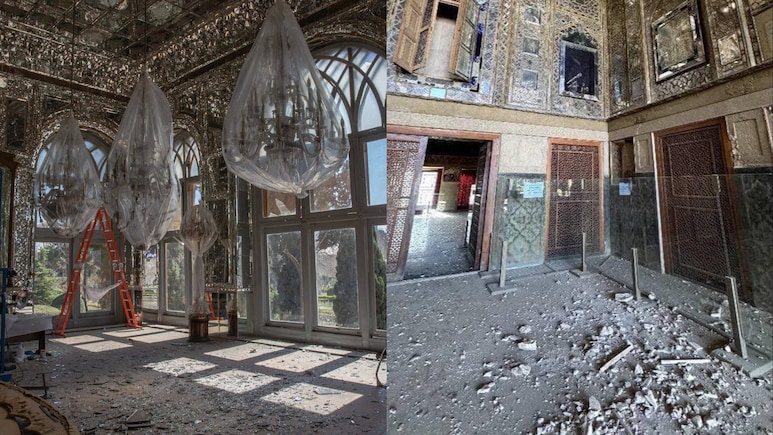
US and Israeli strikes on Iran have damaged four cultural and historical sites, including palaces and an ancient mosque. Although the buildings have not been hit by missiles directly, the shock waves from blasts and missile debris have damaged glass, tiles and stonework.
Golestan Palace's archways are broken, windows blown out, and glass from its mirrored ceilings broken.
Iran's Foreign Minister Seyed Abbas Araghchi blamed Israel for bombing Iranian historical monuments and wrote on X, "It's natural that a regime that won't last a century hates nations with ancient pasts."
Israel is bombing Iranian historical monuments dating as far back as the 14th century. Multiple UNESCO World Heritage Sites have been struck.
— Seyed Abbas Araghchi (@araghchi) March 12, 2026
It's natural that a regime that won't last a century hates nations with ancient pasts. But where's UNESCO? Its silence is unacceptable. pic.twitter.com/7eu09Cjiyf
However, UN spokesperson Stephane Dujarric said, "What is happening is clear to all: In these increasingly modern conflicts, it's civilians who pay the price, it's civilian infrastructure that pays the price, and we've all seen the destruction of priceless historical heritage," according to the Associated Press.
UNESCO confirmed that it has verified damage to the lavish Qajar-era Golestan Palace in Tehran as well as the 17th-century Chehel Sotoun palace and the Masjed-e Jame, the country's oldest Friday mosque, both in Isfahan.
Golestan Palace, the Versailles of Persia/Iran,
— Touraj Daryaee (@tourajdaryaee) March 2, 2026
a UNESCO heritage site was damaged.
کاخ گلستان pic.twitter.com/EFlZV71oOQ
There also was verified damage at buildings close to the Khorramabad Valley, which includes five prehistoric caves and one rock shelter providing evidence of human occupation dating to 63,000 BC.
UNESCO said that it had provided all parties involved in the war with geographical coordinates of the heritage sites much before the conflict started in order for them to take "precautions to avoid damage".
US Defence Secretary Pete Hegseth had said that the US would not take an approach to the war including "stupid rules of engagement".
The Isfahan governor, Mehdi Jamalinejad, said in a speech on social media that in none of the previous conflicts, be it the Afghan wars, the Mughal conquest or the Iran-Iraq war, was such destruction seen.
"This is a declaration of war on a civilisation," he added. "An enemy that has no culture pays no heed to symbols of culture. A country that has no history has no respect for signs of history. A country that has no identity sets no value for identity."
The affected sites are among the nearly 30 Iranian sites designated as under special protection as part of UNESCO's World Heritage list.
Track Latest News Live on NDTV.com and get news updates from India and around the world


